ALGORITHMIC TRADING · WHITE-LABEL

A Crypto Algorithmic Trading Platform You Deploy as Your Own Product

The Algorithmic Trading Platform runs ready-made and custom trading bots — including grid strategies — inside a risk-controlled engine with live monitoring, P&L, and kill-switch controls. It ships white-label, so your exchange publishes the bots to your own users, under your brand and your limits.

Book a Demo
Pre-tradeRisk checks on every bot order
Paper or liveDeployment mode per strategy
Kill-switchAt four scopes, on demand
INSIDE THE PLATFORM

Five Screens That Run a Bot Product End to End

Publishing bots is not a feature toggle. It is a library your users pick from, a configuration surface they can be trusted with, a live view of what is running, an honest P&L, and a risk layer that decides what is allowed. All five ship together.

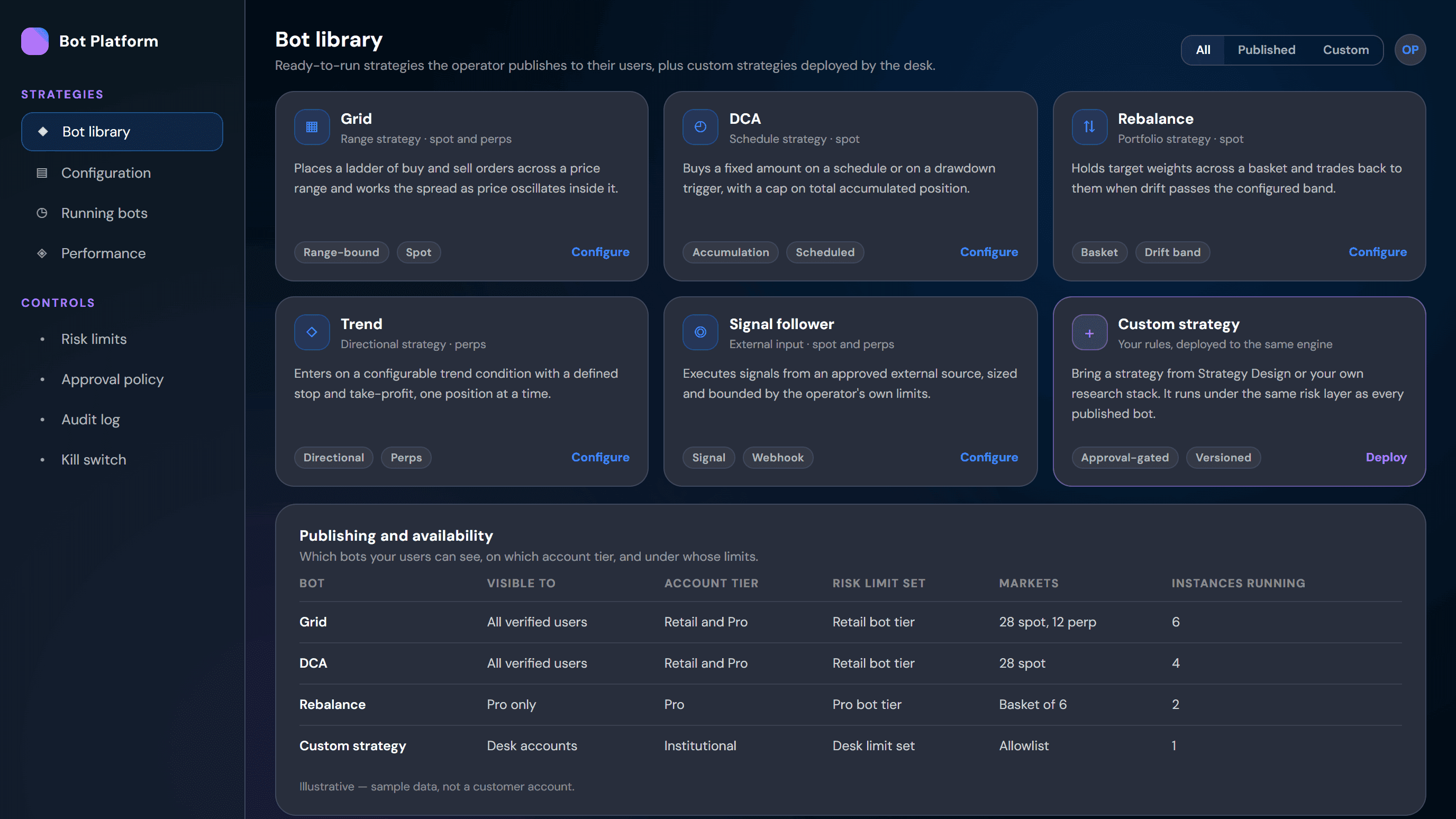
Bot library. The catalogue your users see.

Ready-to-run strategies you publish under your own brand, with per-tier visibility and a risk limit set attached to each one. Nothing appears to a user that you have not deliberately released to them.

  • Grid, DCA, rebalancing, trend and signal-follower bots ship in the library
  • Publish per account tier — retail, pro or institutional desks
  • Each published bot carries the limit set for the tier it runs on
  • Custom strategies appear beside the published bots for desk accounts
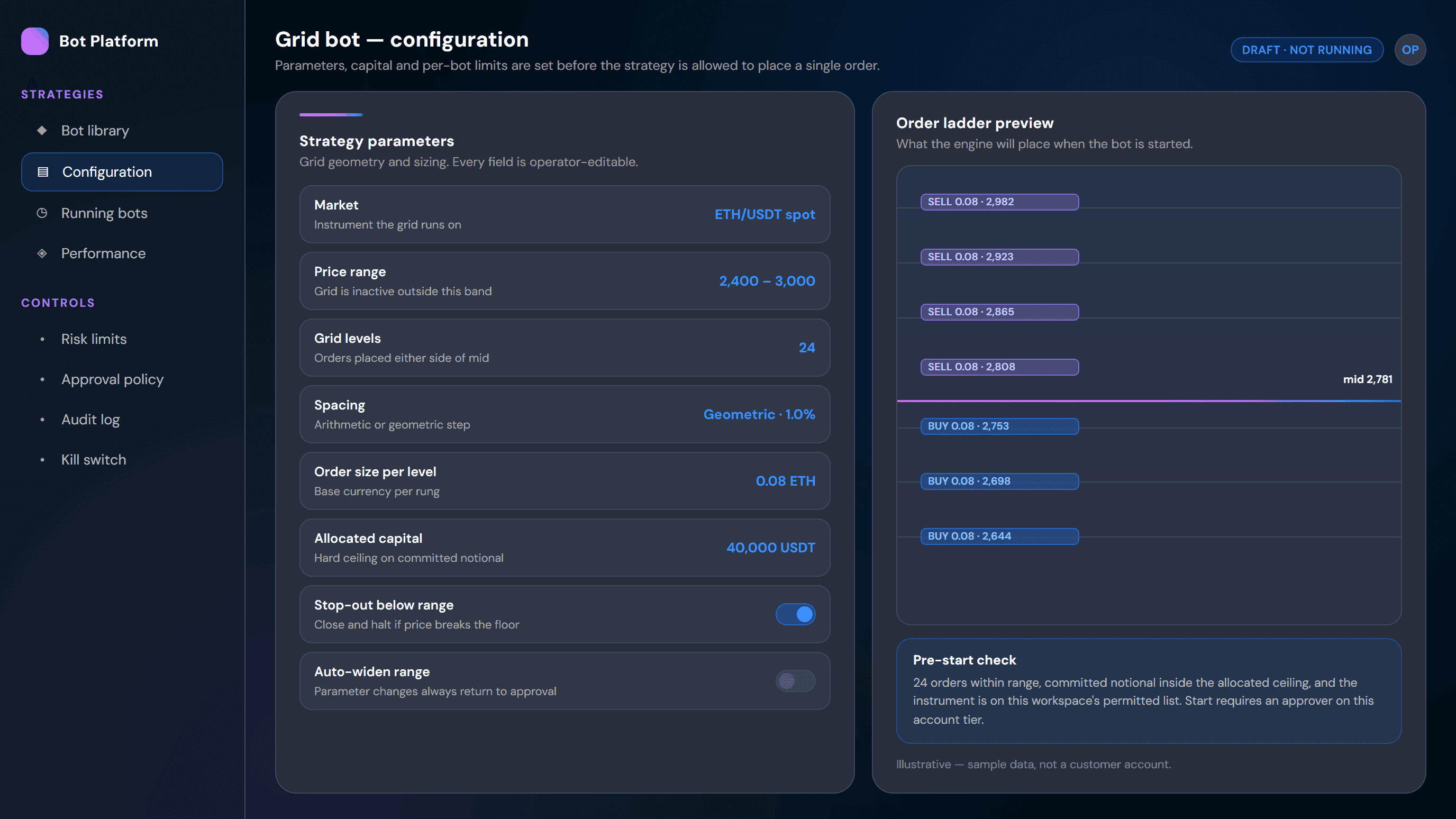
Bot library and strategy configuration showing grid parameters and risk limits
HOW IT GOES LIVE

Choose. Bound. Publish. Watch.

Deployment is a configuration exercise, not an engineering project. The engine, the risk layer and the consoles are already built — what you decide is which strategies your market gets and how far they are allowed to go.

1

CHOOSE THE BOT SET

Pick which strategies belong in your product. Publish the whole library, or a deliberately narrow set — a grid bot and a DCA bot is a complete retail offering. Custom strategies from your own desk sit beside the published ones.

2

BOUND IT

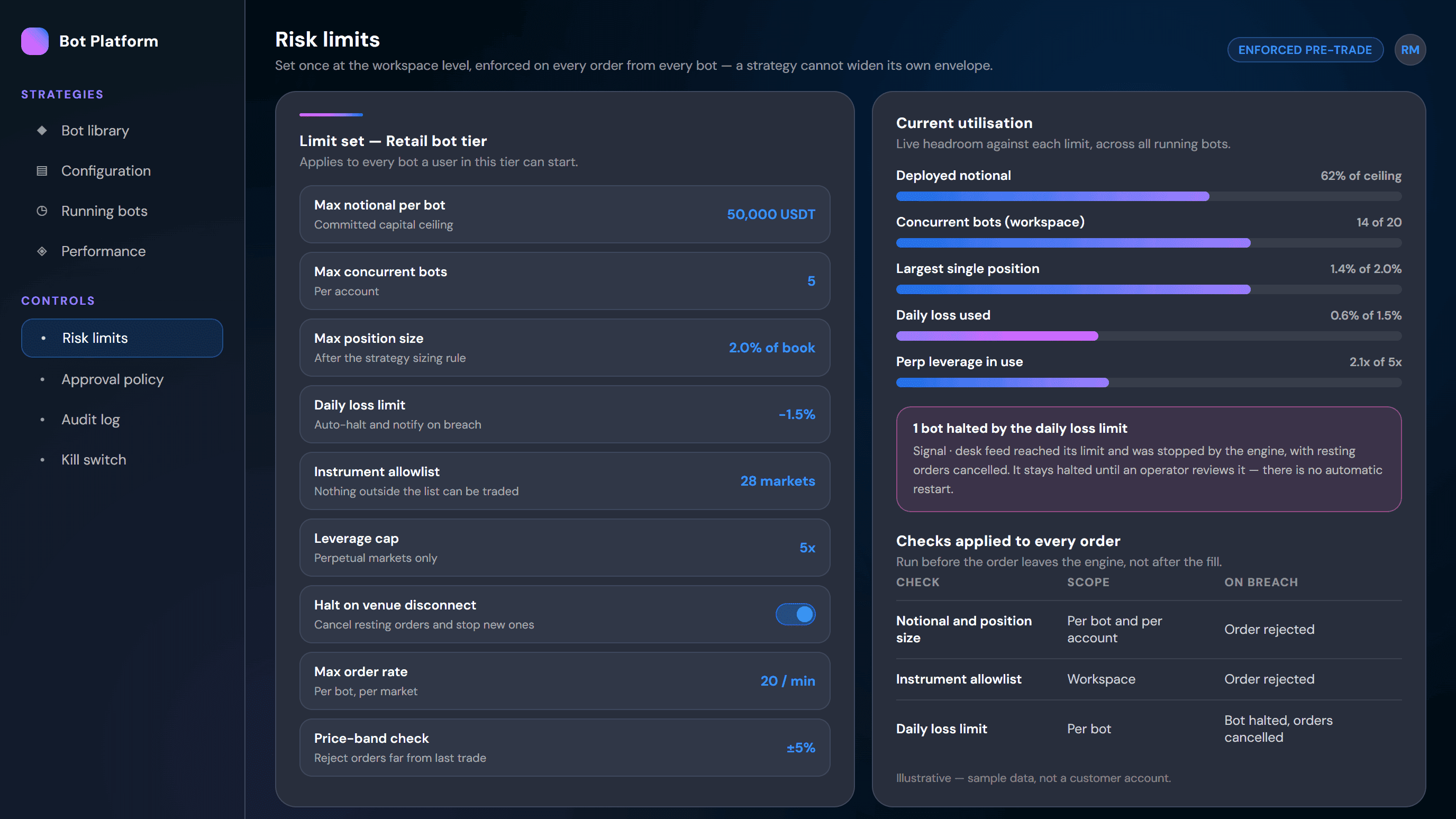
Attach a limit set to each account tier: maximum notional per bot, concurrent bots, position size, leverage cap, instrument allowlist and a daily loss limit. Only an operator can change them.

3

PUBLISH TO YOUR USERS

Bots appear inside your exchange under your brand, with your fee configuration. Users choose a strategy, set its parameters and start it — inside the tier limits you attached, with no way to configure their way past them.

4

WATCH AND CONTROL

Run the product from the live console: state, P&L and alerts per instance, with pause, resize and halt per bot and a kill switch at four scopes. Every action lands in the audit trail with a name.

ENGINE ARCHITECTURE

The Risk Layer Sits Between the Bot and the Venue

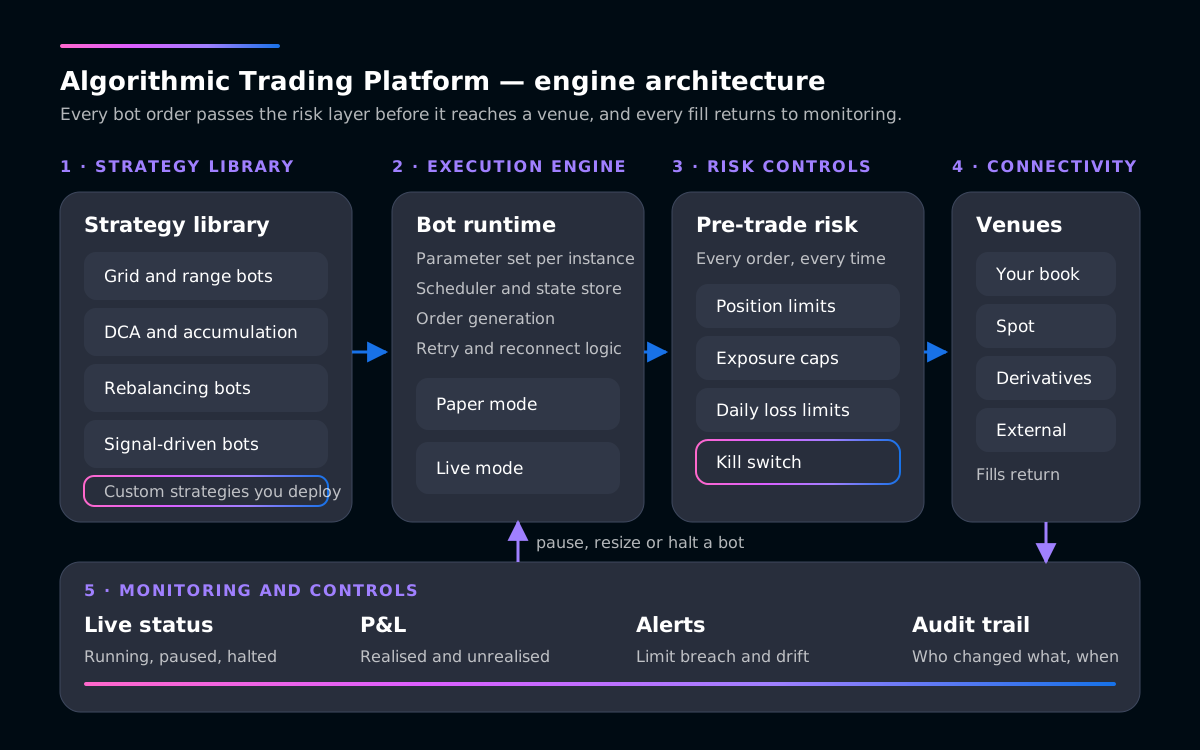
Strategies generate orders. The risk layer decides which of them are allowed out. Monitoring closes the loop, and the controls that stop a bot live in the same place as the numbers that tell you to.

Diagram: strategy library, execution engine, risk controls and monitoring around exchange connectivity

No bot reaches a venue without passing the operator's pre-trade checks, and no bot can widen the limits it runs under.

WHAT THE PLATFORM DOES

Four Capabilities, One Engine

The library, the deployment path, the risk layer and the console are not four products bolted together. They are one runtime, which is why a custom strategy inherits the same controls as a published bot.

READY-TO-USE TRADING BOTS

A Bot Library You Publish, Not Build

Grid, DCA, rebalancing, trend and signal-follower strategies ship configured and tested, with the parameter surface your users need and nothing they should not touch. Each carries the limit set of its tier.

  • Five strategy families in the shipped library
  • Per-tier visibility and per-tier limits
  • Operator-configured fees on bot activity
CUSTOM STRATEGY DEPLOYMENT

Deploy Your Own Strategies to the Same Runtime

A desk strategy runs as a versioned deployment beside the published bots: approved before it trades, allocated its own capital and loss limits, and startable in paper mode. Same engine, same pre-trade checks.

  • Versioned deployments with approval before live trading
  • Paper mode first, with the same limits applied
  • Same monitoring, P&L and controls as published bots
Learn more
RISK-CONTROLLED ENGINE

Limits the Strategy Cannot Argue With

Maximum notional, concurrent bots, position size, leverage cap, instrument allowlist, order-rate throttle and price-band check, evaluated before an order leaves the engine. A loss limit halts, it does not warn.

  • Pre-trade evaluation, not post-trade reporting
  • Breach halts the bot and cancels resting orders
  • Only an operator can change a limit set
MONITORING AND CONTROLS

One Console for Everything That Is Running

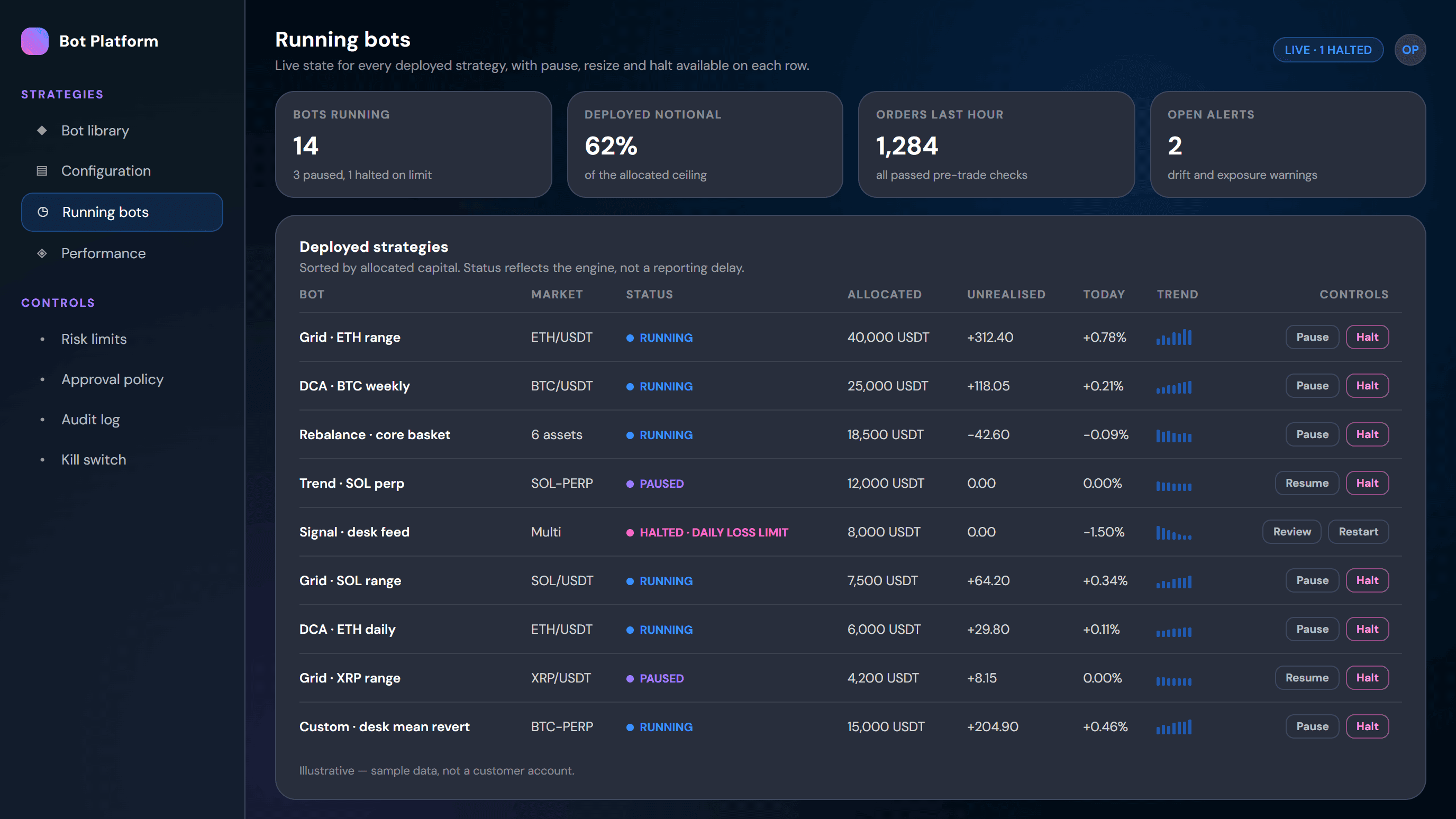
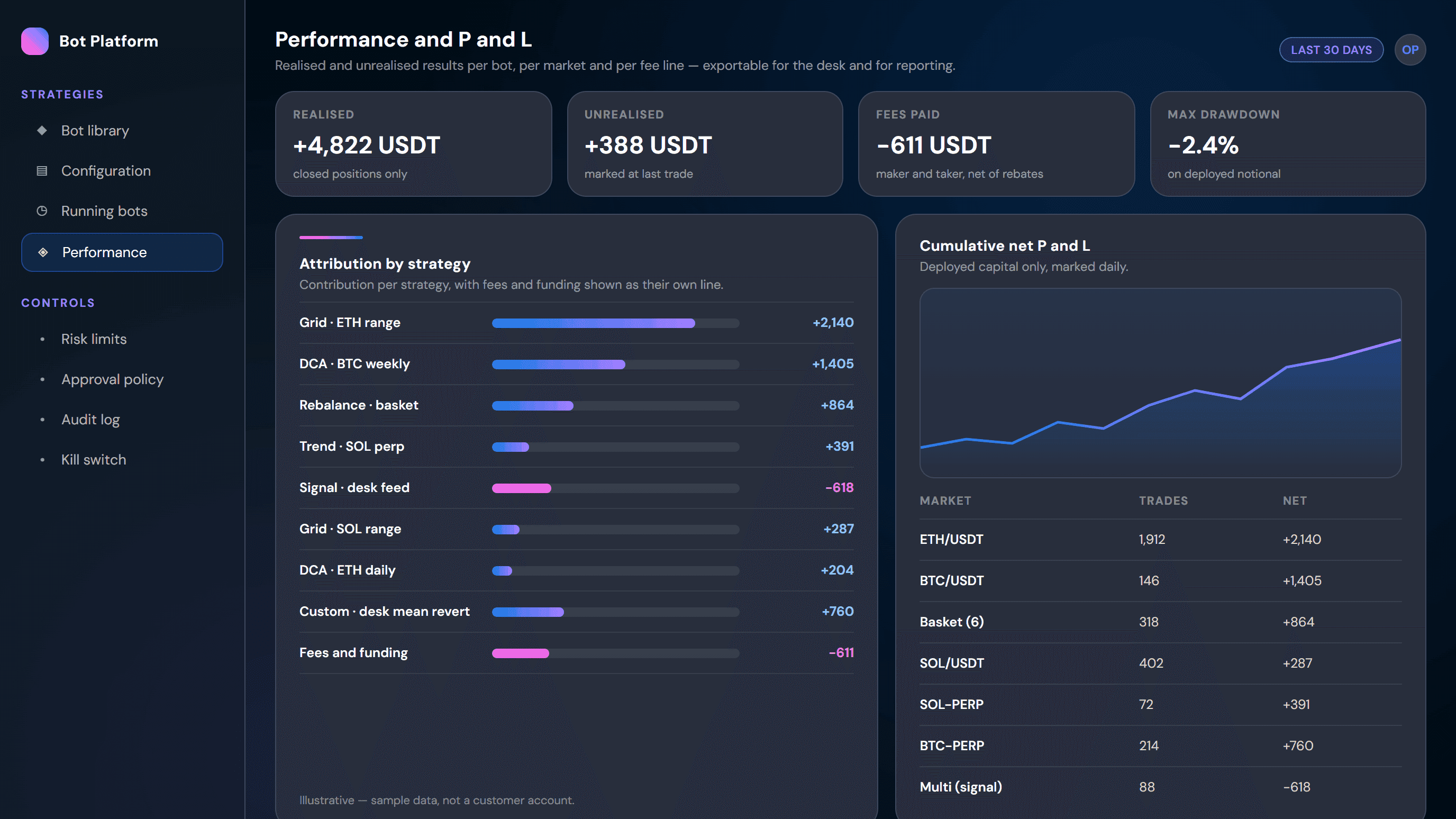
Live state for every deployed bot with allocated capital, realised and unrealised P&L, order counts and alerts on drift. Pause, resize and halt are on the row, and every action is written to the audit trail.

  • Live status as the engine sees it, not a delayed report
  • P&L attribution by strategy, market and fee line
  • Exportable audit trail of every start, pause and halt
STRATEGY SELECTION

Which Bot Fits Which Market

Bots are not interchangeable, and publishing all of them to everyone is how an operator inherits support tickets. The table is the selection guide your product team needs: what each strategy actually does, the conditions it suits, and the parameters that decide its behaviour.

#StrategyWhat it doesSuitsParameters that matter
1GridPlaces a ladder of buy and sell orders across a price range and works the spreadspot and perpetual marketsRange-bound, oscillating marketsRange bounds, level count, spacing, order size, stop-out
2DCABuys a fixed amount on a schedule or on a drawdown triggerwith a cap on total accumulationLong-horizon accumulationInterval or trigger, order size, maximum position
3RebalancingHolds target weights across a basket and trades back when drift passes a bandbasket defined by the operatorMulti-asset portfolios held over timeTarget weights, drift band, minimum trade size
4TrendEnters on a configurable trend condition with a defined stop and take-profitone position at a timeDirectional, trending marketsEntry condition, stop, take-profit, position size
5Signal followerExecutes signals from an approved external source, sized by operator limitssource must be allowlistedDesks with an existing signal feedSource, sizing rule, per-signal and daily caps
6CustomYour own rules deployed as a versioned strategy on the same runtimeapproval-gated before liveDesks and funds with proprietary logicCapital allocation, instrument scope, loss limits, mode
PRODUCT WALKTHROUGH

See a Bot Configured, Started and Stopped

The recorded walkthrough — library, grid configuration, live status, P&L and the kill switch — is in production. The platform itself is live today: book a demo and we will configure a bot on your markets, with your limits, in the session.

No video available
Video Coming Soon
CONTROLS & AUDIT

The Controls That Stop a Bot, and the Record That Explains It

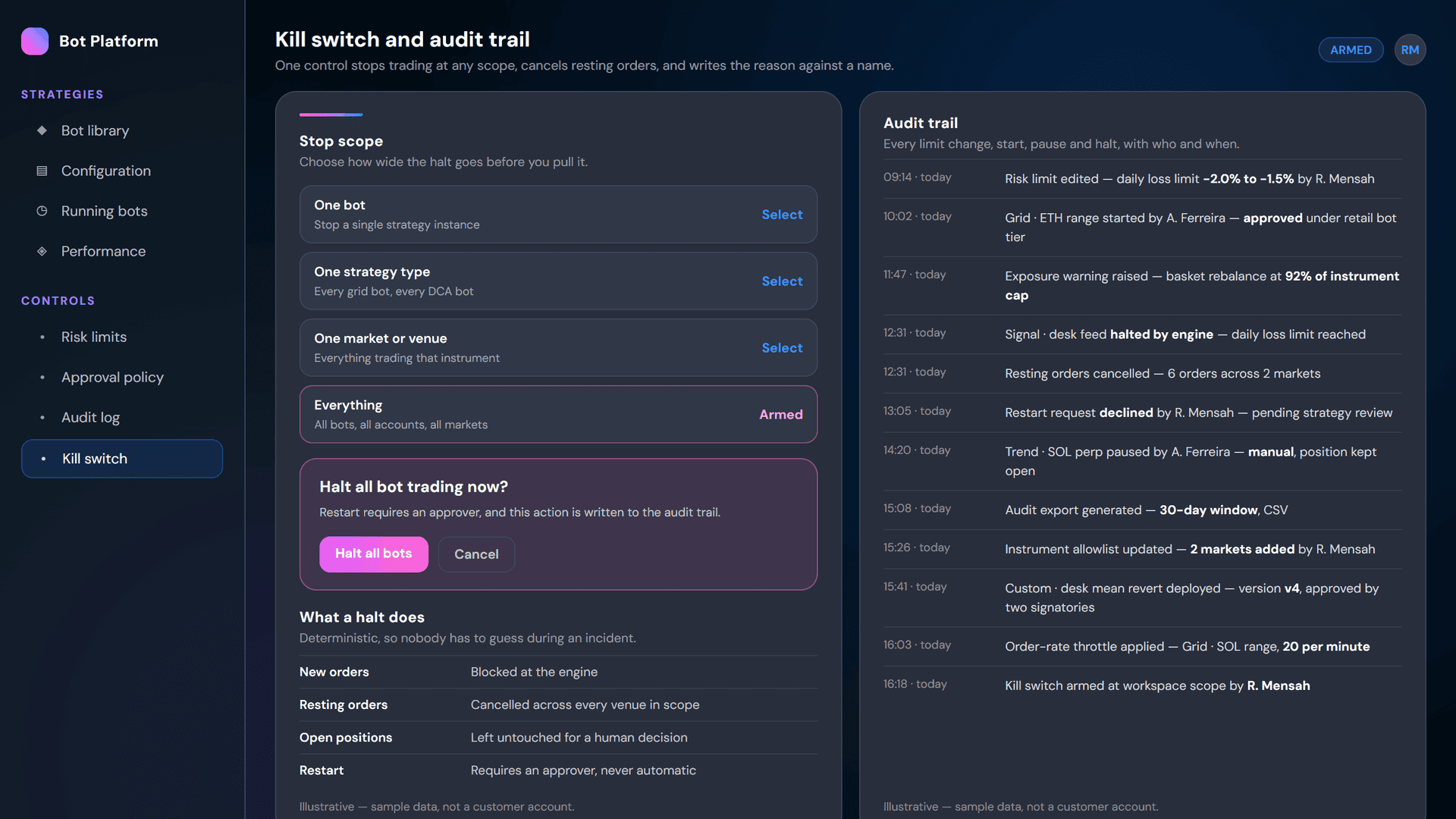
Automated trading is only as safe as the fastest way to stop it. The kill switch works at four scopes, a breach halts a strategy without waiting for anyone, and every limit change, start, pause and halt is written down with a name and a timestamp against it.

icon
Kill switch at four scopesStop one bot, one strategy type, one market or everything. New orders blocked, resting orders cancelled, open positions left for a person.
icon
Automatic halt on breachA daily loss limit, a leverage breach or a venue disconnect halts the strategy and cancels its resting orders. Nothing restarts on its own.
icon
Approval-gated restartA halted bot stays halted until an operator reviews it. Restart requires an approver, and a decline is recorded as clearly as an approval.
icon
Segregated permissionsWho may publish a bot, who may set limits and who may approve a restart are separate rights, so deploying is not the same as letting it trade.
icon
Exportable audit trailLimit edits, starts, pauses, halts, cancelled orders and restart decisions, each with identity and timestamp, ready for review.
icon
Paper mode before live capitalAny strategy can run against live market data with no real orders, so behaviour is observed before an operator allocates capital.
Book a Demo
WHAT THE BOTS TRADE INTO

The Markets Behind the Strategies

Bots are only as good as the venue underneath them. Coiny's matching engine handles 1M+ TPS with sub-millisecond matching across 1500+ trading pairs, so a grid bot's ladder rests on real depth rather than on a queue.

1M+ TPS

Matching Engine

Bots trade into the same matching engine that runs the exchange itself, rated at 1M+ TPS with sub-millisecond matching.

1500+

Trading Pairs

1500+ trading pairs are available, and the operator decides which of them any bot tier may touch through the instrument allowlist.

Spot & perps

Market Types

Grid, DCA and rebalancing strategies run on spot markets; grid, trend, signal and custom strategies also run on perpetual markets, where a leverage cap applies on top of every other limit.

CONNECTED SYSTEMS

Where the Bot Platform Sits in the Coiny Stack

This page is the deployable bot product — the engine that runs strategies and the controls around them. Designing a strategy, researching one, and quoting markets are separate systems, and they connect to this one.

Design strategies in plain language

Describe a strategy in plain English, get explicit rules, and validate them before deployment. An approved strategy is then deployed to this engine as a versioned custom bot.

Market-making & arbitrage engines

Quoting two-sided markets with spread and inventory controls, and running cross-venue and triangular arbitrage, are their own engines with their own configuration surface.

Backtesting, research & strategy APIs

Historical market data, programmatic testing and the strategy APIs quant teams work through sit in the research layer, upstream of anything this engine runs live.

Quant trading systems

The bot platform is one of five deployable quant systems that share the same risk controls. The hub compares them and explains which one owns which job.

BUILT FOR

Operators Adding a Bot Product, and Desks Running Their Own

Two very different buyers use the same engine: one is publishing bots as a revenue feature, the other is deploying proprietary strategies. The limits layer is what makes both safe on one platform.

Exchange operators adding a bot product

Publish a bot library under your own brand, per account tier, with your fee configuration and a limit set attached to each tier.

Prop firms and trading desks

Deploy proprietary strategies as versioned bots on a runtime that already enforces capital, scope and loss limits.

Brokers extending an existing platform

Add automated strategies to an existing user base without rebuilding execution or risk, on the markets you already run.

Risk and compliance owners

Read the limit set every bot runs under, see which strategies are halted and why, and export the audit trail.

COMMON QUESTIONS

FAQ

A crypto algorithmic trading platform is software that runs trading strategies automatically against exchange markets, inside limits an operator sets. Coiny Exchange's Algorithmic Trading Platform ships a library of ready-to-run bots — grid, DCA, rebalancing, trend and signal-following — alongside custom strategies a desk deploys itself. Every order from every bot passes the same pre-trade risk layer, and each running strategy reports live status, P&L and a kill switch.

A grid trading bot places a ladder of buy and sell orders across a price range and works the spread as price moves inside it. In Coiny Exchange's bot platform, an operator or a user sets the market, the upper and lower bounds of the range, the number of grid levels, arithmetic or geometric spacing, the order size per level and the allocated capital ceiling. A stop-out rule closes the grid if price breaks the floor.

Yes. Coiny Exchange's Algorithmic Trading Platform is white-label: an exchange operator publishes a chosen set of bots under its own brand, decides which account tiers can see each one, and attaches a risk limit set to every tier. Users configure and run bots inside those limits without the operator writing any strategy code, and the operator keeps one view of every running instance.

A custom strategy is deployed to Coiny Exchange's bot engine as a versioned strategy that runs beside the published bots. It is approved before it can trade, given its own capital allocation, instrument scope and loss limits, and it can be started in paper mode first. Because it runs on the same runtime, it inherits the same pre-trade checks, monitoring, P&L reporting and kill switch as every other bot.

An algorithmic trading engine needs limits enforced before an order leaves it, not after it fills. Coiny Exchange enforces maximum notional per bot, maximum concurrent bots, position size, a daily loss limit that halts the strategy on breach, an instrument allowlist, a leverage cap on perpetual markets, order-rate throttles and a price-band check. Limits are set by the operator, and a strategy can never widen its own envelope.

Running bots are monitored from one console rather than one strategy at a time. Coiny Exchange shows live state for every deployed bot — running, paused or halted — with allocated capital, realised and unrealised P&L, order counts and open alerts, plus per-row pause, resize and halt controls. Alerts fire on limit breaches and on drift from a strategy's tested behaviour, and every state change is written to an exportable audit trail.

A trading bot decides what to trade and when: it holds a strategy, generates its own orders and manages the resulting positions. An execution algorithm decides how to fill an order somebody has already decided to send, splitting it to reduce market impact. Coiny Exchange runs bots on its Algorithmic Trading Platform and keeps execution algorithms in its smart execution toolkit, and the two are configured separately.

A kill switch is a single control that stops automated trading immediately. In Coiny Exchange's Algorithmic Trading Platform it can be pulled at four scopes — one bot, one strategy type, one market or venue, or everything — and it blocks new orders, cancels resting orders across every venue in scope, and leaves open positions untouched for a human to decide on. Restarting requires an approver and is recorded.

RUN IT ON YOUR MARKETS

Bring a Strategy. Leave With It Bounded and Running.

In a working session we configure a bot on your instruments, attach the limit set you would actually publish, start it in paper mode, and walk through the live console, the P&L attribution and the kill switch.

Book a Demo