Smart-Contract Security & DeFi Risk Reviews Before You Integrate
They answer one question — is this protocol’s code and economic design sound enough to depend on — with findings, severities and evidence your team can act on. These are reviews and risk assessments, not independent audits: Coiny does not certify that a contract is safe.
Book a Security Review
Review, Report, Remediation, Verification
Four stages, one engagement. Most reviews stop at the report; the value is in what happens after it.
Review
Contracts, privileged roles, external dependencies and economic assumptions are assessed against one framework at a named commit. Every area in scope is recorded as assessed, including the ones that came back sound.
Report
Findings are written up with a severity, the evidence and reproduction behind each, and what it would mean on your platform. Anything the review cannot settle becomes an open question, versioned with the report.
Remediation
Each finding carries the specific change that would resolve it, not a generic recommendation. Anything you accept rather than fix is recorded with the approver and the reason.
Verification
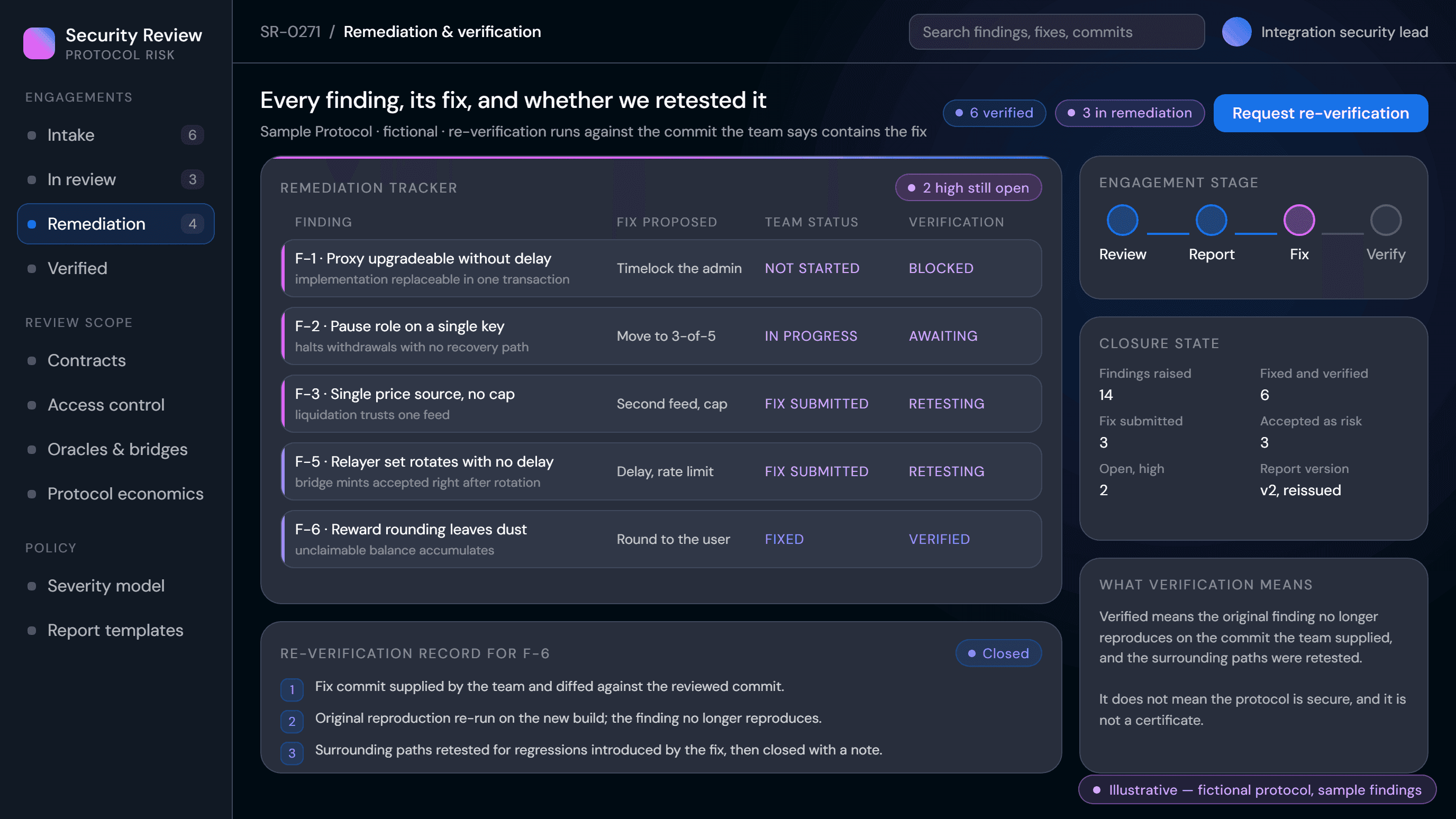
When a fix lands, the supplied commit is diffed against the reviewed one, the original reproduction re-run, and surrounding paths retested. Verified means that finding no longer reproduces on that commit.
Watch what changes
After integration, contract upgrades, role changes, oracle repoints and exit liquidity falling below your threshold reopen the file. A review describes a protocol at one commit; integrated protocols keep moving.
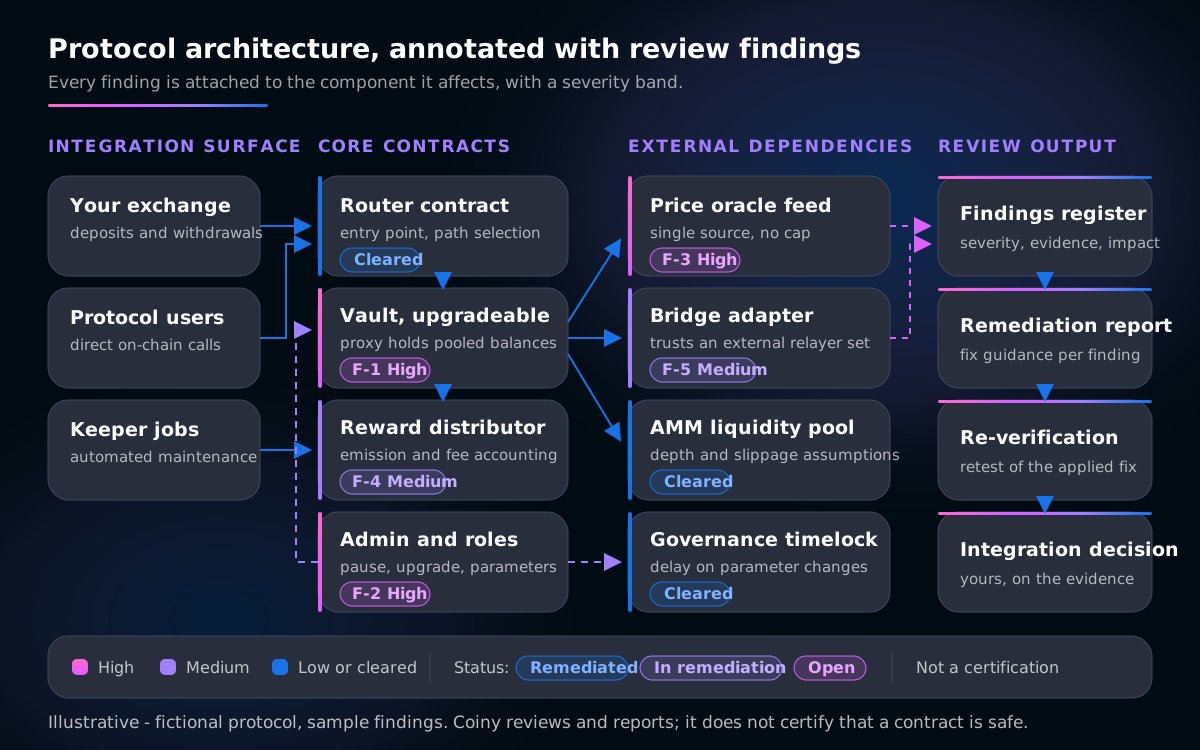
Findings Mapped Onto the Protocol They Affect
The architecture, with each finding attached to the component it affects and the status it is in. Illustrative - a fictional protocol with sample findings; no real protocol is named or assessed here.
Six Areas, Assessed the Same Way on Every Engagement
Each one is a section of the report, run against the same framework so two reviews months apart can be compared.

Smart-contract review
Contract logic and state transitions read at a named commit: external call ordering, reentrancy exposure, arithmetic and rounding, initialization state and the paths that move value. Cleared checks are reported too.

Access-control assessment
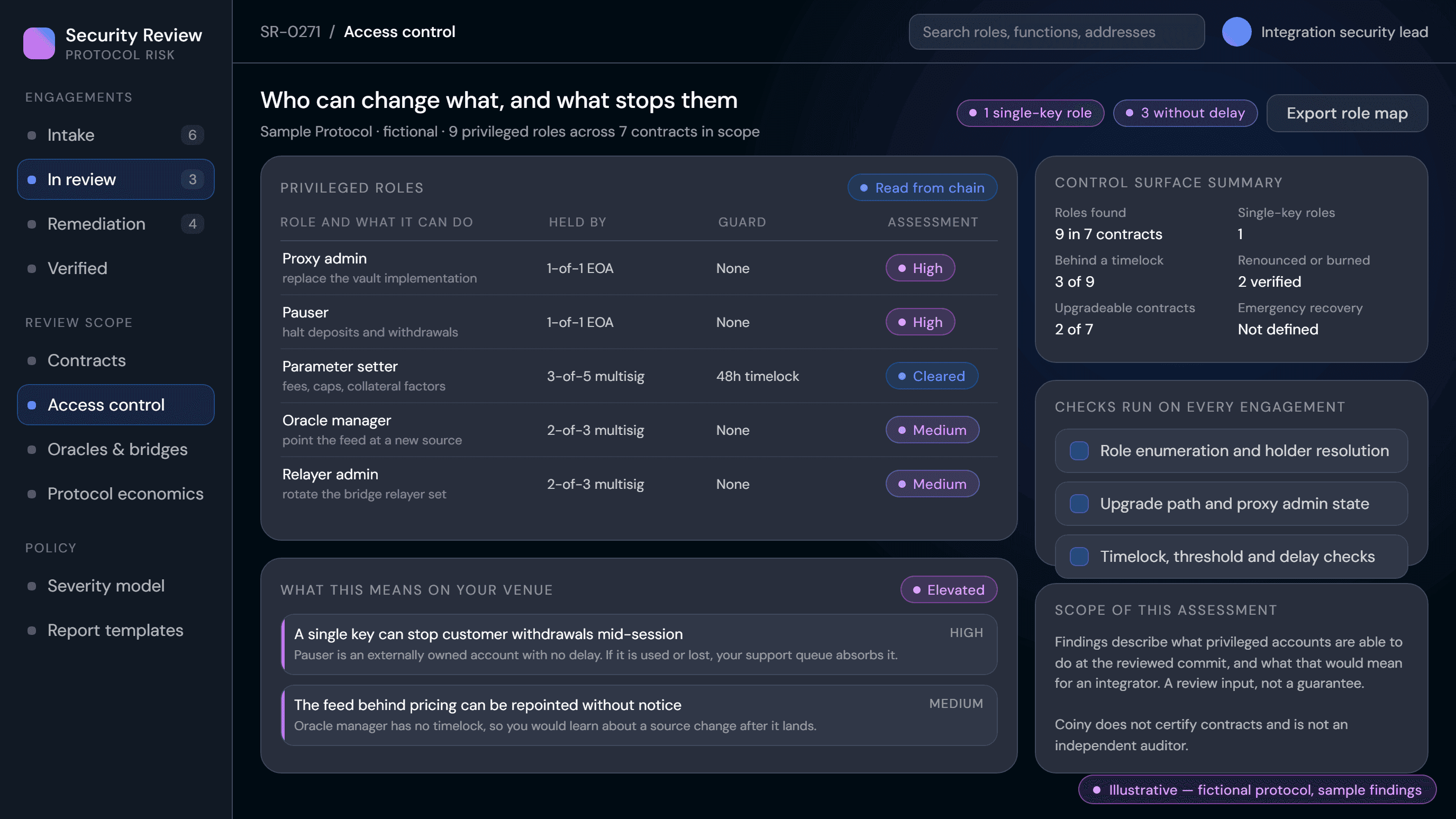
Every privileged role enumerated, its holder resolved and its guard recorded. Pause authority, proxy admins, parameter setters and upgrade paths reported with who can call them and what delays them.

Oracle dependency review
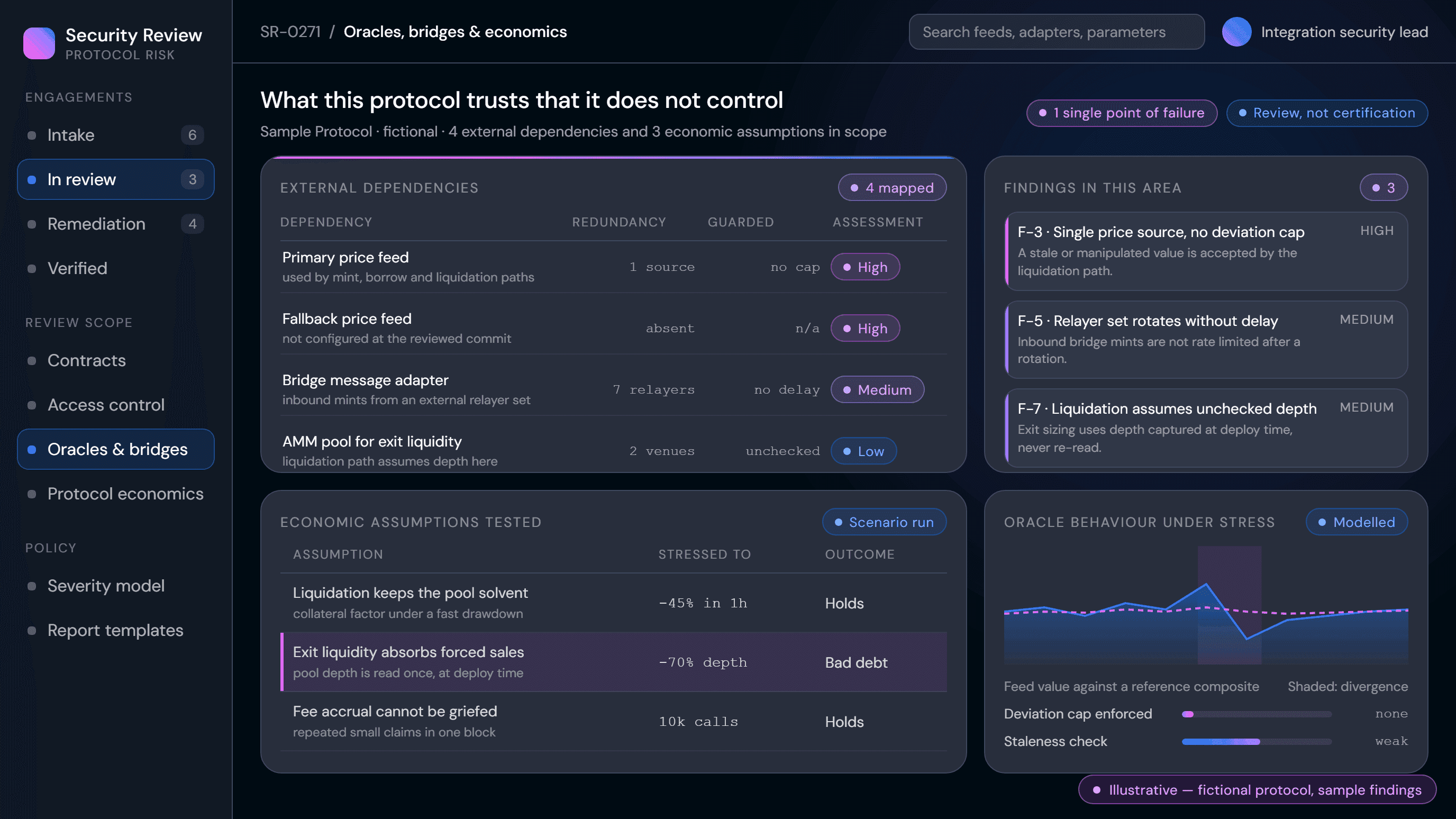
The price sources a protocol trusts, and what happens when they are wrong. Source count, deviation caps, staleness windows and the consuming paths are checked together, because a single feed is only a high finding when liquidation depends on it.

Bridge and cross-chain risk
Which inbound messages a protocol accepts, from which signer set, under what delay. Relayer rotation, rate limiting on inbound mints and chain concentration assessed as an integration exposure.

Protocol and economic risk
Incentive and solvency assumptions stressed rather than accepted: collateral under a fast drawdown, whether exit liquidity is measured or assumed, and ordering effects within a block. Modelled, never predicted.

Remediation and re-verification
Fix guidance per finding, a tracker through the protocol team's changes, and a retest when a fix lands - diff the commit, re-run the reproduction, check the surrounding paths. Accepted risks are recorded with the approver and the reason.
What Your Security Lead Actually Reads
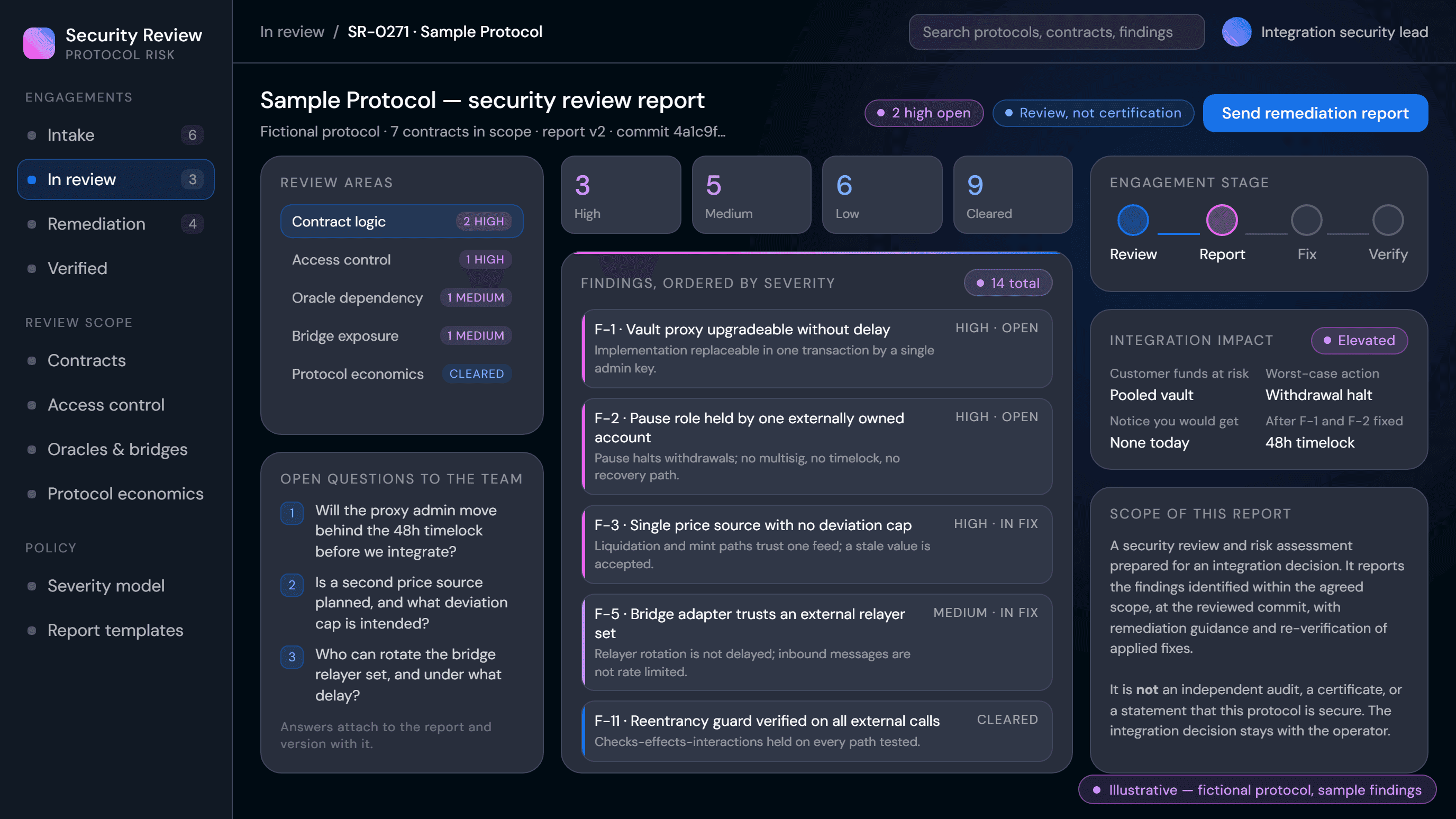
The report and the tracker are the product. Every screen below shows an illustrative review of a fictional protocol with sample findings - no real protocol is named, and no finding here is attributed to any real contract.
Security review report findings, severity, integration impact
Every review area with its own band, findings ordered by severity, and a plain statement of what the open ones mean for your platform. The scope panel sits on the same screen, so nobody mistakes the document for a certificate.
- Review areas indexed with a severity band on each
- Findings ordered by severity, cleared checks included
- Integration impact stated in operator terms, not code terms
- Open questions to the protocol team, versioned with the report
What Is Reviewed, and What You Get Back
Every engagement covers the same areas in the same order. The takeaway: a review answers a bounded question about a named commit, and a clean report on one area never stands in for the others - sound contract logic on a protocol with one price source and a single-key pause is still a risky integration.
| # | Review area | What is assessed | What you get back |
|---|---|---|---|
| 1 | Contract logicdoes the code do what it claims | State transitions, external call ordering, reentrancy exposure, arithmetic and rounding, initialization state | Findings with severity and reproductioncleared checks reported too, so coverage is visible |
| 2 | Access controlwho can change the rules | Privileged roles, holders, upgrade paths, proxy admins, timelocks and multisig thresholds | A role map with guards and consequencesstated in what it would do on your platform |
| 3 | Oracle dependencywhat happens when the price is wrong | Source count and fallbacks, deviation caps, staleness handling, and the paths that consume the feed | Dependency findings with failure behaviourand the minimum guard we would want before integration |
| 4 | Bridge and cross-chainwho can mint into the protocol | Inbound message trust, relayer or signer set, rotation delay, rate limiting, chain concentration | Cross-chain exposure written as an integration risknot as a list of supported networks |
| 5 | Protocol economicsdoes the design hold under stress | Collateral and liquidation behaviour, exit liquidity assumptions, fee and reward accounting, ordering effects | Scenario outcomes with their assumptions statedmodelled results, clearly labelled as models |
| 6 | Remediation and verificationwhat changed after the report | Fix guidance per finding, the team's applied changes, and a retest of the supplied commit | A tracker and a re-verification recordplus accepted risks with the approver and the reason |
Set the Scope, the Severity Model and the Integration Gates Yourself
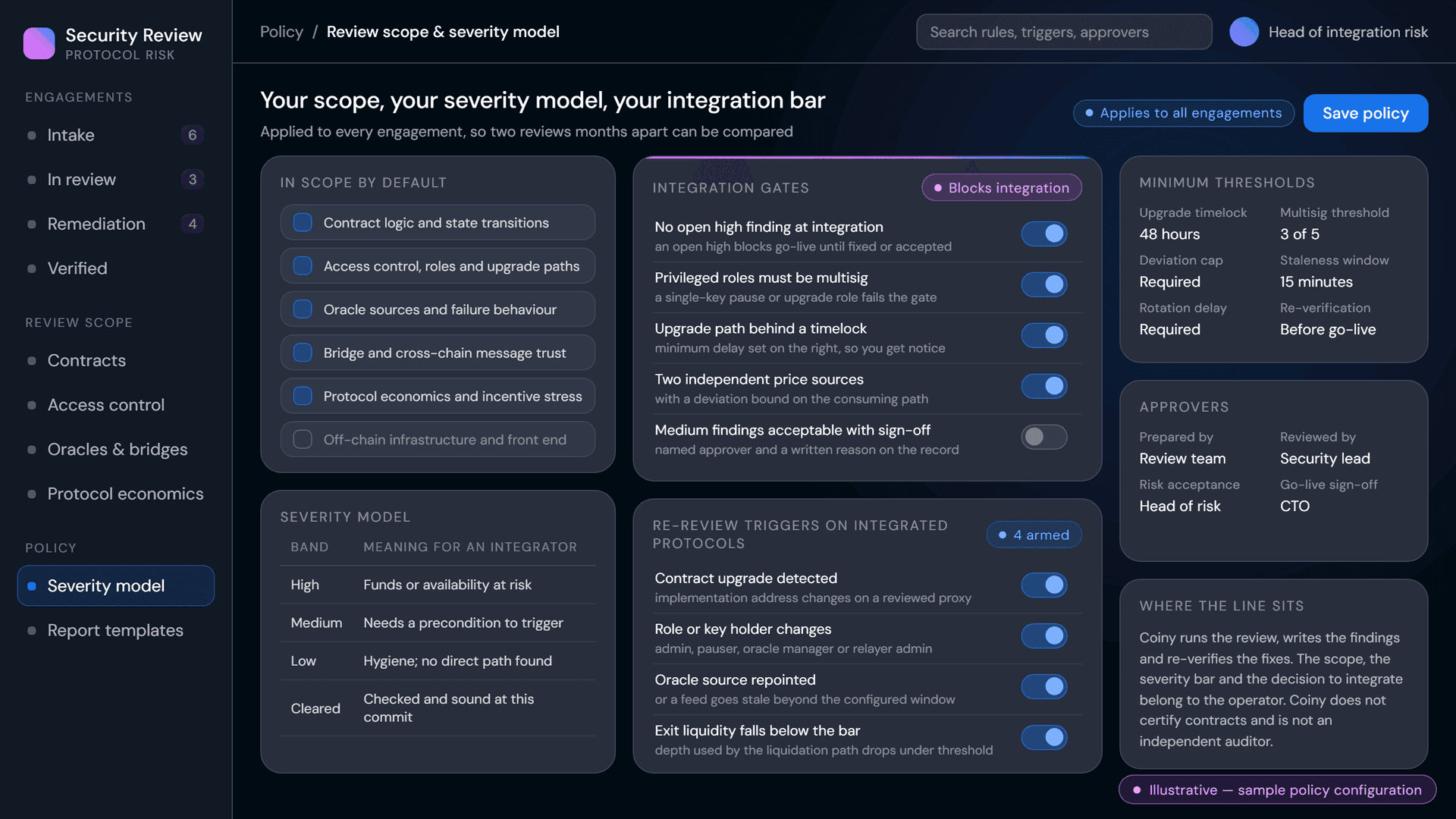
The review is the same on every engagement; the bar is yours. Define what is in scope, what each severity band means for your business, and which findings block an integration outright - then every report arrives with your policy already applied, and two reviews months apart can be compared.
What a Coiny Security Review Is, and What It Is Not
Coiny performs smart-contract security reviews and DeFi risk assessments, and produces findings, remediation guidance and post-remediation verification. Coiny is not an independent auditor, does not issue audit certificates, and does not certify that a contract is safe. A review examines an agreed scope at a named commit and cannot prove the absence of vulnerabilities - a protocol that has been reviewed is not thereby secure. Independent audit certification is the work of established audit firms such as Trail of Bits, OpenZeppelin and Certik. Every finding is evidence for your team; the integration decision and the risk stay with the operator. Any protocol shown on this page is fictional, with sample findings.
Where Protocol Security Sits in the Coiny Stack
Integration risk is one question among several. These are the pieces around it.


The People Who Own the Integration Decision
Protocol risk is bought by whoever has to explain the integration afterwards - not by whoever wants the feature shipped this quarter.
CTOs and security leads
A written basis for saying yes or no to a protocol, in a report that still makes sense to someone who was not in the room.
Exchanges adding DeFi products
Need to know what a protocol's admin keys can do to customer balances before the integration ships.
Protocol and product teams
Findings with fix guidance and a retest, so a security conversation ends in verified changes rather than a document in a drive.
Fintechs building on DeFi rails
Oracle, bridge and economic dependencies mapped in plain terms — the paths that fail first and are least visible from an integration guide.
Smart-Contract Security & DeFi Risk FAQ
A smart contract security review is an assessment of a protocol's code, access control and dependencies that produces findings and remediation guidance; an independent audit is a formal engagement by a dedicated audit firm that issues a signed report and is bought as third-party assurance. Coiny Exchange performs security reviews and risk assessments in service of an integration decision. Coiny does not certify that a contract is safe, does not issue audit certificates, and is not an independent auditor. Established audit firms such as Trail of Bits, OpenZeppelin and Certik occupy that role.
A DeFi risk assessment examines everything a protocol depends on that could hurt whoever integrates with it: contract logic, who holds privileged roles, which oracles and bridges it trusts, and whether its economics hold under stress. Coiny Exchange runs those areas as one engagement and returns a report where every finding carries a severity, the evidence behind it, and what it would mean on your venue specifically, so the integration decision is made on written evidence rather than on reputation.
An access control assessment enumerates every privileged role in the contracts, resolves who actually holds it, and records what guards it. Coiny Exchange reports each role with its holder, its guard and its consequence: whether a pause or upgrade sits on a single externally owned account, whether the proxy admin is behind a timelock, which parameters can move without delay, and what notice your platform would get. A single-key pause that can stop customer withdrawals is reported as exactly that.
Oracle risk is the chance that a price a protocol trusts is stale, thin or manipulable, and bridge risk is the chance that inbound cross-chain messages are accepted from a set of signers you do not control. Coiny Exchange maps every external dependency, checks whether the consuming path enforces a deviation cap and a staleness window, and reports how the relayer set is rotated and whether inbound messages are rate limited.
A remediation report lists every finding with its severity, the evidence and reproduction behind it, the specific change that would resolve it, and what the finding means for an integrator until it is resolved. Coiny Exchange writes remediation guidance per finding rather than a generic recommendation list, tracks each item through the protocol team's fix, and records anything the operator chooses to accept as risk with who accepted it and why.
Post-remediation verification is the retest that happens after a protocol team says a finding is fixed. Coiny Exchange diffs the supplied fix commit against the reviewed commit, re-runs the original reproduction to confirm the finding no longer occurs, and retests the surrounding paths for regressions the fix may have introduced. Verified means that specific finding no longer reproduces on that commit. It does not mean the protocol is secure, and it is not a certificate.
A smart contract security review asks whether a protocol's code and economic design are sound enough to integrate; token due diligence asks whether a specific asset should be listed on your venue. Coiny Exchange offers both. The security review covers contract logic, access control, oracle and bridge dependencies and protocol economics. Token due diligence for listings covers contract findings, holder concentration, liquidity depth, governance, treasury and the asset's own transaction risk, composed into a listing-decision report.
Yes. Integrating a DeFi protocol means your customers' funds and your platform's availability start depending on code and key holders you do not control. Coiny Exchange reviews the protocol before that dependency exists, so the integration gate is a written set of findings rather than a judgement call, and reviews it again when a trigger fires afterwards: a contract upgrade, a role change, an oracle repoint, or exit liquidity falling below the bar you set.
Ready to Put a Protocol Through a Real Review Before You Integrate?
Book a walkthrough of the report, the four review areas and the remediation tracker - and we will set the scope and the integration gates against the risk appetite your team already works to.
Book a Demo