Identification of Systemic Risk
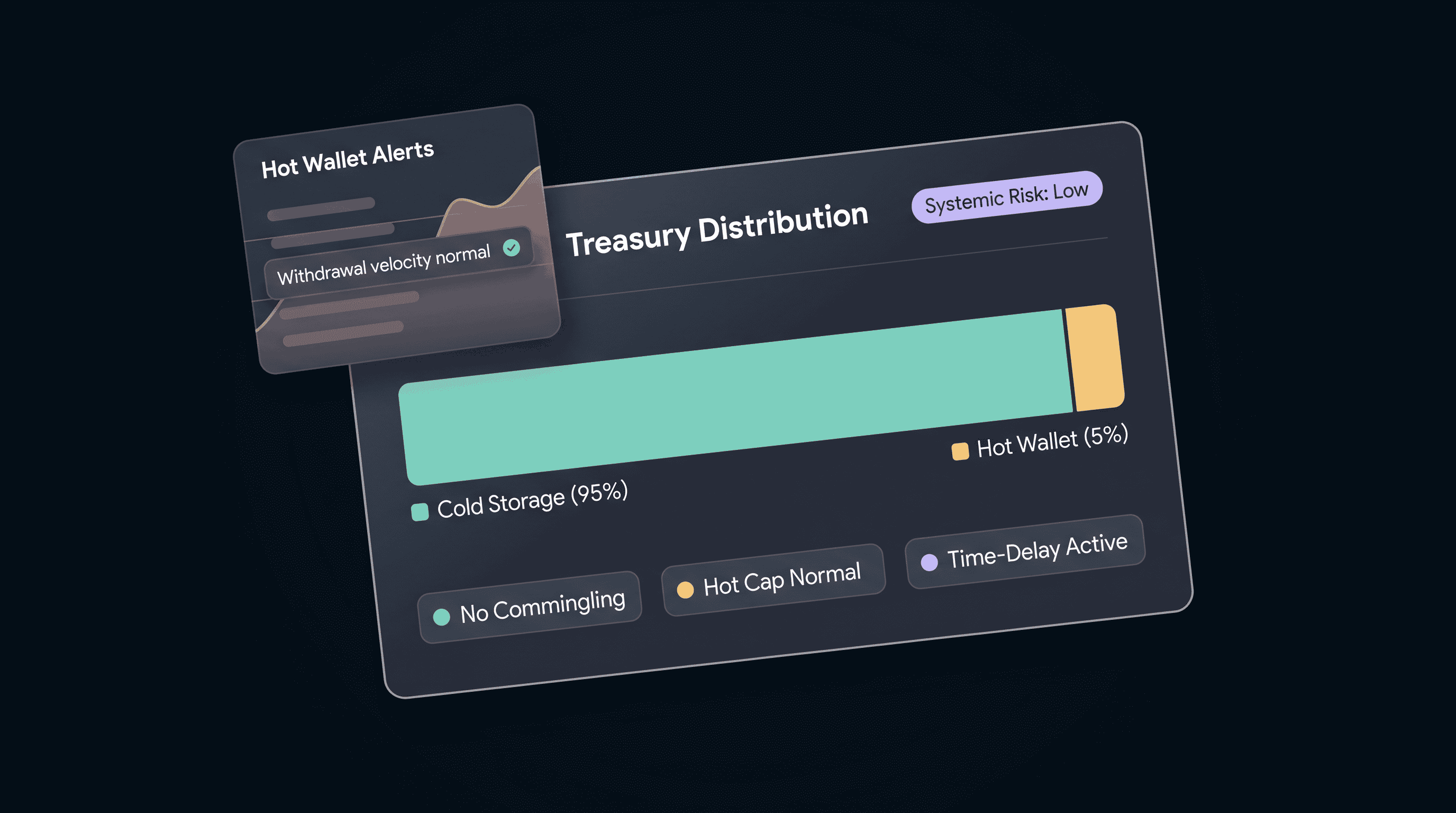
Most exchange security incidents trace to the same root causes: hot wallets holding too much capital, no time delay on warm-to-hot transfers, cold storage without quorum, and user funds commingled with treasury.
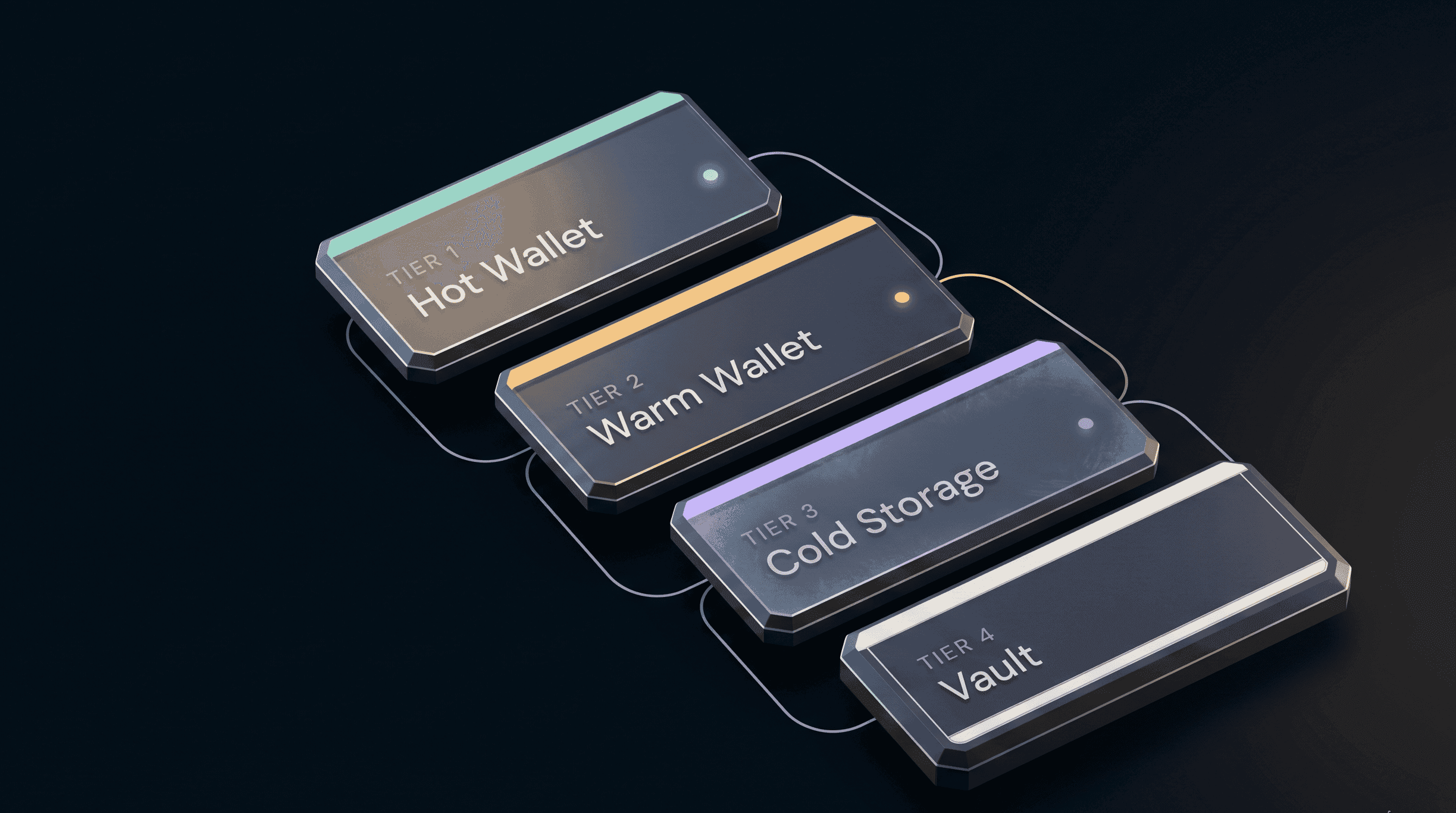
Four-tier wallet architecture, four custody models, and multi-signature authorization at every level. Operator-controlled capital flows, velocity limits and custody routing, built for enterprise scale without giving up protection.
Most exchange security incidents trace to the same root causes: hot wallets holding too much capital, no time delay on warm-to-hot transfers, cold storage without quorum, and user funds commingled with treasury.
The infrastructure addresses each one architecturally rather than by policy. Custody tiers, multi-sig quorum rules, time delays and fund segregation are built into the infrastructure layer and enforced there.
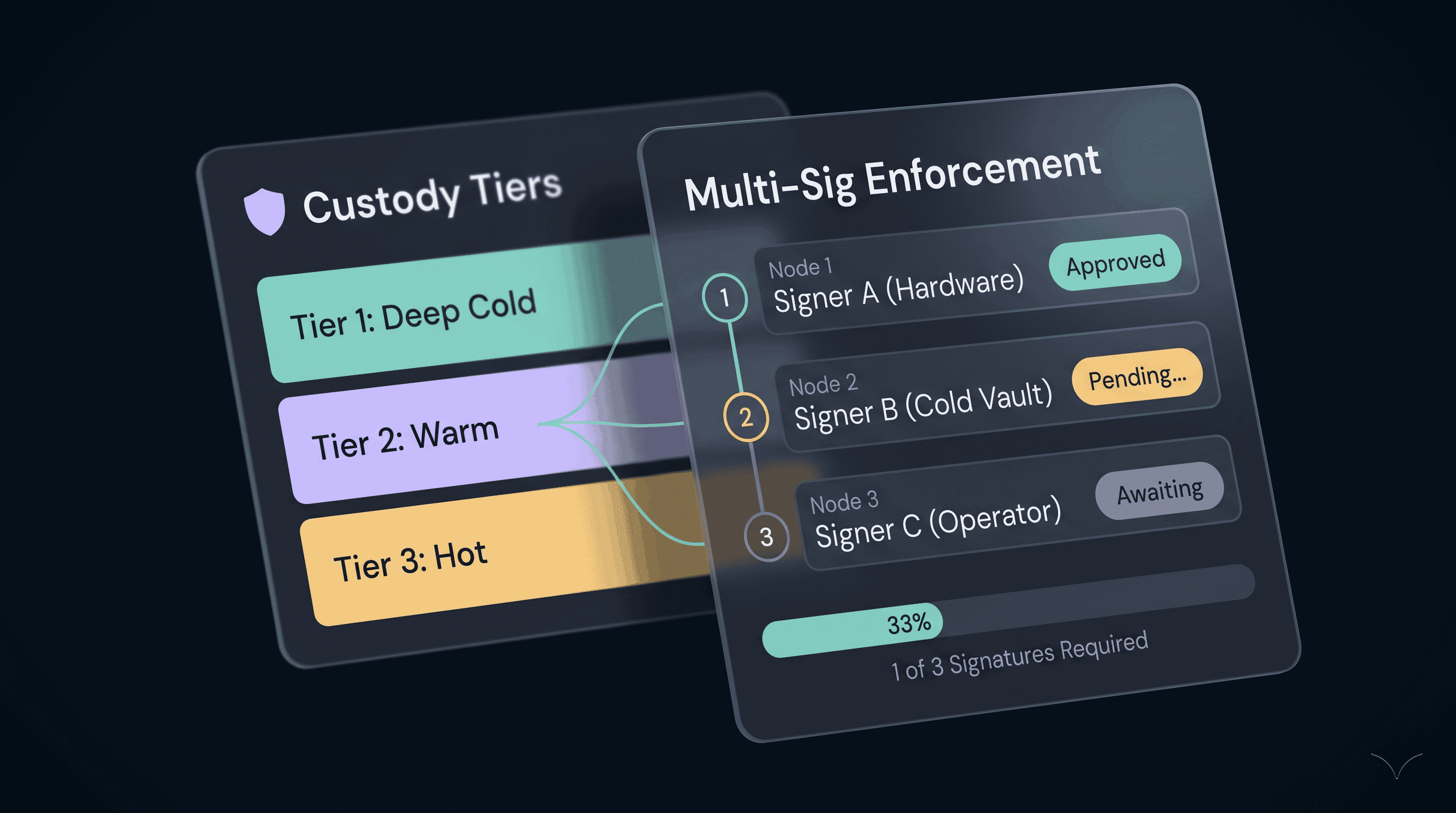
Deep liquidity meets vault-grade security.
Real-time withdrawal processing with tightly controlled minimum balance — enough to service active demand without over-exposing assets. Automated rate limiting flags anomalous outflow patterns. Replenished from warm storage when balances fall below operator-defined thresholds. Speed is the priority — exposure is tightly capped.
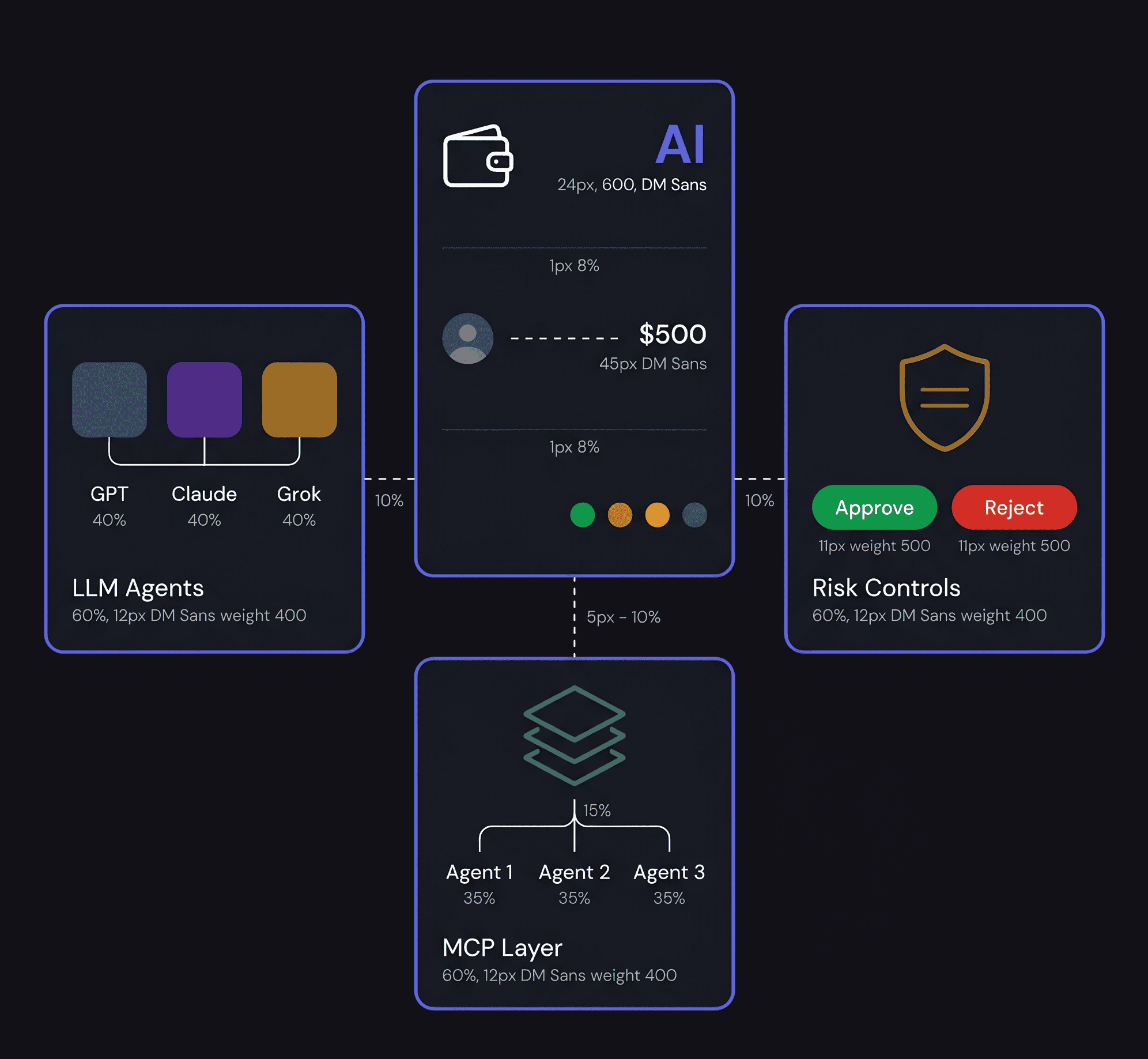
A non-custodial wallet that holds, thinks, and acts — entirely within the boundaries you set.
Connect any frontier model, or your own. The wallet turns natural-language instructions into validated, policy-bound transactions.
Every transaction passes through your rules. Spending caps, vendor allowlists, time windows, and category limits — enforced architecturally, not by trust.
A dedicated Model Context Protocol layer gives every agent its own sub-wallet, balance, and audit trail — with a single tap to pause everything instantly.
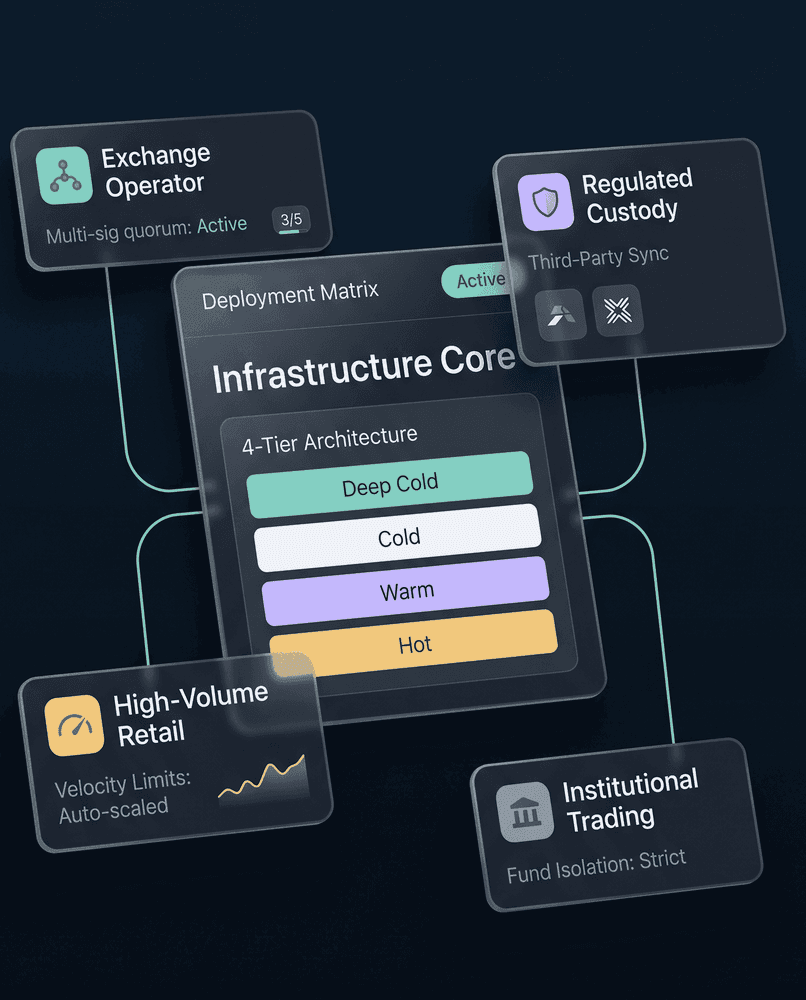
Four distinct custody models — deployable independently or in combination across platform modules.
The standard centralized model: private keys generated, stored and managed by the platform on behalf of users, who interact through account balances. Subject to custody regulation in most jurisdictions.
Multi-Party Computation splits key material into shares held by the platform and the user. Neither holds a complete key and neither can sign alone, so a platform breach does not expose funds.
Users hold complete ownership of private keys. The platform facilitates trading but never touches or stores user funds, and architecturally cannot freeze, seize or redirect them.
Every transaction requires approval from multiple independent keyholders, in 2-of-3, 3-of-5 or custom M-of-N configurations. Cold storage distributes keyholders geographically.
Per-user deposit addresses with multi-network routing auto-detect the originating network and credit accordingly. No manual network selection errors. No lost deposits on wrong chains.
Blockchain networks supported across the custody layer, each with its own confirmation policy, fee handling and sweep behaviour set per operator.
From major coins to long-tail tokens, with listing controls deciding which of them a given deployment actually holds and moves.
Custodial, MPC, non-custodial and multi-signature, deployable independently or side by side so one venue can meet several frameworks.
Managing velocity and security across every transaction.
Per-user dedicated addresses with multi-chain routing. Automatic network detection and balance crediting. Confirmation thresholds configurable per asset and network.
Per-user daily and monthly caps configurable by verification tier. Sudden withdrawal spikes trigger automated holds — protecting against account compromise and coordinated drain attempts.
User-initiated to any external address with configurable confirmation requirements: email verification, 2FA, and address whitelisting. Operator-defined review thresholds for large or flagged transactions.
User-to-user transfers within the platform settle at zero network cost via internal ledger reconciliation. Instant and feeless.
Configure every parameter without developer intervention.
| 1 | Hot Wallet Thresholds | Min/max balance caps and auto-replenishment triggers. |
|---|---|---|
| 2 | Withdrawal Limits | Per-user daily/monthly caps by verification tier. |
| 3 | Velocity Monitoring | Automated detection and hold on abnormal withdrawal patterns. |
| 4 | Value Thresholds | Transactions exceeding defined values routed to manual review. |
| 5 | Segregated Permissions | Role-based access for approval and cold storage management. |
| 6 | Tier-Based Access | Functionality gated by user KYC verification level. |
| 7 | Fund Routing Rules | Policies for deposit flow between hot, warm, and cold tiers. |
Our infrastructure eliminates single points of failure by enforcing cryptographic integrity and multi-layered physical security protocols throughout the entire asset lifecycle.
Outbound transactions require multi-party cryptographic approval with quorum rules.
Private keys stored in tamper-resistant hardware. Keys never exist in software memory.
Cryptographically signs every request to prevent forgery and replay.
Granular key profiles (read-only, trade-only, withdrawal, full access) to limit breach impact.
Reduced gas costs and complexity via consolidated token storage.
ERC-20 and compatible token standards consolidated under unified wallet addresses — significantly reducing gas costs and contract interaction overhead per user. Multi-token balances managed through optimized contract structures instead of individual smart contract wallets.
Direct blockchain integration across supported networks with multi-signature custody backed by distributed keyholders. Lower infrastructure cost per user at scale, faster deposit crediting, and lower withdrawal fees.
Enterprise operators requiring third-party institutional custody — for regulatory, insurance, or client-mandated reasons — connect through native integrations.
BitGo
Institutional-grade multi-sig custody with insurance-backed asset protection. Regulatory compliance across multiple jurisdictions.
Fireblocks
MPC-based key management and transfer network with DeFi, staking, and tokenization workflows. SOC 2 Type II certified.
Ledger
Hardware-secured cold storage with Ledger Enterprise vault infrastructure. Air-gapped signing with governance-controlled access policies.
Trezor
Offline hardware wallet integration for operator-managed cold storage. Open-source firmware verification with multi-sig support.
Real-time monitoring and reporting for every dimension of wallet operations.
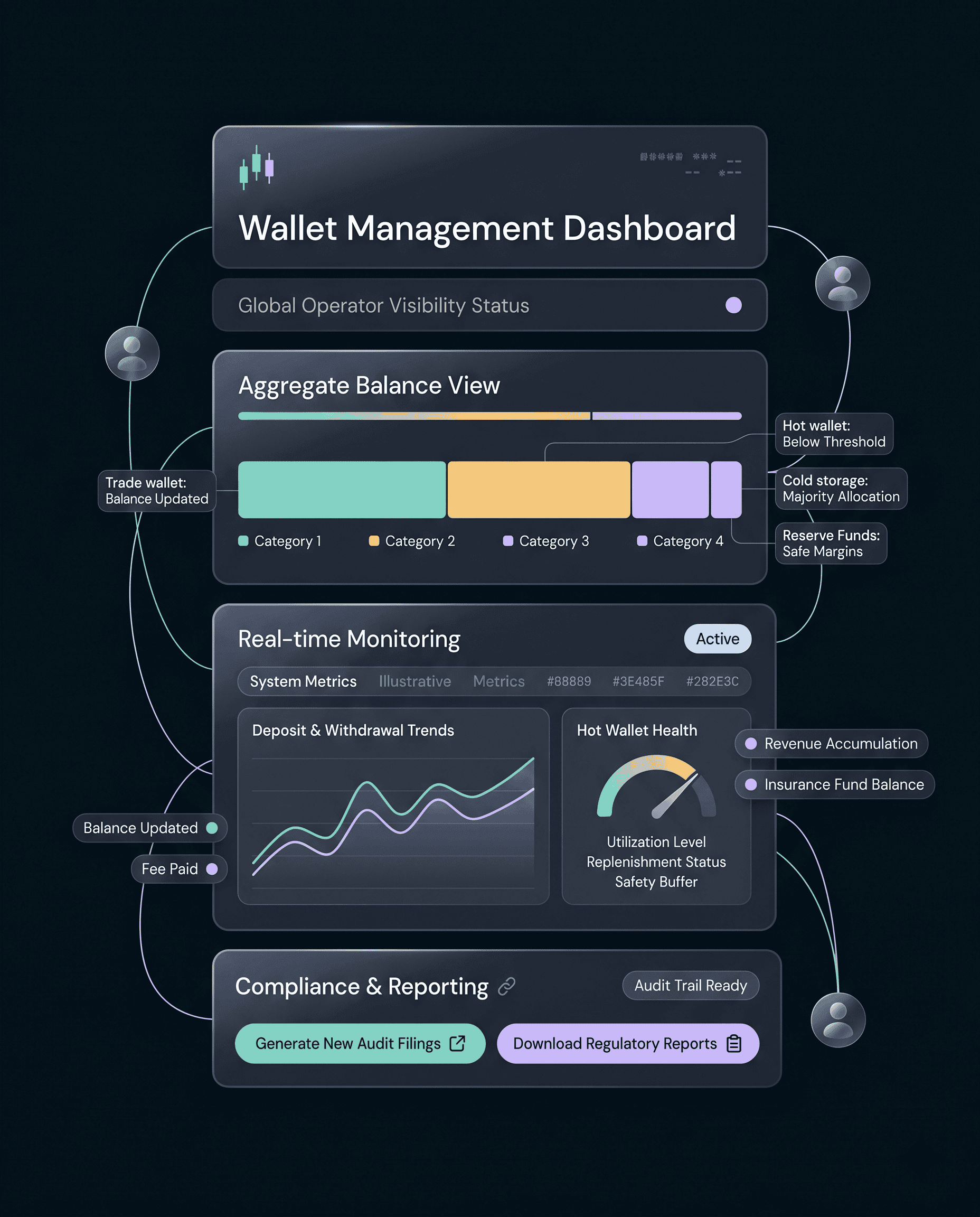
Hot wallet balances are capped at minimum operational levels. Rate limiting, velocity monitoring and threshold review intercept anomalous withdrawals, so a full hot-wallet compromise exposes a fraction of assets.
Four custody models deployable independently or together. Native integrations with BitGo, Fireblocks, Ledger and Trezor cover jurisdictions requiring third-party institutional custody.
Every wallet operation generates an immutable audit log. The operator dashboard provides aggregate and per-user balance visibility across all tiers, with exportable reports formatted for regulatory filing.

Deploy institutional custody without a dedicated security team. The four-tier architecture arrives configured with multi-sig and velocity controls.
Satisfy licensing requirements with pre-built custodial, MPC and non-custodial models, and integrate BitGo or Fireblocks for third-party mandates.
Multi-sig quorum controls and segregated treasury management, with configurable M-of-N structures and infrastructure-level fund isolation.
Scale withdrawal infrastructure with automated replenishment and velocity-based fraud detection, and manage allowlisting with no downtime.
Four tiers: Hot (operational liquidity), Warm (intermediate buffer with multi-sig and time-delay), Cold (air-gapped vault, HSM, 95%+ of assets), and Reserve/Treasury (segregated operator funds).
Custodial (platform-managed keys), Semi-Custodial/MPC (distributed key shares), Non-Custodial (user-owned keys), and Multi-Signature (quorum-based approval across all tiers).
50+ networks including Ethereum, Bitcoin, BNB Chain, Solana, Tron, Polygon, Arbitrum, Optimism, Avalanche, Base, zkSync, Cardano, Near, Cosmos, and more. Multi-chain deposit addresses with automatic network detection.
Native integrations with BitGo, Fireblocks, Ledger, and Trezor. Optional — the native wallet infrastructure operates independently.
Every parameter — withdrawal caps, velocity thresholds, review triggers, hot wallet limits, fund routing rules, and tier-based access — configurable from the admin panel.
Walk through the full wallet architecture — custody models, tier configuration, security layers, and operator controls.
Book a Demo