
Deposit investigation
Credited twice, never credited, missing memo or a rotated address — each pattern opens a case with the evidence already gathered.
Every unmatched record becomes a case: the evidence already gathered, a stated root cause, a previewed correction and a named approver. Ledger, chain, venue and payment-provider data reconcile on your schedule.
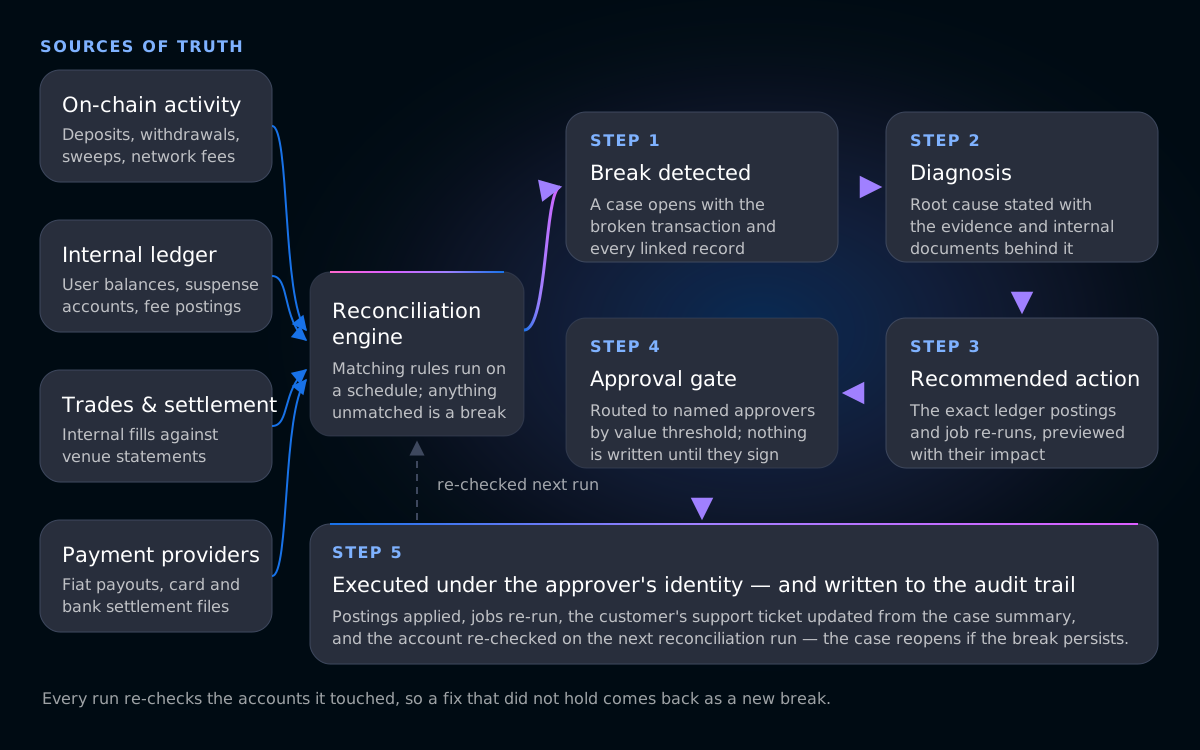
The same six steps run for a stuck deposit, an unsigned withdrawal, a missing settlement leg or a duplicated fee. The desk always knows which step a case is on and who it is waiting for.
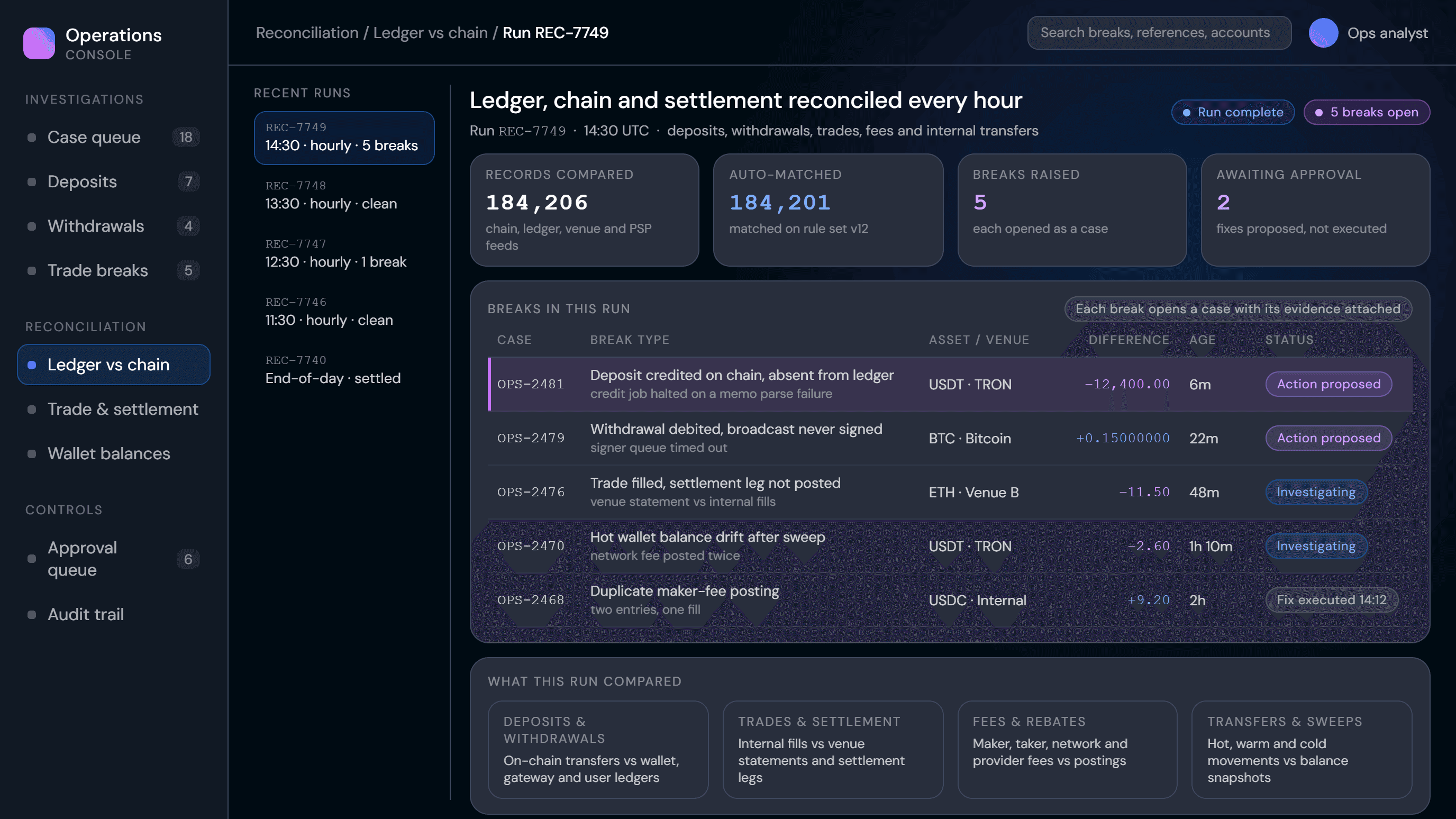
Matching rules compare the internal ledger against on-chain activity, venue statements and payment-provider files on your cadence — hourly to end-of-day. Rule sets are versioned, so you change the logic without a release.
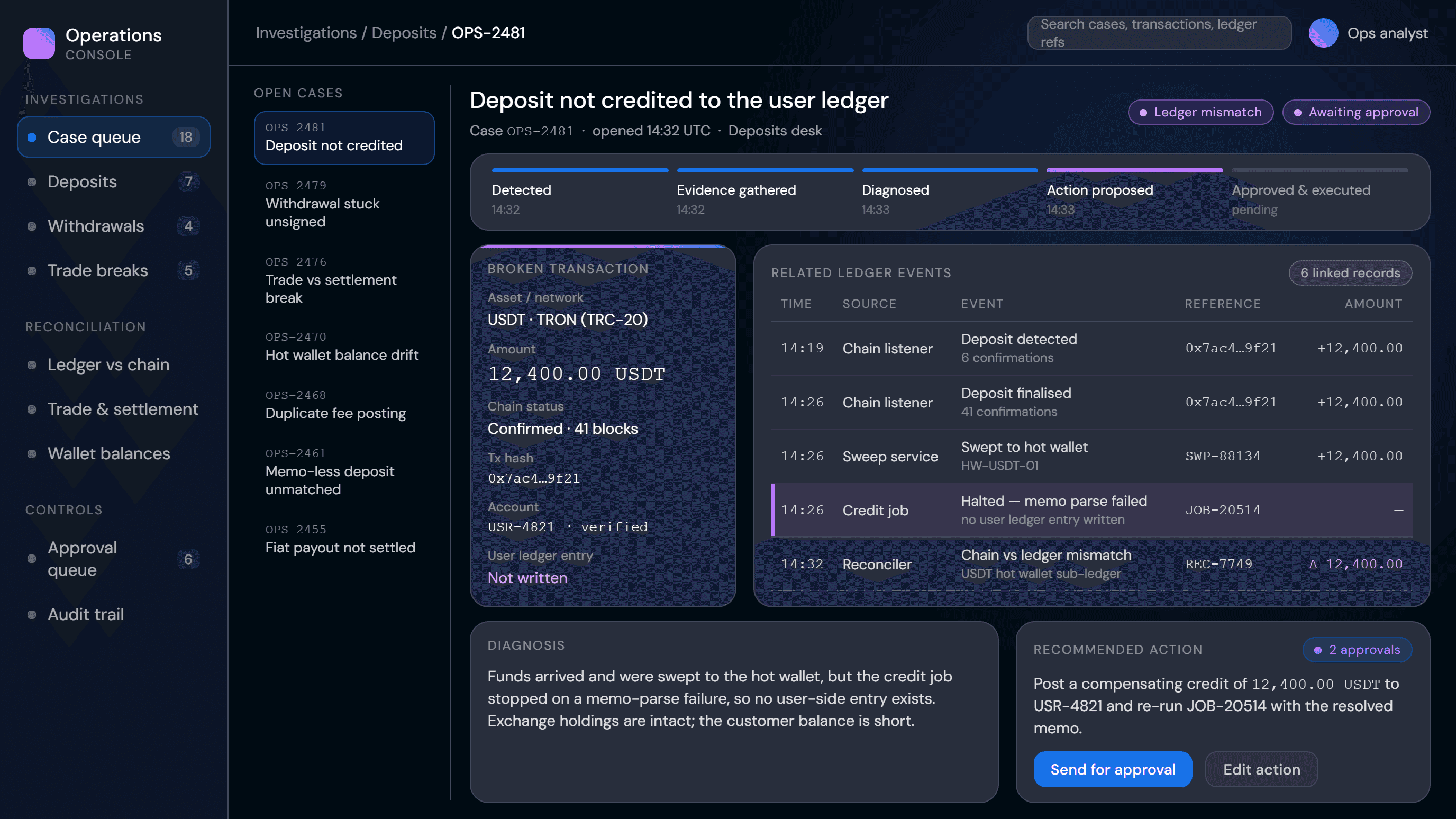
Anything unmatched becomes a case with the broken transaction pinned to the top and the evidence already attached: chain events, sweep records, job logs, ledger postings and provider statements on one timeline.
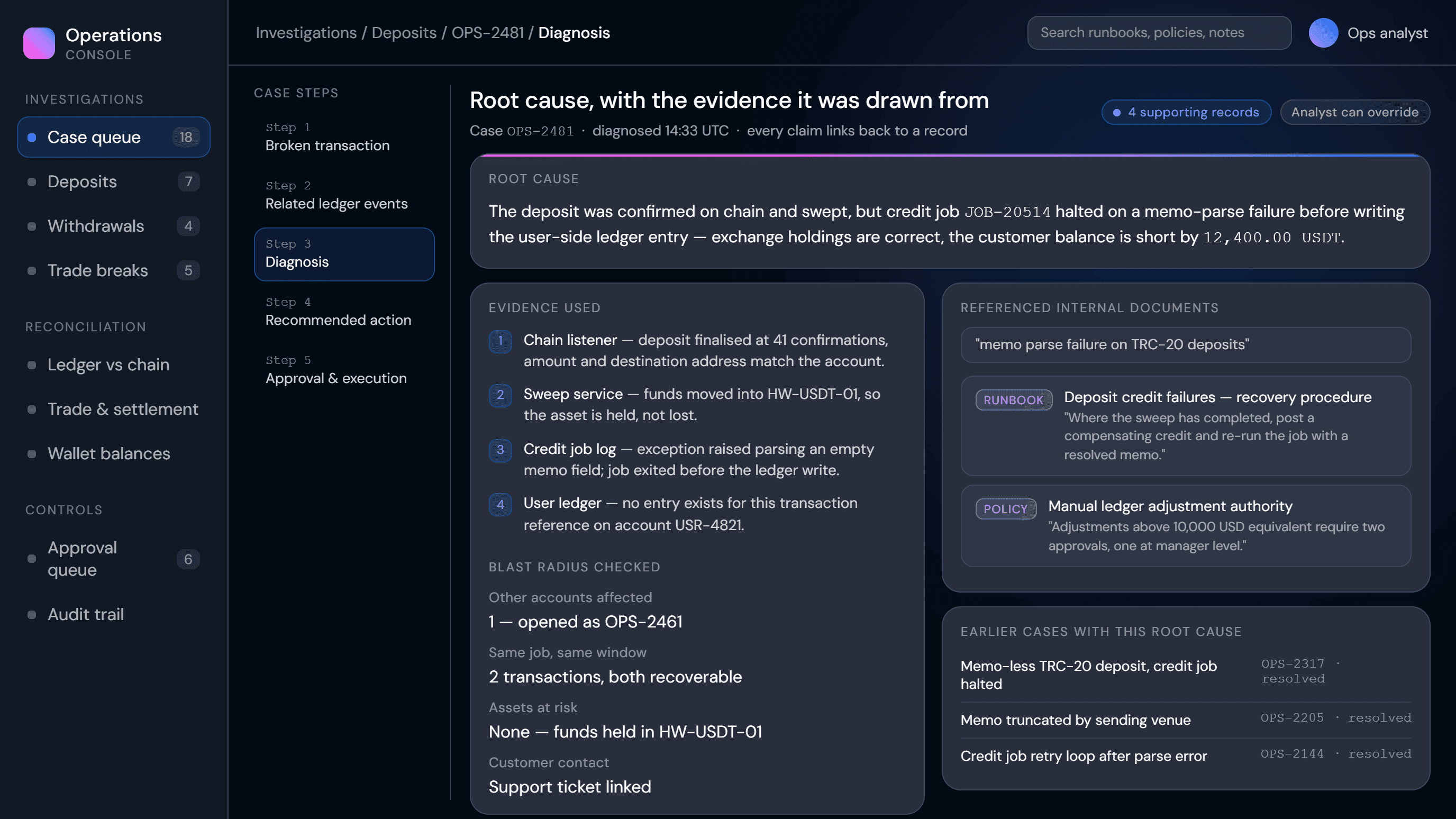
The console states what went wrong in a sentence, lists the records that support it, and cites the passages from your own runbooks and policies that apply. The analyst accepts or overrides; nothing is written yet.
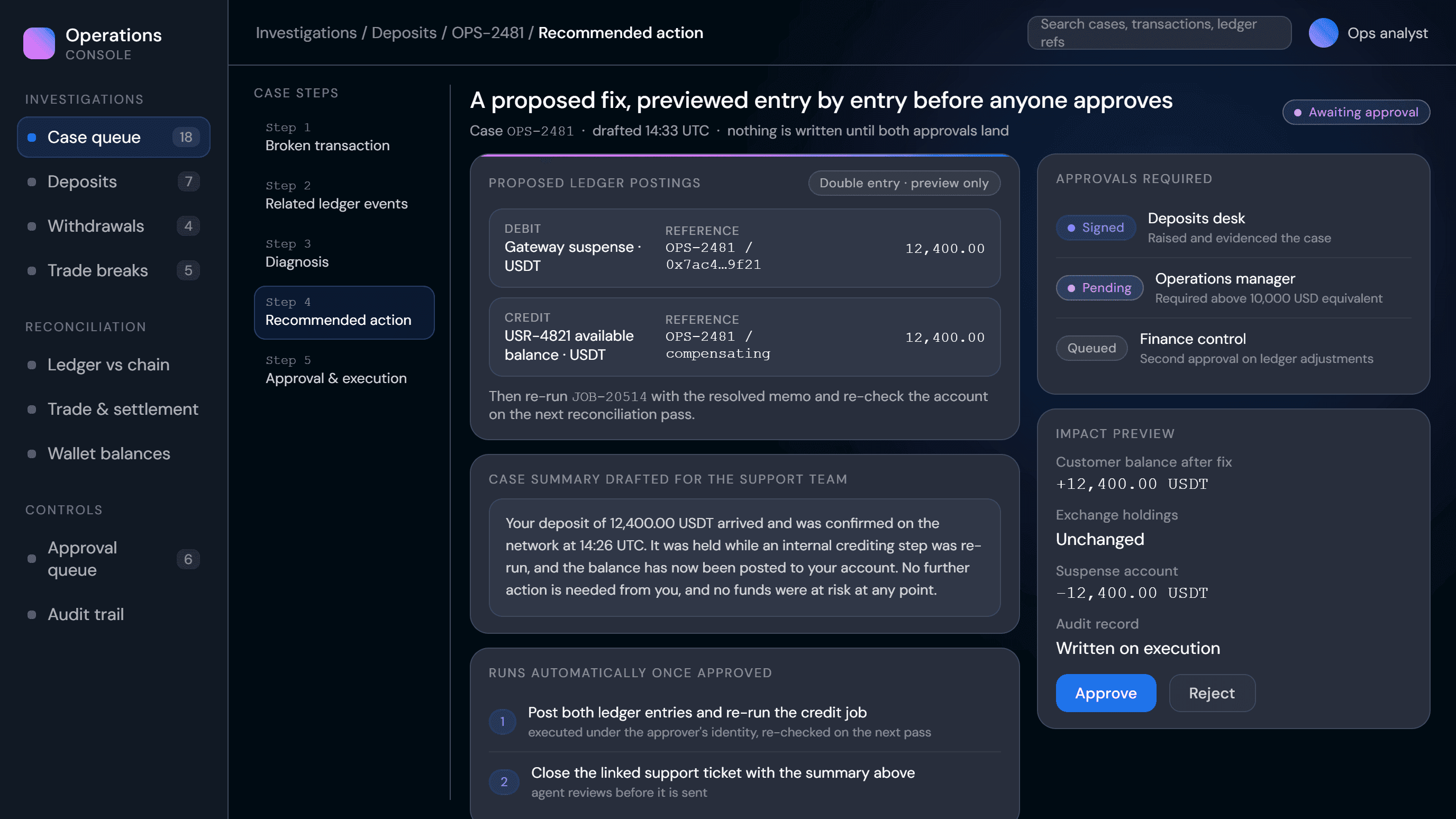
The recommended action is drafted as specific double-entry postings, the job to re-run and the expected impact on the customer balance and suspense account — plus a summary for support to review.
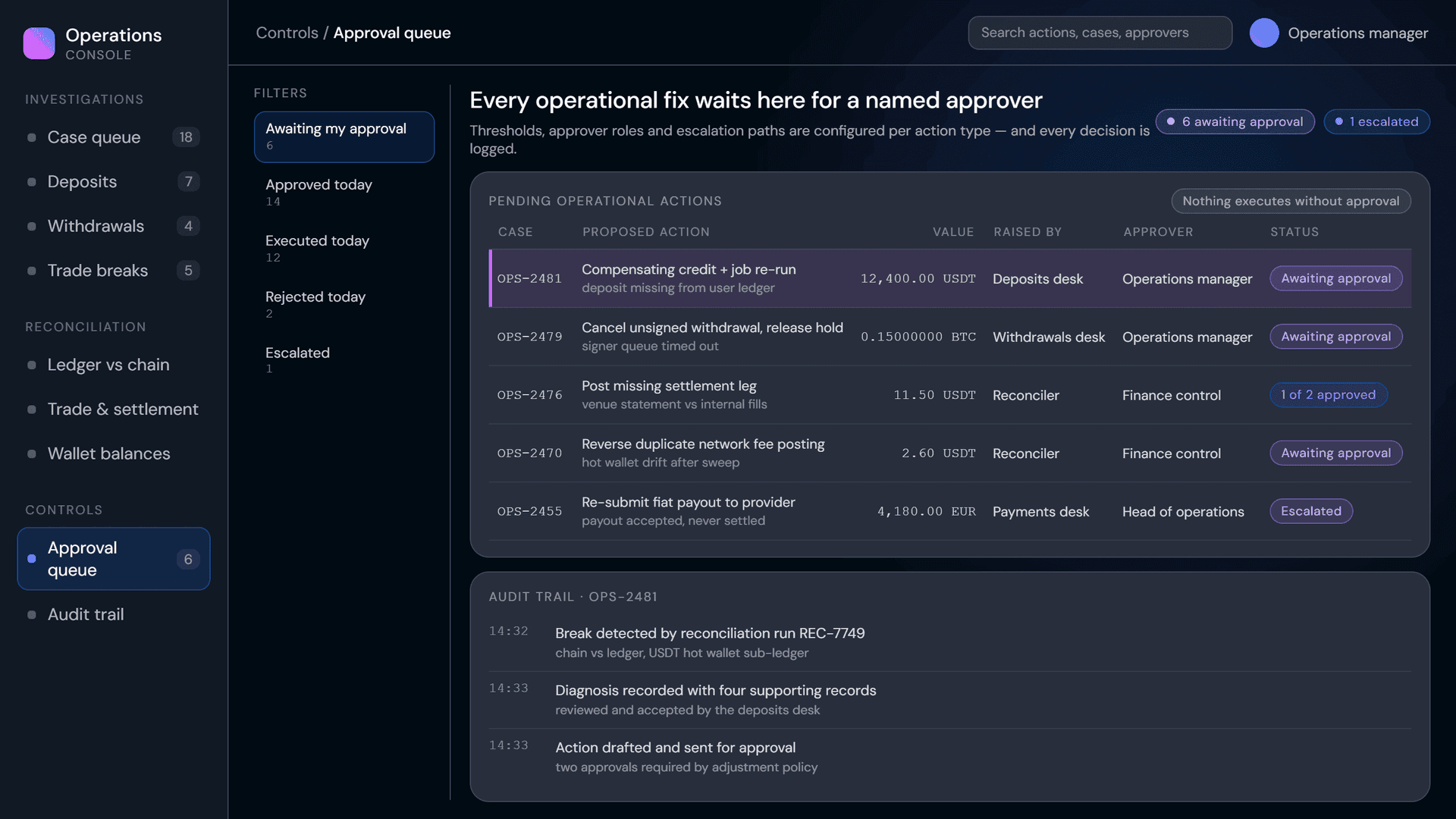
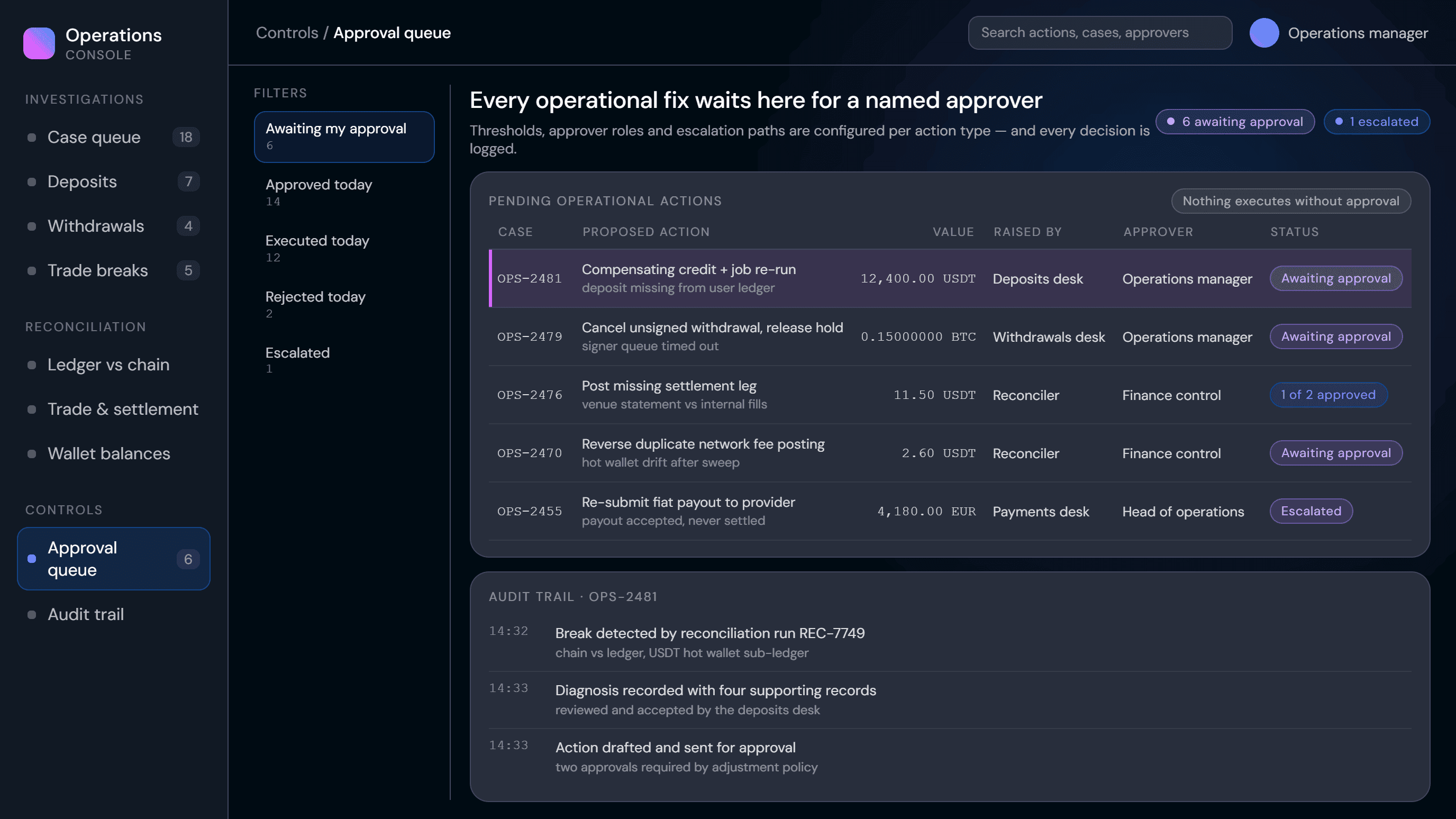
Thresholds, approver roles and escalation paths are configured per action type. A fee correction can clear with one signature; a large ledger adjustment can require two, one at manager level.
On approval the postings apply and the jobs re-run under the approver's identity, the audit trail records who decided what, and the account is re-checked on the next pass. If the break persists, the case reopens.
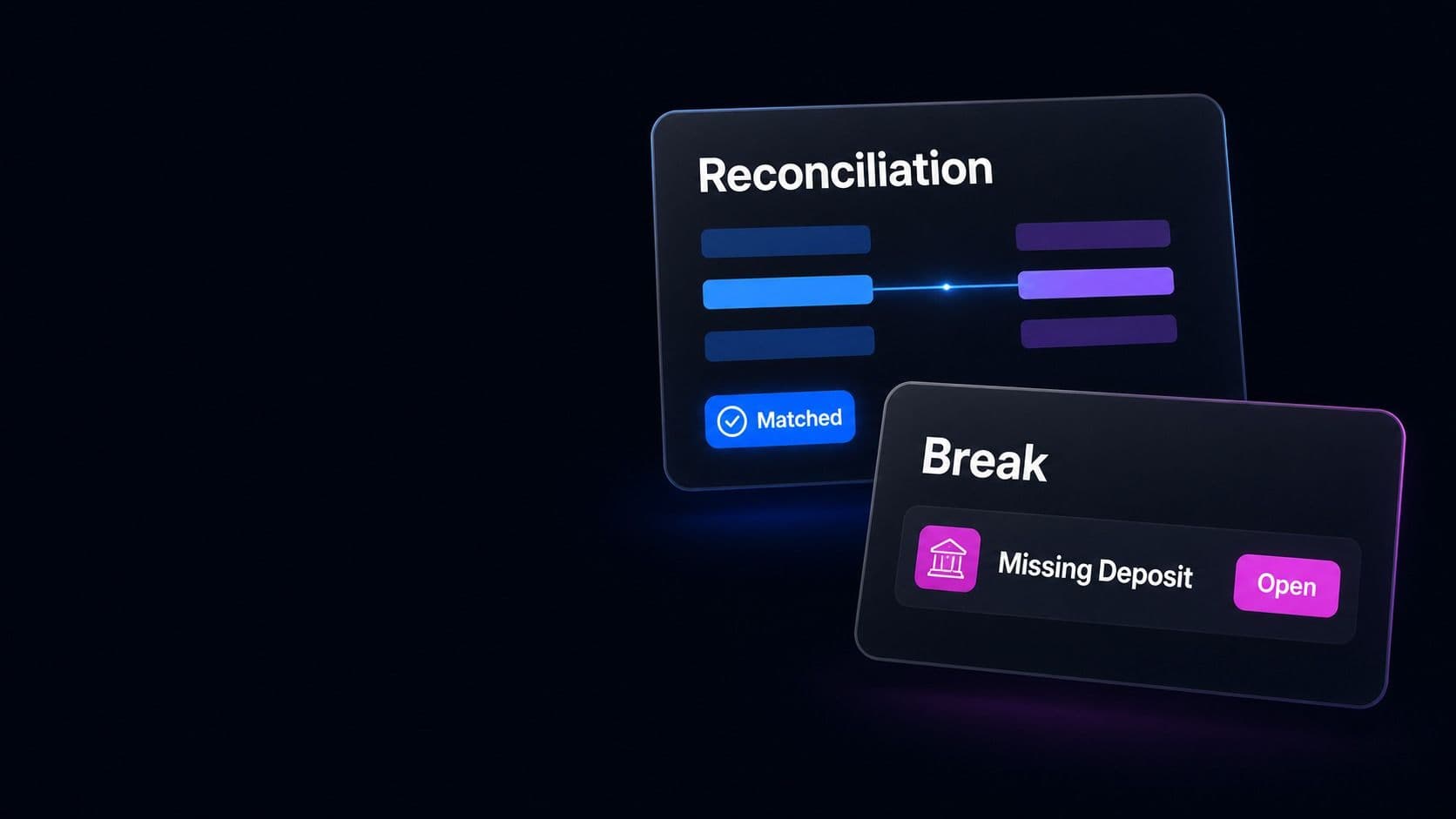
Four sources of truth feed one reconciliation engine. Anything that does not match becomes a case, and a case only closes through an approval gate. The loop is deliberate: it is what makes a corrective ledger entry defensible months later.
A customer's USDT deposit confirmed on chain and never appeared in their balance. Here is what the ops desk actually sees, screen by screen, from the moment reconciliation flags it to the moment an approver signs the correction.
The case opens with the broken transaction pinned to the top, its position in the workflow, and every related ledger event already gathered beside it. The desk sees what happened, what is missing and what is being proposed without opening a second tool.
Credited twice, never credited, missing memo or a rotated address — each pattern opens a case with the evidence already gathered.

Never broadcast, stuck in the signer queue, underpriced or broadcast twice — hold, signing state and chain result side by side.

Internal fills missing from the venue statement, settlement legs that never posted, and price or quantity differences, per venue.

Where a balance drifted, when, and which job caused it — a root cause with its records, grouped when a failure hit many accounts.

Deposits, withdrawals, sweeps and network fees reconciled against wallet, gateway and user ledgers, per asset and per network.

Internal fills reconciled against venue statements and their settlement legs, so a difference surfaces the same session.

Fiat payouts and card and bank settlement files reconciled against the ledger entries raised when the payment was accepted.

Rule sets are versioned and operator-editable, with tolerances per asset and venue. Change the logic without a release.

Value thresholds per action type decide how many signatures a fix needs, and at what seniority, before anything is written.

Every pending action carries the role that must approve it and who it sits with, and escalates when its clock runs out.

The desk that raises a case cannot be the only signature on its fix. Permissions keep proposal and approval in different hands.

Detection, diagnosis, drafted action, approvals and execution recorded with identities and timestamps, exportable as one pack.
Part of the exchange stack, not bolted on beside it. It reads the same ledger and wallets your deployment already runs on.
Centralized, decentralized, dedicated DEX chain, P2P and mobile — and where back-office operations sit across each model.
Operational investigation asks whether a transaction is correct. Financial-crime alerts and sanctions casework sit in compliance.
Hot, warm and cold balances reconciled against the sweeps and transfers the custody infrastructure underneath produces.
Reconciliation, evidence gathering and diagnosis are automated because they only read. Anything that changes a balance stops and waits for a person — that boundary is the product, not a limitation of it.
| # | Operational task | Runs automatically | Requires human approval |
|---|---|---|---|
| 1 | Reconciling the ledgerchain, venue and provider feeds | Yeson your schedule, hourly to end-of-day | Noread-only comparison |
| 2 | Raising a case for a breakwith every linked record attached | Yesone case per break | Nonothing has changed yet |
| 3 | Stating the root causeand citing the internal documents | Draftedwith its supporting records listed | Analyst reviewoverride before it stands |
| 4 | Drafting the corrective postingsdouble entry, previewed | Draftedwith a full impact preview | Approver reviewsthe preview before signing |
| 5 | Writing a ledger adjustmentcustomer credits, reversals | Neverno automatic balance changes | Named approverscount set by value threshold |
| 6 | Releasing or cancelling a withdrawalstuck or unsigned transfers | Neverheld until a decision is made | Named approverexecuted under their identity |
| 7 | Updating the customer's ticketcase summary in plain language | Draftedfrom the closed case | Agent reviewbefore anything is sent |
| 8 | Writing the audit recorddetection through execution | Alwaysincluding rejected actions | Nothe record cannot be edited |
The approval queue is where an operations team's controls become real. Thresholds, roles, escalation paths and separation of duties are configured once and enforced on every action — and the record of what was decided outlives the people who decided it.
Back-office operations is where an exchange quietly loses money, time and customer trust. This console is built for the people who carry that — and for the executives who have to answer for it.
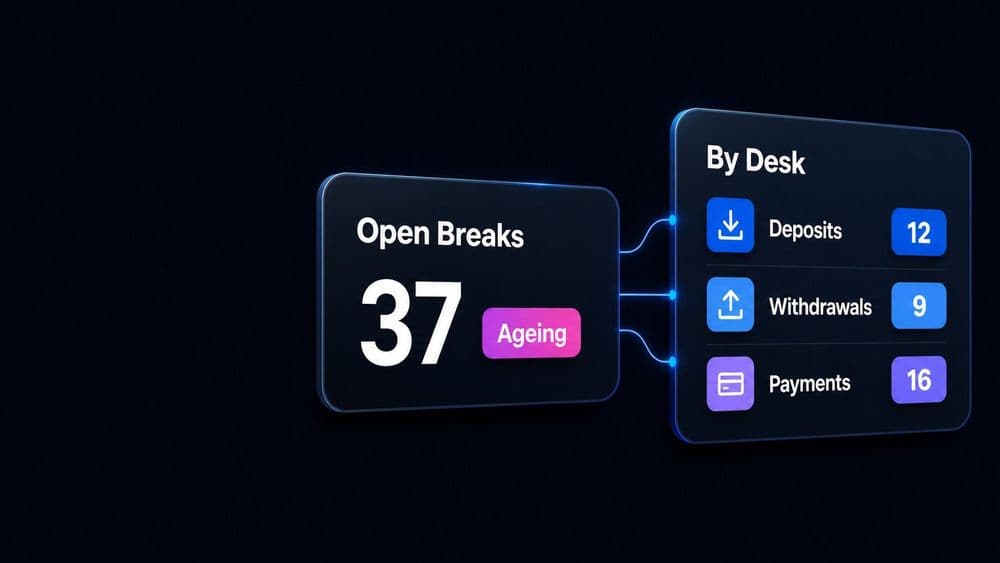
How many breaks are open, what they are worth, who they are waiting for and which are ageing — without asking three people.
The same failure patterns every week. The console gathers the evidence before you open the case and drafts the correction.
You approve entries that change customer balances. You get a previewed posting, a stated cause and a record that survives review.
Agents inherit every operational incident. Each case produces a plain-language summary of what happened, ready to review and send.
Crypto exchange reconciliation is the process of comparing an exchange's internal ledger against on-chain activity, venue and settlement statements, and payment-provider records, then resolving every record that does not match. On a crypto exchange it covers deposits and withdrawals against the blockchain, internal fills against venue statements, fee and rebate postings, and wallet balances against sweeps and transfers. Each unmatched record is a break, and a break is only closed when its cause is identified and a corrective entry is posted and approved.
A crypto exchange runs six back-office operations every day: reconciling the internal ledger against chain, venue and payment-provider records; investigating deposits that did not credit and withdrawals that did not settle; resolving trade and settlement breaks; monitoring hot, warm and cold wallet balances against expected positions; approving and executing corrective ledger entries; and answering the support tickets each of those incidents generates. Coiny's operations console runs all six in one place, with every corrective action gated behind a named approver.
The console assembles every record connected to the unmatched entry — chain events, sweep records, job logs, ledger postings and provider statements — orders them on one timeline, and states the root cause in a sentence, listing the records that support it. It also searches the operator's own runbooks, policies and integration notes and cites the passages that apply. An analyst can accept the diagnosis or override it; nothing is written to the ledger at this stage.
No. The console drafts the fix — the exact ledger postings, the job to re-run and the expected impact — and holds it for approval. Approval thresholds, approver roles and escalation paths are configured per action type by the operator, so a small fee reversal and a five-figure customer credit follow different routes. Only after a named approver signs does anything execute, and it executes under that approver's identity with a full audit record.
Operational investigation asks whether a transaction and its ledger records are correct; AML transaction monitoring asks whether a customer's activity is suspicious. This console investigates transactions and ledger breaks so balances are right and customers are made whole. Financial-crime alerts, sanctions screening and suspicious-activity casework are handled by Coiny's AML, KYC and KYT compliance infrastructure, which is a separate module with its own review queues and reporting.
It reads the exchange's internal ledger, the chain listeners and sweep services behind its wallet infrastructure, its trading and settlement records, and the statements returned by connected payment providers. It ships as part of a Coiny exchange deployment, so those connections are already in place; it does not require a separate data warehouse or a nightly export to start reconciling.
Walk through the console on the break types your desk actually fights — stuck deposits, unsigned withdrawals, missing settlement legs, duplicated fees — and see the evidence, the diagnosis, the previewed fix and the approval trail end to end.
Book a Demo