
Price and order-book coverage
Spot and derivatives pricing with depth snapshots, spreads and session ranges, from the venues the platform already connects to.
A research workspace combining price, on-chain, news and filing data into source-cited answers and real-time market-event alerts. It monitors markets 24/7 and hands every finding to your desk with the sources attached.
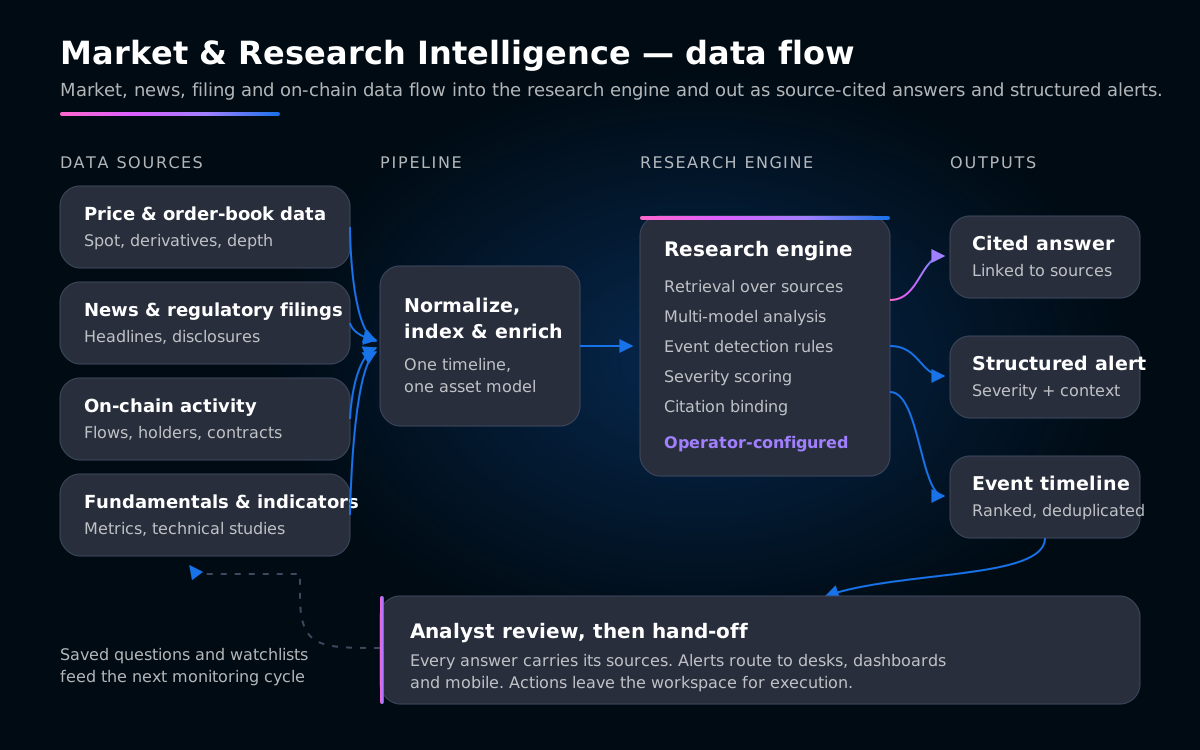
Six stages run continuously inside one workspace. Nothing is a separate subscription, and nothing leaves the platform your markets already run on.
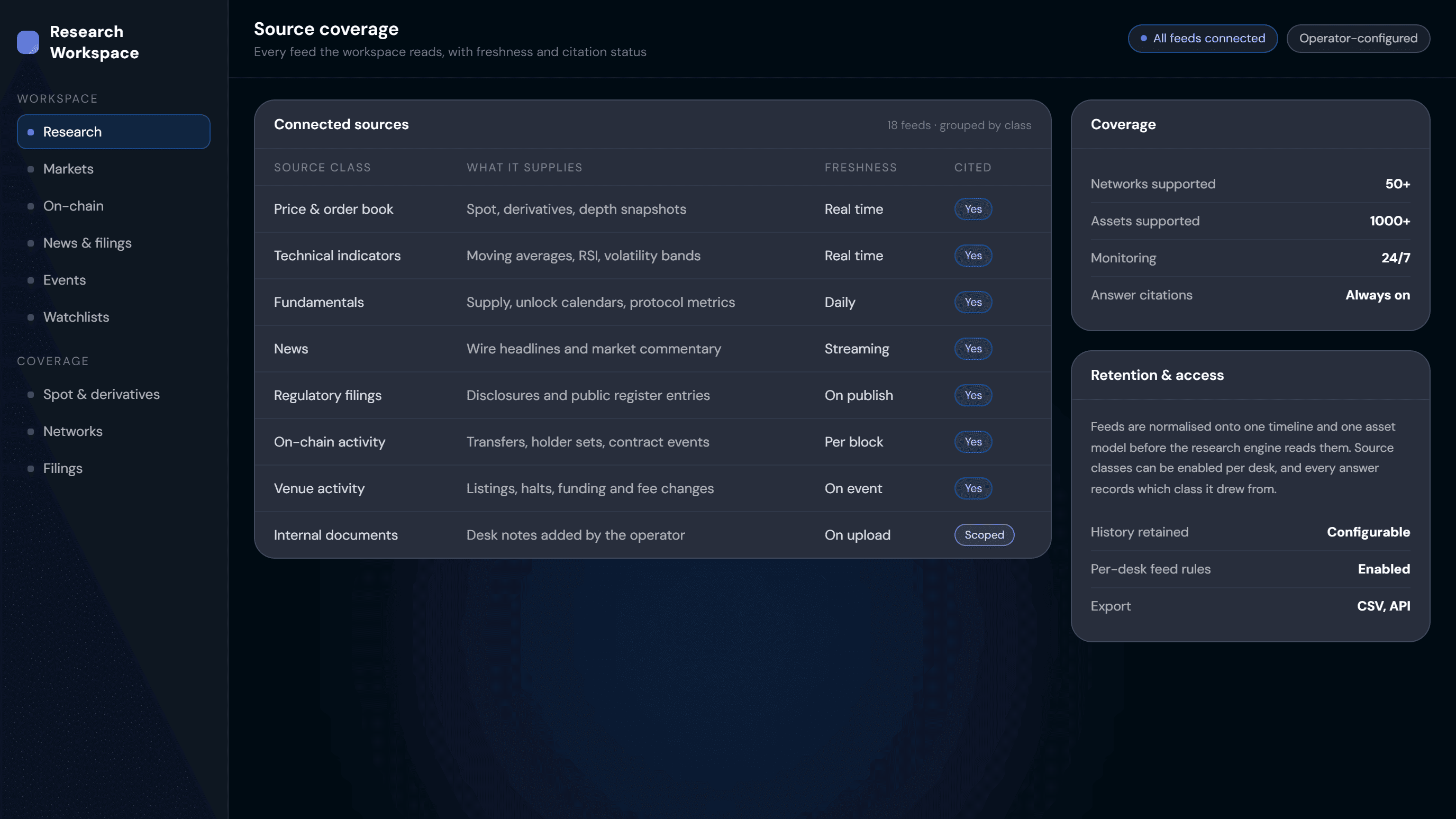
Price and order-book data, indicators, fundamentals, news, filings, venue activity and on-chain flows land in one place. Operators decide which classes each desk sees, and internal desk notes sit alongside public data.
Every feed is mapped onto one asset model and one clock. A funding-rate move, a filing published minutes earlier and a shift in on-chain flow line up against the same price series.
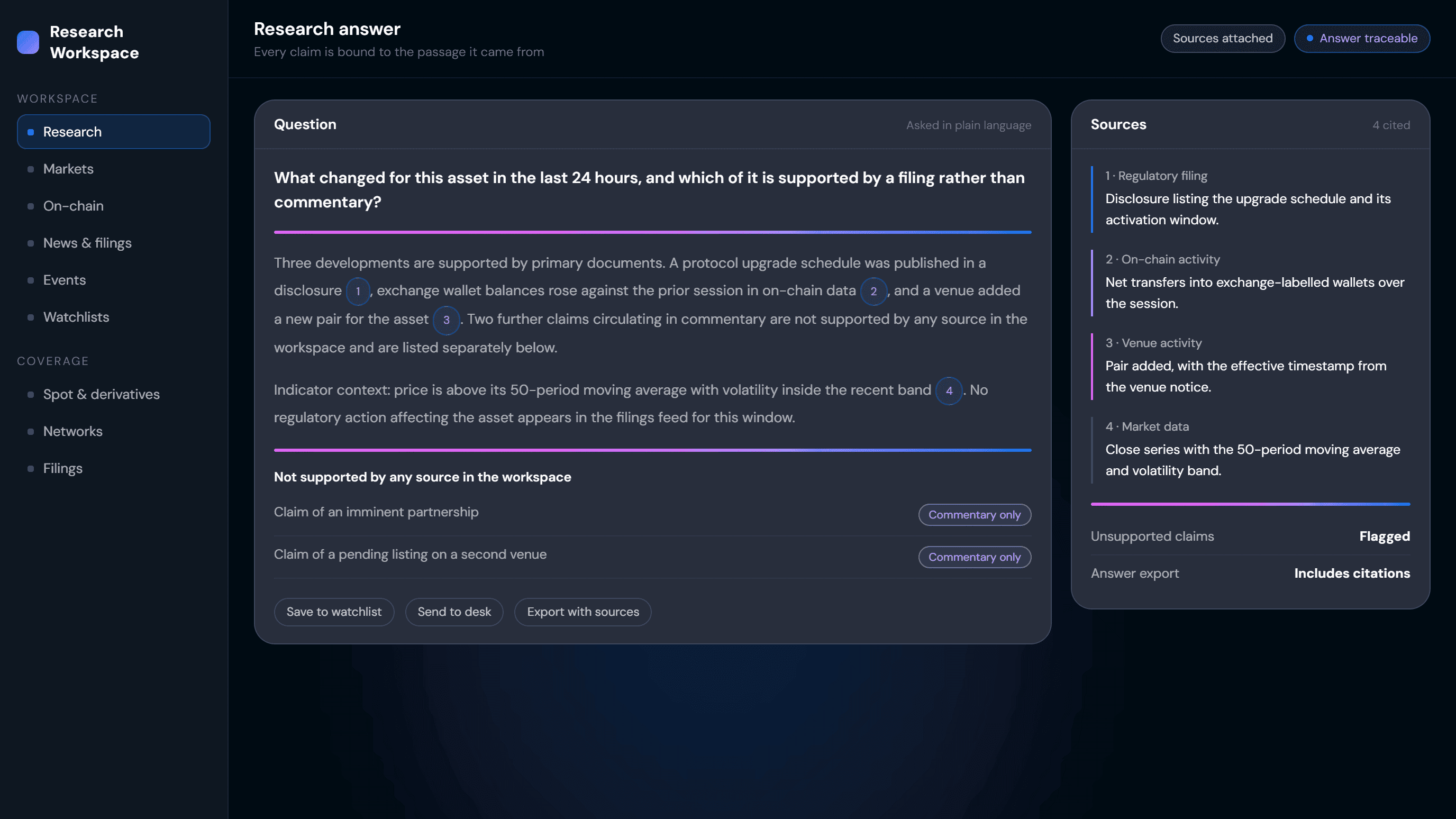
Analysts type the question they would ask a colleague. The engine retrieves across connected sources and binds each claim to the passage, filing or series behind it. Unsupported commentary is listed separately.
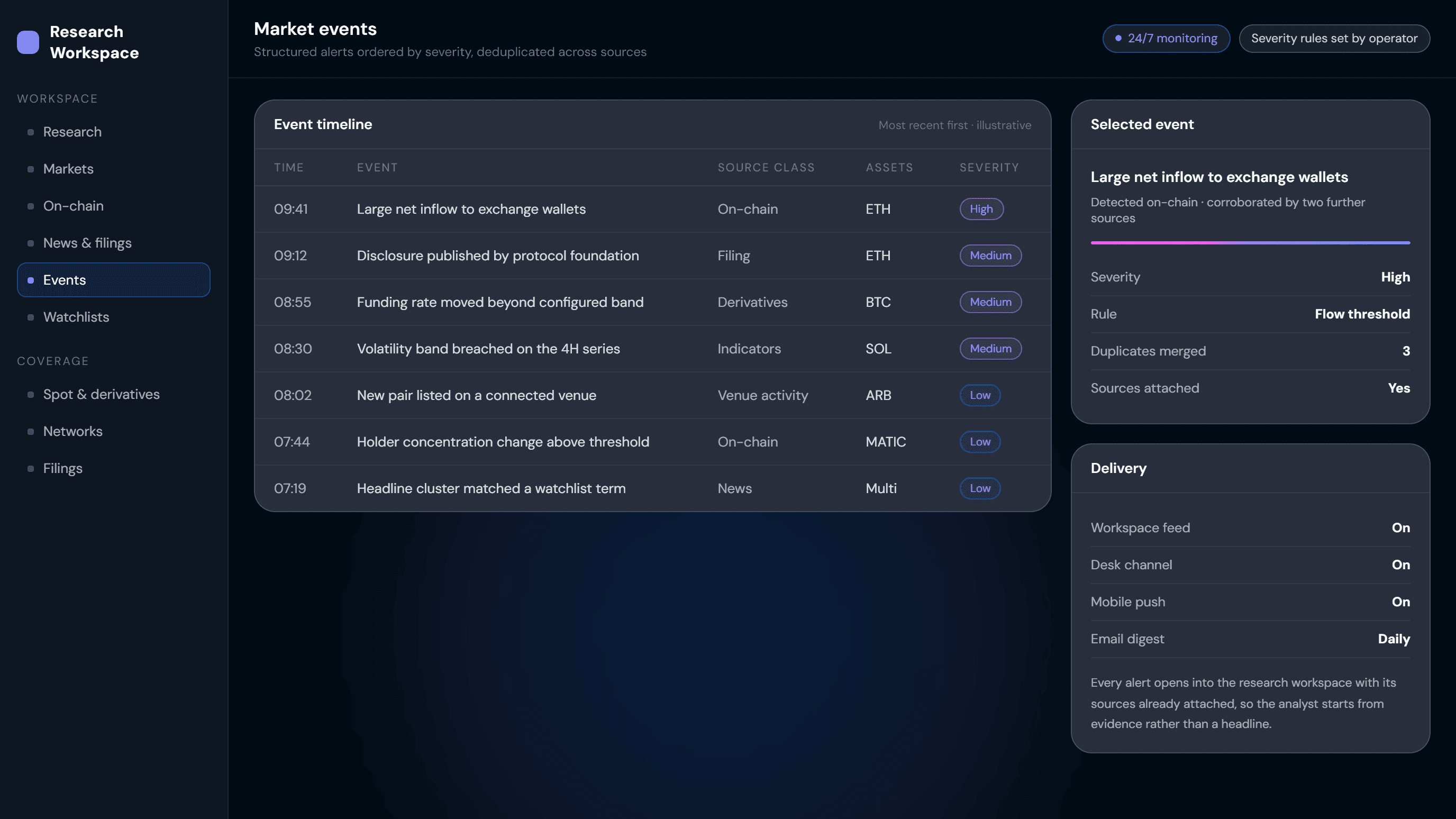
Detection rules run 24/7 over the same feeds: volatility bands, funding thresholds, large flows, holder-concentration shifts, filings, listings and halts. Each firing becomes a structured event with its evidence.
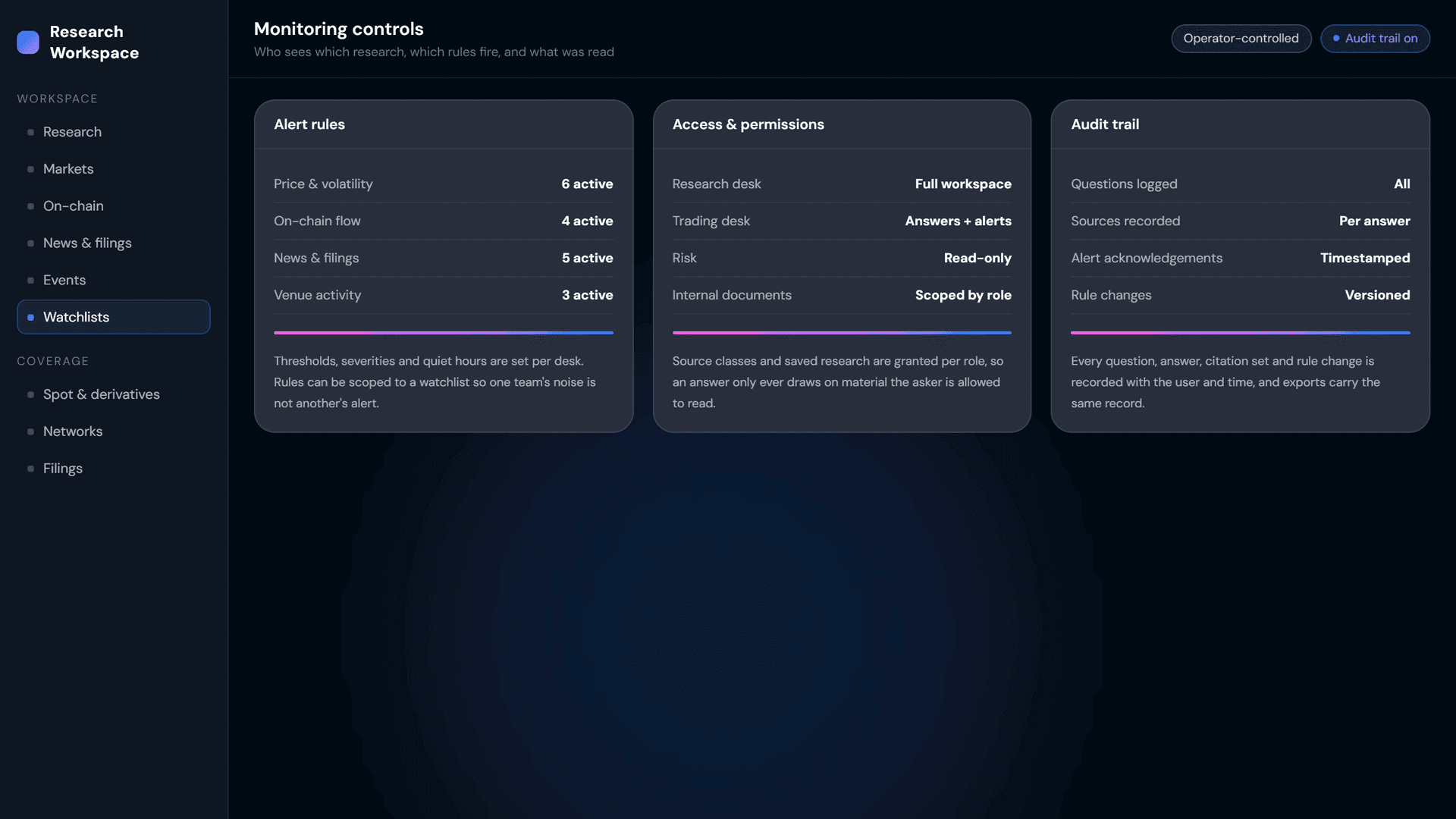
Alerts reach the workspace feed, desk channels, email digests and mobile push. Thresholds, severities and quiet hours are set per desk and watchlist, so risk and market-making are not woken by the same events.
Because the workspace sits on the Coiny platform, a finding is not retyped into another system. Research moves to the desk with its sources intact and continues into pre-trade analytics and the order ticket.
The workspace is one pipeline, not a stack of dashboards: sources in on the left, cited answers and structured alerts out on the right, analyst review in the middle of the loop.
Spot and derivatives pricing with depth snapshots, spreads and session ranges, from the venues the platform already connects to.

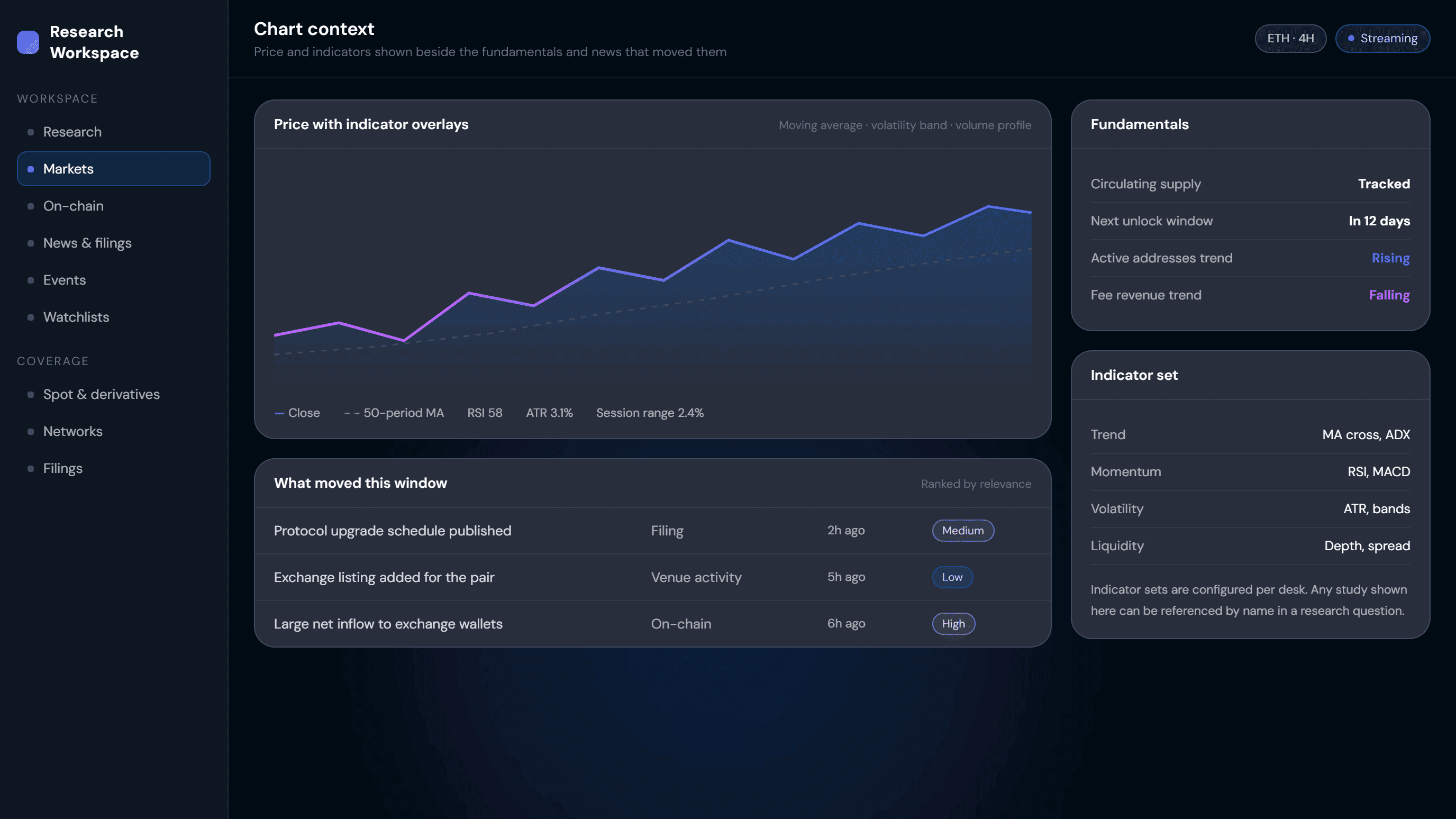
Moving averages, RSI, MACD, ADX, ATR and volatility bands, configured per desk and referenceable by name inside a question.

Band breaches, spread widening and depth changes surfaced as readable context, so the state of the market is legible at a glance.

Funding rates, open-interest shifts and basis moves monitored against your thresholds and tied back to the spot picture.

Supply, unlock calendars, protocol activity and fee-revenue trends tracked per asset, beside the price series they explain.

Disclosures and public register entries ingested as they publish, classified by asset and citable as primary documents.

Headlines and commentary grouped into clusters, so a story reported by twelve outlets arrives as one item with its sources.

Claims backed by a filing or a data series are kept apart from claims that only exist in commentary, visibly so.

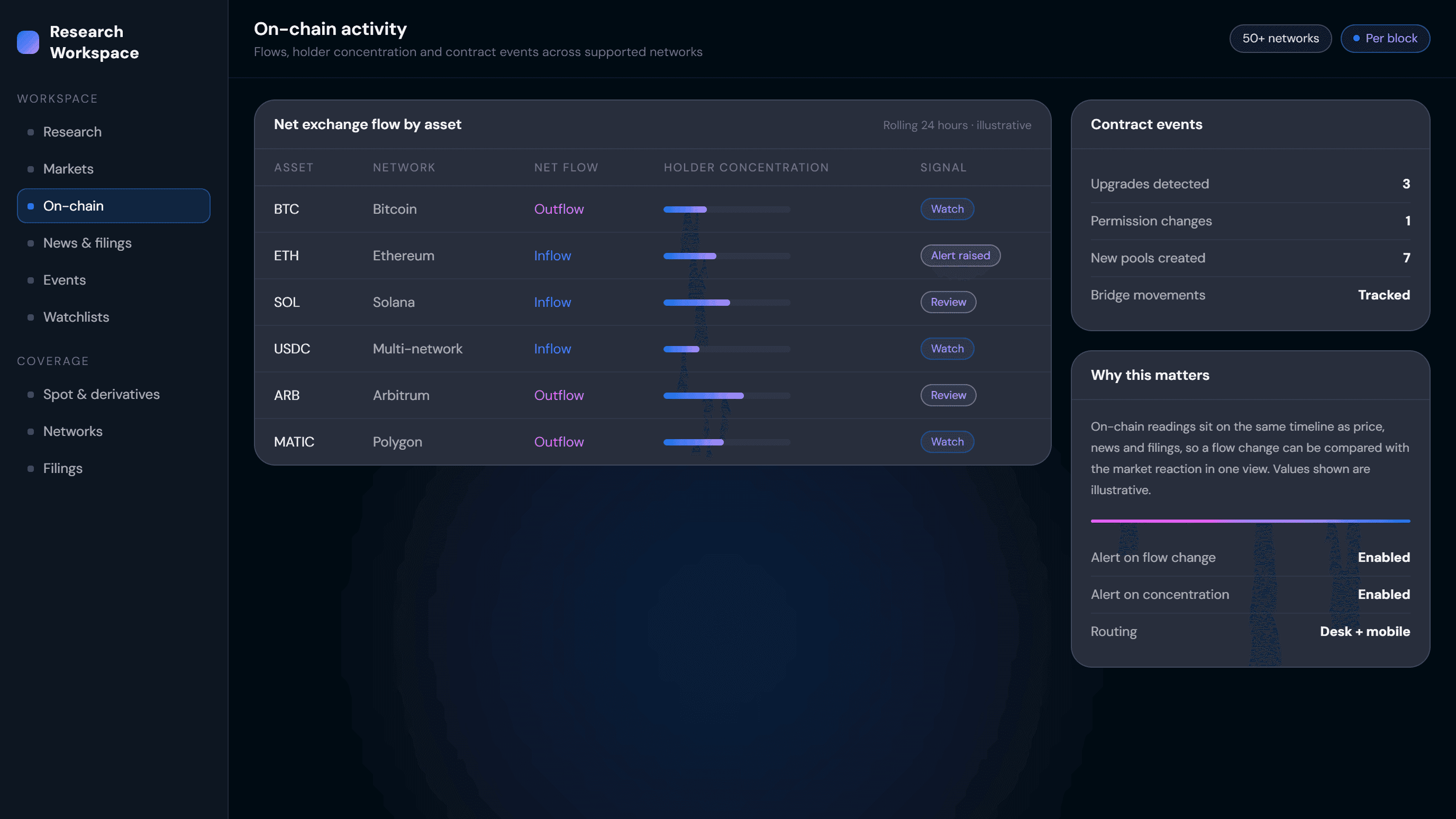
On-chain activity across 50+ networks and 1000+ assets, read per block and normalised onto the same asset model as market data.

Net movement into and out of exchange-labelled wallets, per asset and per network, with thresholds that can raise an alert.

Distribution across holder sets and the changes in it, so a concentration shift is visible before it shows up in price.

Every on-chain reading sits on the shared timeline, so it compares directly with order-book behaviour, filings and news.

Each firing becomes an event record with a rule, a severity, merged duplicates and its evidence — not a bare notification line.

Severities, thresholds, watchlist scope and quiet hours are configured per desk, so alerting matches how each team actually works.

Workspace feed, desk channels, scheduled email digests and mobile push, each opening back into the workspace with sources.

Research, events and coverage data can be exported or read programmatically, so findings feed reporting and downstream systems.
The workspace gathers, normalises, retrieves and monitors; people judge and act. Every automated step ends in something a person can check, which is why each answer ships with its sources and each alert with its evidence.
| # | Research step | The workspace does | Your team decides |
|---|---|---|---|
| 1 | Data collectionSources, freshness, coverage | Ingests and normalises every source classOne timeline, one asset model | Which classes each desk may seePer-role source permissions |
| 2 | AnalysisIndicators, fundamentals, flows | Computes indicators and on-chain readingsContinuously, per asset | Which indicator set the desk trustsConfigured per team |
| 3 | Research answersPlain-language questions | Retrieves, composes and cites every claimUnsupported claims flagged | Whether the evidence is good enoughAnalyst reads the sources |
| 4 | Event detectionRules over live feeds | Fires, scores and deduplicates eventsEvidence attached | Thresholds, severities and quiet hoursSet by the operator |
| 5 | Alert deliveryFeed, desk, email, mobile | Routes each alert to the configured channelsOpens back into the workspace | Who is on which alert routePer desk and watchlist |
| 6 | ActionWhat happens next | Hands the finding on with its sourcesNo retyping between systems | Every trading and risk decisionAlways a person |
Research is only trustworthy if you can see where it came from and who was allowed to ask. Every control below is configured by the operator, not by us.


Research desks, funds, exchange operators and risk teams working from the same evidence, on the same platform.
Answer the question in front of you without stitching four terminals together. Price, flows, filings and news share one timeline.
Build a defensible view from primary documents rather than commentary, with unsupported claims separated and citations exportable.
Offer research and market alerts as a product feature under your own brand, with source classes and permissions per user tier.
Watch concentration shifts, funding moves, filings and venue events continuously, with severity rules and quiet hours per team.
Research that ends in an order ticket only works if the rest of the stack is already there. These are the products the workspace feeds and is fed by.
A crypto market intelligence platform is a research system that brings price, on-chain, news, fundamental and regulatory-filing data into one workspace and turns it into answers and alerts a trading team can act on. Coiny Exchange's Market & Research Intelligence adds source citations to every answer, monitors markets continuously for events, and runs alongside the exchange and execution stack it reports on.
A source-cited research answer is an answer in which every claim is bound to the passage, filing or data series it came from. In Coiny Exchange's Market & Research Intelligence, an analyst asks a question in plain language, the engine retrieves from the connected sources, and the answer returns with its citations attached and anything unsupported flagged separately, so a claim can be checked before anyone trades on it.
Coiny Exchange's research workspace reads price and order-book data, technical indicators, asset fundamentals, news, regulatory filings, venue activity such as listings and funding changes, and on-chain activity across 50+ networks and 1000+ assets. Operators choose which source classes each desk can see, and internal desk documents can be added so private notes sit on the same timeline as public market data.
Real-time market-event monitoring runs detection rules continuously over every connected feed. When a rule fires — a volatility band breached, a large on-chain flow, a new regulatory filing, a venue listing — Coiny Exchange's Market & Research Intelligence records a structured event with a severity, merges duplicates reported by more than one source, and attaches the evidence, so the alert arrives as context rather than a headline.
Alerts from Coiny Exchange's Market & Research Intelligence are delivered to the workspace feed, to desk channels, to email digests and as push notifications in the operator's mobile trading apps. Every delivery opens back into the workspace with the event's sources already attached, so a trader acting on a phone sees exactly the evidence an analyst sees at a desk.
Operators control the research workspace: source classes, saved research and alert rules are granted per role, so an answer only ever draws on material the person asking is permitted to read. In Coiny Exchange's Market & Research Intelligence, every question, answer, citation set and rule change is recorded with the user and timestamp, and exports carry the same record for review.
Walk through the workspace on your own asset list — source coverage, a cited answer end to end, the event timeline, and the operator controls behind them.
Book a Demo