Token Due Diligence & Asset Risk for Exchange Listing Decisions
It answers one question — should we list this asset — with a sectioned report, a severity on every finding, and a decision record your committee can point at a year later. It is not an independent audit or a certification that a contract is safe.
Screen Your Next Asset
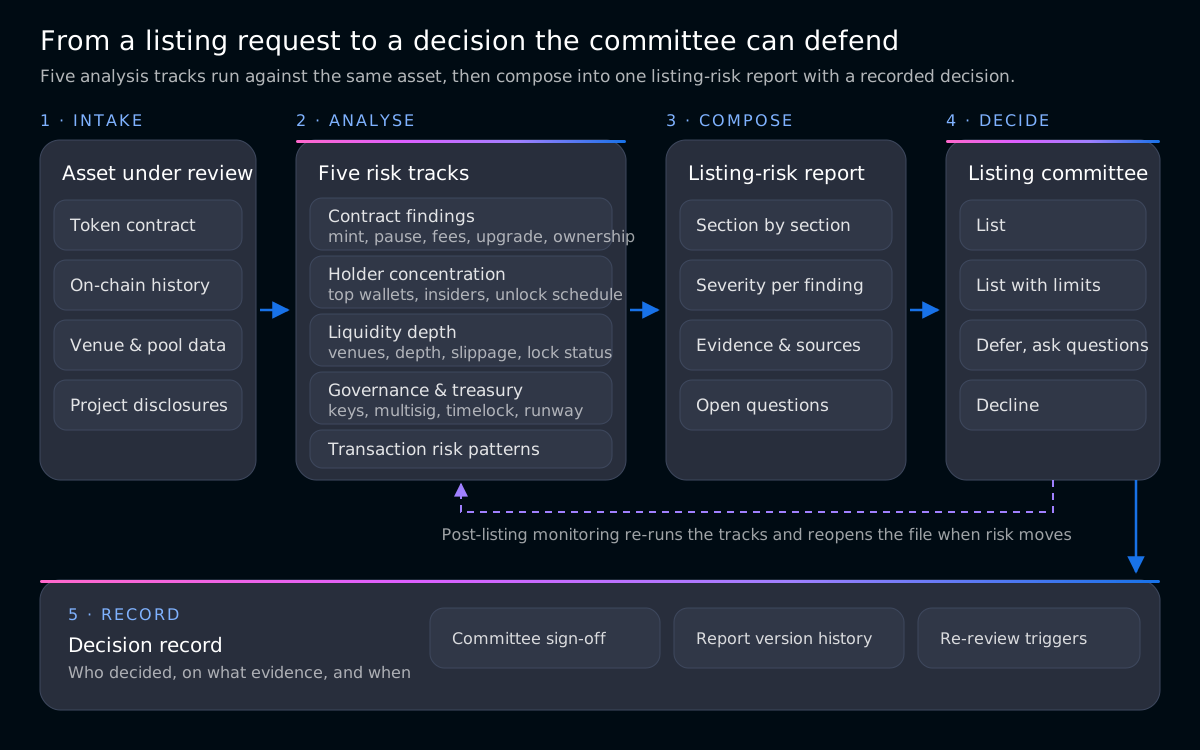
How a Listing Request Becomes a Decision You Can Defend
Five stages, one report, one record. The committee argues about risk appetite, not about whether anybody checked.
Take in the asset
The contract, its on-chain history, the venues and pools it already trades on, and whatever the project disclosed are pulled into one file. Every later finding cites the source it came from.
Run five analysis tracks
Contract behaviour, holder concentration, liquidity depth, governance and treasury, and transaction-risk patterns are assessed against one framework — the same checks for a large project and an unknown one.
Compose the listing-risk report
Findings are written up section by section with a severity, the evidence, and what each would mean on your venue. Anything the analysis cannot settle becomes an open question to the project.
Put it in front of the committee
The report arrives complete, thresholds already applied: which findings force a vote, which trigger position limits, which decline the asset. Members read one document, not three spreadsheets.
Record the decision, then keep watching
List, list with limits, defer with questions, or decline — the outcome is stored with the report version, the voters and the date. After listing, monitoring re-runs the tracks and reopens the file when a trigger fires.
Five Analysis Tracks, One Report, One Record
The whole path from a listing request to a decision that is still legible when someone reopens it next year.
Six Things Worth Knowing Before You List an Asset
Each one is a section of the report, assessed the same way on every asset so two reviews can be compared.

Contract analysis
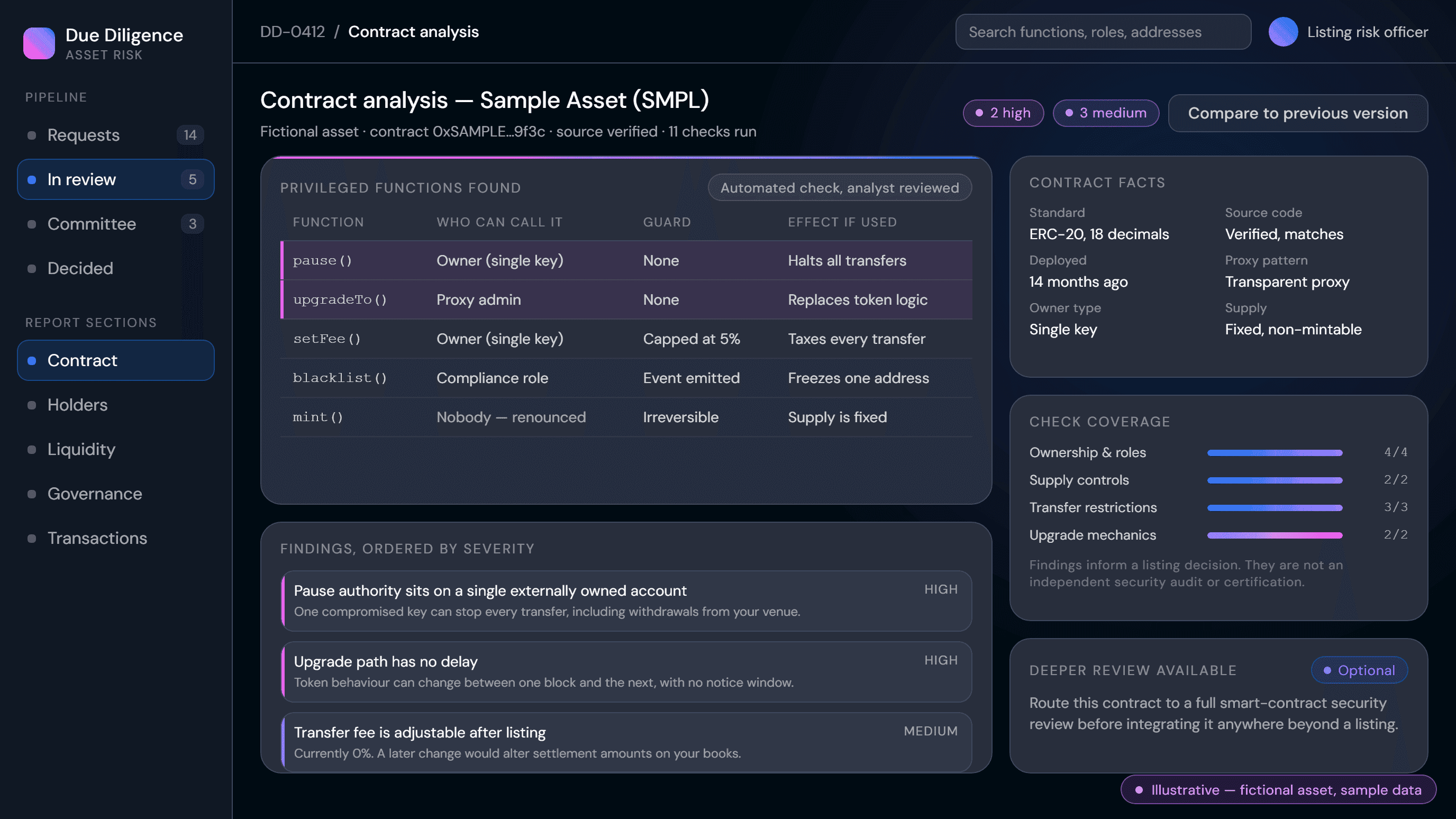
Every privileged function in the deployed contract, with who can call it, what guards it and what it would do on your venue. Pause authority, upgrade paths, adjustable fees and mint controls carry a severity.

Holder concentration
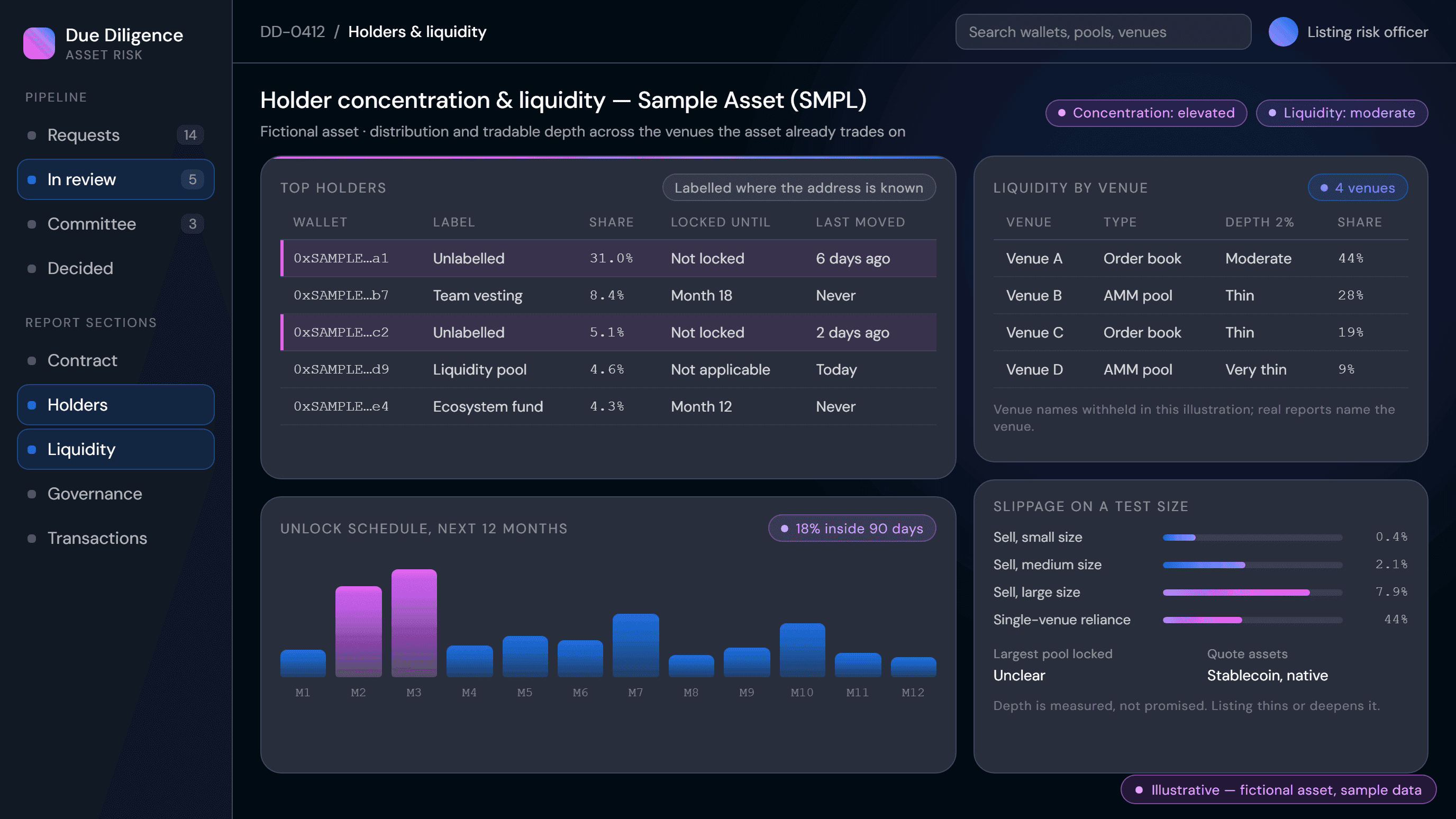
Top holders with labels where the address is known, the top-ten share, the portion identified as team or insider supply, and the unlock schedule ahead. Concentration is read together with what can actually move, and when.

Liquidity depth
Where the asset trades today, how much depth sits near the touch on each venue, what a test-size sell costs in slippage, and how much of the total depends on a single venue or pool. Depth is measured, never assumed.

Governance & treasury
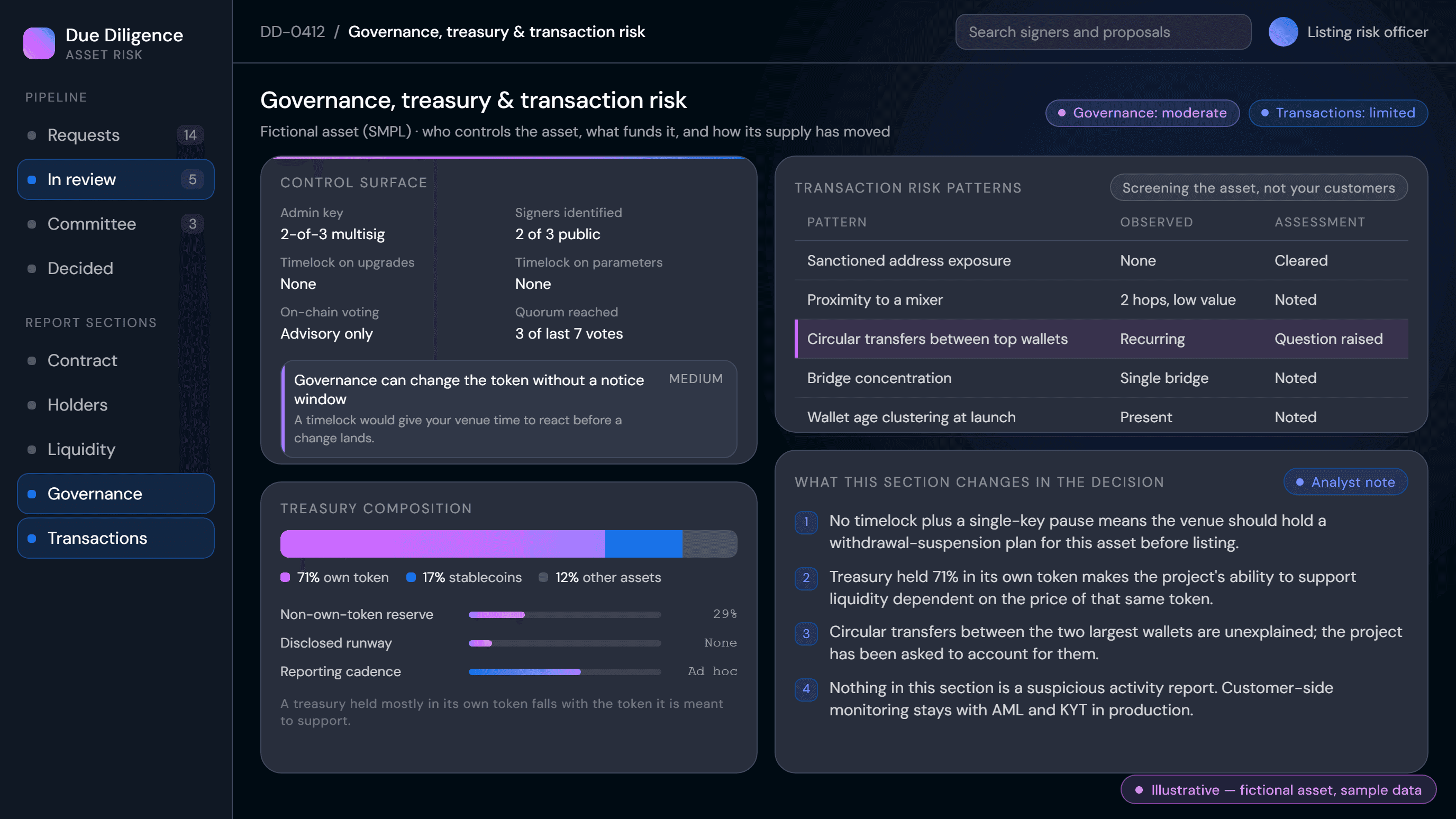
Who holds the admin keys, whether upgrades and parameter changes pass through a timelock, how governance actually decides, and what the treasury is held in. A treasury denominated in its own token falls with the token it exists to support.

Transaction risk patterns
The asset's own on-chain history: sanctioned-address exposure, proximity to mixers, circular transfers between large wallets, bridge concentration and wallet-age clustering at launch. This screens the asset, not your customers.

Listing-risk report
All of it composed into one document with a severity per finding, the evidence behind each, open questions for the project, and a decision record naming who decided what, on which report version, and when.
What Your Listing Committee Actually Reads
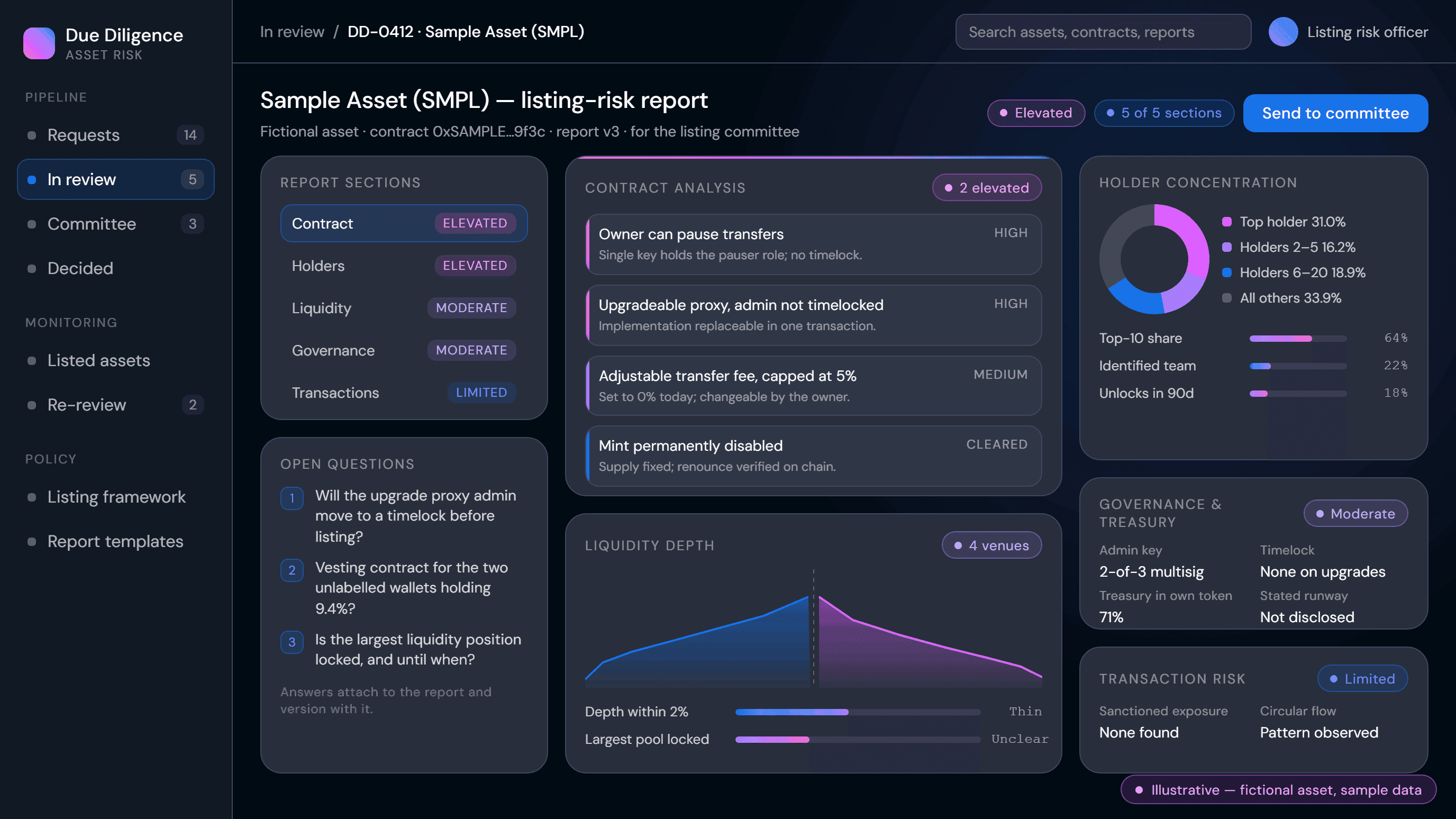
The report is the product. Every screen below shows an illustrative review of a fictional asset with sample data — no real token is named, and no risk finding here is attributed to any real asset.
Listing-risk report five sections, one verdict
Contract findings, holder concentration, liquidity, governance and transaction risk on one screen, each with its own risk band. The committee sees where the asset is difficult before reading a word of detail.
- Section index with a risk band on each of the five sections
- Contract findings ordered by severity, cleared items included
- Concentration, unlocks and measured depth side by side
- Open questions addressed to the project, versioned with the report
The Five Sections, and What Each One Decides
Every report carries the same five sections in the same order, so two assets reviewed months apart can be compared. The takeaway: each section answers a different failure mode, and a listing decision needs all five — a clean contract on a token nobody can sell is still a bad listing.
| # | Report section | What it assesses | What the committee gets |
|---|---|---|---|
| 1 | Contract analysiscan the owner change the rules | Privileged functions, ownership, upgrade path, transfer restrictions, supply controls | Findings with severity and venue impactplus the option to route on to a deeper security review |
| 2 | Holder concentrationwho can sell, and when | Top holders, labelled addresses, insider supply, vesting and unlock schedule | Distribution with an unlock timelineso limits can be sized to what is about to move |
| 3 | Liquidity depthcan it be sold at all | Venues, measured depth near the touch, slippage on test sizes, pool lock status | Depth per venue and single-venue reliancethe basis for quote-size caps at listing |
| 4 | Governance & treasurywho is behind it | Admin keys, signers, timelocks, voting behaviour, treasury composition and disclosure | Control surface and treasury qualitythe notice window your venue would actually get |
| 5 | Transaction riskwhat the history shows | Sanctioned exposure, mixer proximity, circular transfers, bridge concentration, launch clustering | Screened patterns with an assessmenton the asset itself, separate from customer monitoring |
Thresholds, Approvers and Re-Review Triggers You Set Yourself
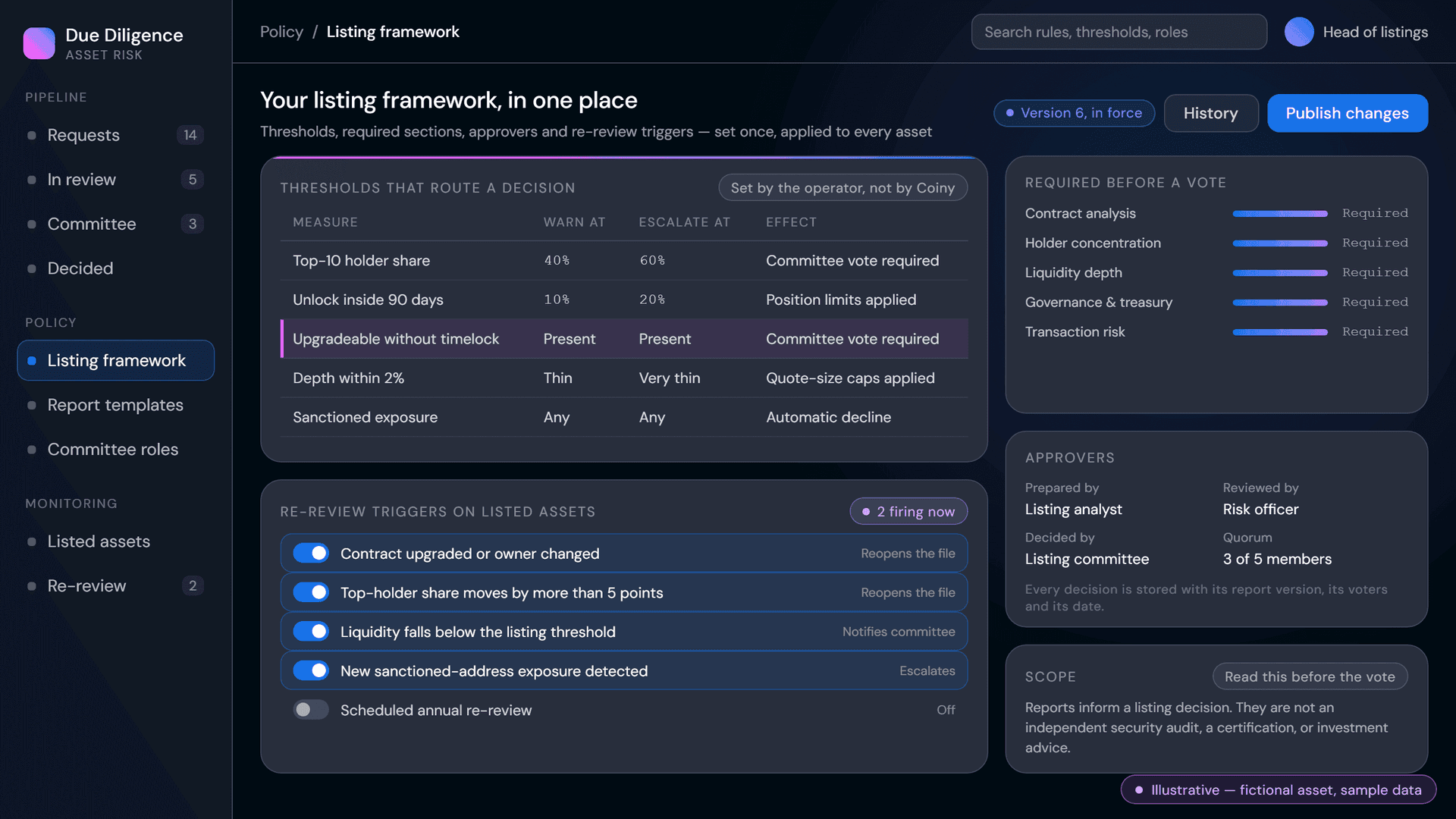
The analysis is the same for every asset; the risk appetite is yours. Set the thresholds once and every report arrives with them already applied, so a decision is consistent whether it is the first listing of the quarter or the fortieth.
What a Due Diligence Report Is, and What It Is Not
Coiny produces due-diligence reports and risk assessments that inform a listing decision. It does not certify that a contract is safe, does not issue audit certificates, does not act as an independent auditor, and does not give investment advice. Every finding is evidence for your committee; the risk appetite, the decision and the accountability stay with the operator. Any example asset shown on this page is fictional, with sample data.
Where Token Due Diligence Sits in the Coiny Stack
Listing risk is one decision among several. These are the pieces around it.


The People Who Sign Off on What Gets Listed
Listing risk is bought by whoever has to explain the listing afterwards — not by whoever wants the volume.
Listing committees
Every asset assessed against the same framework, so a decision comes down to risk appetite rather than who looked at the contract.
Risk officers and heads of listings
Need a report that stands up when a listed asset goes wrong, and a record showing what was known, who decided, and on what evidence.
White-label operators
A listing framework from day one, because a new venue is asked to list unfamiliar assets long before it has a research team.
Exchanges with a growing listed set
A growing listed set is a growing surveillance surface: re-review triggers reopen a file rather than waiting for a complaint.
Token Due Diligence FAQ
An exchange should check five things before listing a token: what the contract lets its owner do, how concentrated the supply is and when it unlocks, how much real liquidity exists and on which venues, who controls governance and what the treasury is held in, and what the token's own transaction history looks like. Coiny Exchange's token due diligence runs all five as one review and returns a single listing-risk report, so the committee decides on the same evidence every time.
Token due diligence is the review an exchange runs on an asset before deciding whether to list it, covering contract behaviour, supply distribution, liquidity, governance, treasury and on-chain transaction patterns. Coiny Exchange produces that review as a sectioned listing-risk report with a severity on every finding, the evidence behind it, and the open questions the project still has to answer, so a listing committee can approve, restrict, defer or decline on a documented basis.
The common red flags in a token contract are an owner who can pause or block transfers, an upgrade path with no timelock, an adjustable transfer fee, unrestricted minting, and hidden blacklist or allowlist controls. Coiny Exchange's contract analysis lists every privileged function it finds with who can call it, what guards it, and what would happen on your venue if it were used — for example, a single-key pause that could stop customer withdrawals mid-session.
Holder concentration is measured by the share of supply held by the largest wallets, adjusted for which of those wallets are contracts, pools, exchanges or vesting schedules rather than people who can sell tomorrow. Coiny Exchange's report shows the top holders with labels where the address is known, the top-ten share, the portion identified as team or insider supply, and the unlock schedule ahead — because concentration only becomes a listing problem when it can move.
No. A token due diligence report is a listing-decision document; a smart contract audit is an independent security engagement that Coiny Exchange does not provide or certify. Coiny's contract analysis reads the deployed contract for the behaviours that affect a venue — privileged functions, upgrade paths, transfer restrictions — and reports them with severity. For depth on protocol code, access control, oracle and bridge risk before integration, Coiny offers smart-contract security reviews and risk assessments as a separate service.
Token due diligence screens the asset's own transaction patterns before listing; AML and KYT monitoring screens your customers' transactions in production, continuously. Coiny Exchange's due diligence looks at sanctioned-address exposure, mixer proximity, circular transfers between large holders and bridge concentration in the token's history, as one section of a listing report. Customer identity, sanctions screening and suspicious activity reporting stay with the AML, KYC and KYT compliance infrastructure.
A listed asset should be re-reviewed whenever something in the original decision stops being true, not on a calendar alone. Coiny Exchange monitors listed assets for contract upgrades, owner changes, large moves in holder concentration, liquidity falling below the listing threshold and new sanctioned-address exposure, and reopens the file when one of those triggers fires — so the delisting conversation starts from an updated report rather than from a support ticket.
Yes. Every threshold in Coiny Exchange's listing framework belongs to the operator: the holder-concentration levels that warn or escalate, the unlock percentage that triggers position limits, the depth below which quote sizes are capped, which findings force a committee vote, and which conditions decline an asset outright. Coiny supplies the analysis, the report and the workflow; the risk appetite and every listing decision remain the operator's.
Ready to Put Your Next Listing Through a Real Review?
Book a walkthrough of the report, the five analysis tracks and the listing framework — and we will set the thresholds against the risk appetite your committee already works to.
Book a Demo