DEVELOPER PLATFORM

Crypto Exchange APIs Your Team Can Actually Build On

Coiny's APIs provide REST and WebSocket access to trading, market data, and strategy connectivity, with SDKs, webhooks, authentication, rate limits, and a test environment provisioned during integration. Every endpoint your exchange runs on is an endpoint your engineers can call — the same matching engine, the same accounts, the same market data — under keys you scope, allowlist and revoke yourself.

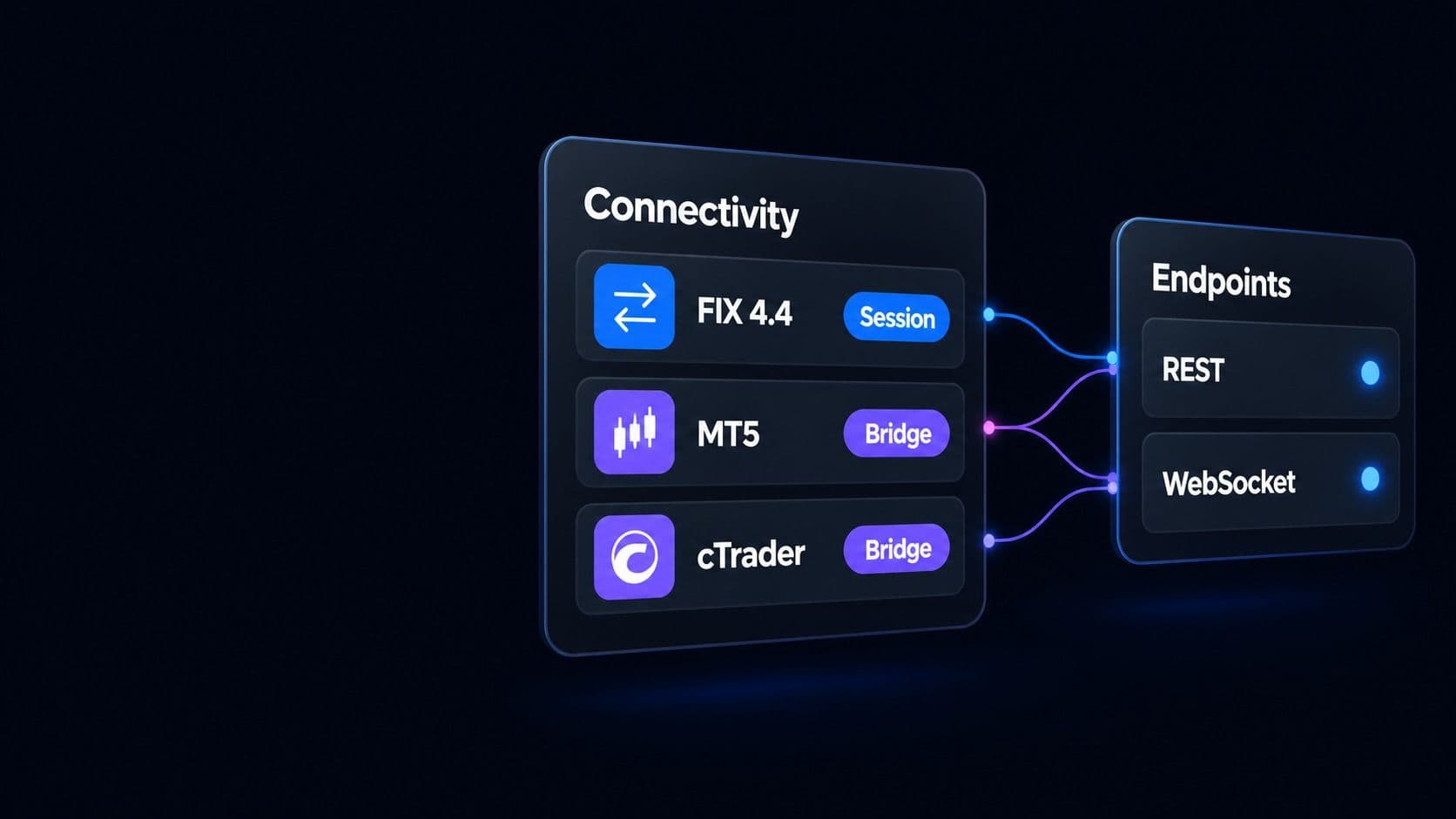
A connectivity card listing a FIX 4.4 session and MT5 and cTrader bridges, beside REST and WebSocket endpoints
  • REST and WebSocket

    Request and response for orders, balances, transfers and reference data. Streaming sockets for order books, trades, tickers and your own private order and fill events.

  • SDKs and CCXT

    Comprehensive REST, WebSocket and CCXT SDK support with documentation, so a desk already trading through CCXT points the same client at your venue and keeps its code.

  • Signed webhooks

    Deposits, fills, verification results and settlement are pushed to your endpoint, signed and sequenced, so your services stop polling for things that have already happened.

  • Keys, scopes and limits

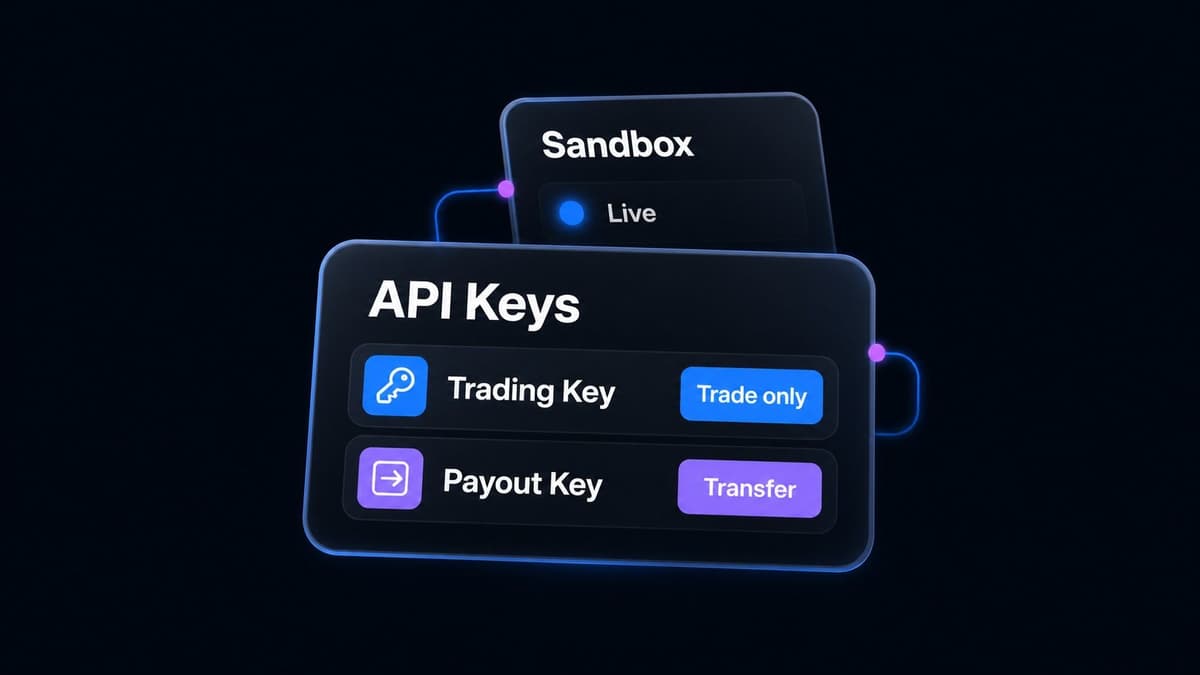
    Read, trade and transfer are separate grants. Every key carries an IP allowlist and a rate-limit band, and revoking one takes effect on the next request.

THE SURFACE, LAYER BY LAYER

Four Ways In, One Exchange Behind Them

There is no second-class API here. The platform's own trading screens, mobile apps and admin console call the same endpoints your integration will, which is why the surface is complete rather than a subset published for partners.

REST API
SYNCHRONOUS

REST API

Place, amend and cancel orders; read positions, balances, transfers, deposits and withdrawals; pull the reference data that tells you what a market allows — symbols, tick sizes, fee tiers and order limits. Requests are idempotent on your own client order id, so a retry after a timeout cannot double-fill a position.

1 of 4
ARCHITECTURE

Every Call Passes Through One Gate

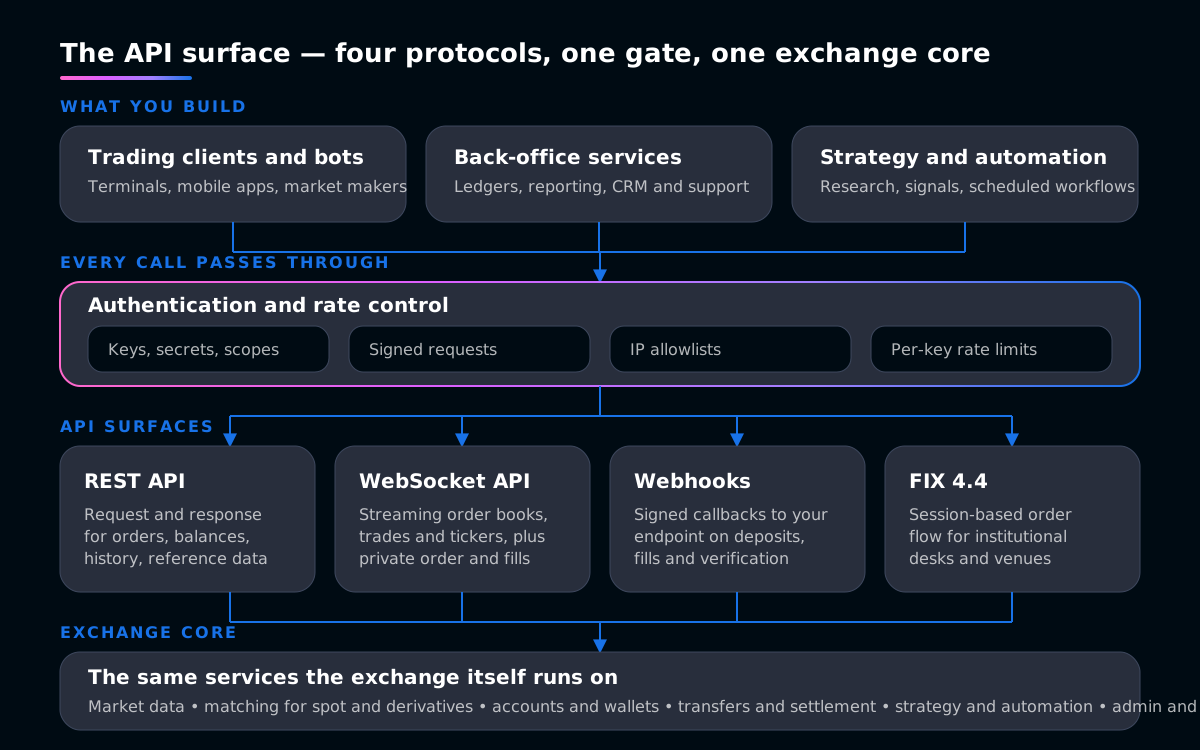
Authentication and rate control are not per-endpoint decisions bolted on later. They sit in front of the whole surface, which is why a scope granted on a key means the same thing whether the call arrives over REST, a socket or a FIX session.

Diagram: REST, WebSocket, webhook and FIX 4.4 API surfaces sitting over one authentication and rate-control gateway, which fronts the exchange core of market data, matching, accounts and operations services

Client applications reach four surfaces — REST, WebSocket, webhooks and FIX 4.4 — through a single authentication and rate-control gate, which fronts the same exchange core the platform itself runs on: market data, matching for spot and derivatives, accounts and wallets, transfers and settlement, strategy and operations.

WHAT TEAMS BUILD

Four Integrations That Start on Day One

These are the four shapes an integration usually takes. Each one is a different combination of the same surfaces, and each has a deeper product page behind it.

TRADING CLIENTS

Trading front ends, terminals and bots

Order entry over REST, live books and fills over the socket, and a scoped key per bot so a strategy that misbehaves is revoked on its own.

  • Order entry, amend and cancel over REST
  • Order book, trade and ticker streams
  • Private order, fill and balance channels
RESTWebSocketCCXT
Learn more
BACK OFFICE

Ledgers, reporting and support tooling

Read-only keys feed your accounting, reconciliation and CRM systems, and webhooks push deposits, withdrawals and settlement state as they happen rather than on a nightly export.

  • Read-only keys with no trade or transfer scope
  • Deposit, withdrawal and settlement webhooks
  • Transfer and statement history over REST
RESTWebhooks
Learn more
STRATEGY

Research and strategy deployment

Pull historical and live market data for research, then deploy an approved strategy through the same authenticated endpoints that carry its fills back.

  • Market data for research and live execution
  • Strategy deployment and state over REST
  • Fills and position updates over the socket
RESTWebSocket
Learn more
VENUE CONNECTIVITY

Institutional and platform connectivity

Desks whose order management system already speaks FIX 4.4 connect over a session rather than an HTTP client. Trading platform bridges and liquidity, payment and compliance providers are catalogued separately.

  • FIX 4.4 sessions for institutional order flow
  • Normalized messaging and hedge account visibility
  • Provider connectivity handled during onboarding
FIX 4.4MT5cTrader
Learn more
THE SURFACE, IN FULL

Every Protocol, How You Authenticate, What Limits It

The three questions a technical evaluator opens this page with, answered in one table: what can I call, how do I prove who I am, and what happens when my integration gets busy. The short version is that authentication and limits are per key on every surface — nothing here is enforced at the account level.

#SurfaceWhat it carriesAuthenticationLimits and controls
1REST APIOrders, balances, transfers, deposits, withdrawals and reference dataidempotent on your client order idAPI key, timestamp and request signature, sent as headersPer-key rate-limit band, scoped permissions, optional IP allowlist
2WebSocket — publicOrder book deltas, trades, tickers and candlessubscribe per instrument and channelNone — public market dataConnection and subscription limits per client
3WebSocket — privateYour own order updates, fills and balance changesthe same events, pushed instead of polledThe same key as REST, authenticated on connectScoped to that key: a read-only key can watch, never send
4WebhooksDeposits, withdrawals, fills, verification results and settlementsequenced, and replayable from the delivery logSigned payload your endpoint verifies before actingRetried with backoff until your endpoint acknowledges
5FIX 4.4Institutional order flow and market data over a sessionfor desks whose OMS already speaks FIXSession logon with credentials issued per counterpartySession-level throttling and permissioned message types
6Test environmentThe same four surfaces, against isolated dataprovisioned as part of your integrationSeparate keys that resolve only in that environmentNo flag promotes a test key into production
IN THE CONSOLE

What the Integration Actually Looks Like

Three screens cover most of what an engineering team needs to see before committing: how a call is authenticated and what comes back, how permissions are cut per key, and what happens to an event when your endpoint is having a bad afternoon.

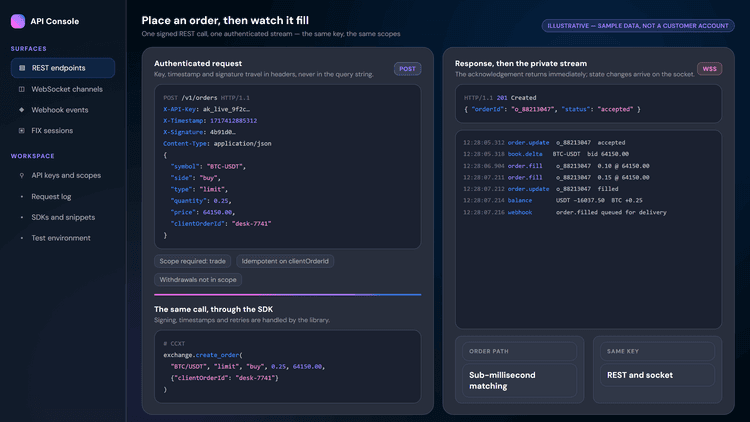
One signed call, then the stream
1/ 03

One signed call, then the stream

A single REST call places the order and returns an acknowledgement immediately. Everything after that — acceptance, partial fills, the final state, the balance change and the webhook queued for delivery — arrives on the authenticated socket under the same key. The SDK path is the identical call with signing, timestamps and reconnection handled by the library.

INTEGRATION QUESTIONS

What Engineering Teams Ask Before They Commit

The questions that decide whether a platform is buildable-on, answered plainly. If yours is not here, an integration engineer will answer it directly rather than pointing you at a form.

  • Can we start building before the platform is live?Yes. An isolated test environment is provisioned as part of the integration, with its own keys that resolve only there. Your team builds and tests against the same four surfaces while the production deployment is still being configured.
  • What happens when a key is compromised?Revoke it. Revocation takes effect on the next request, and because every key is scoped and allowlisted separately, nothing else in your estate stops working. Requests are logged per key, so the blast radius is knowable rather than assumed.
  • Will an API change break our integration?The surface is versioned, and version changes are communicated before they ship rather than discovered in production. Reference data is retrieved from the API rather than hard-coded, so new instruments and fee tiers appear without a client release.
  • Can a trading key move funds off the platform?Not unless you grant it. Transfer is a separate scope from trade and is off by default, so the key your market-making engine uses cannot initiate a withdrawal even if the engine is compromised.
  • How do we handle a bad connection mid-session?REST calls are idempotent on your own client order id, so a retry after a timeout cannot double-fill. Socket subscriptions resume, and webhook events carry a sequence number so a replayed or late delivery is detectable rather than double-counted.
Talk to an Integration Engineer
WHERE THIS CONNECTS

The Rest of the Developer Surface

This page covers what you build against. Which third-party systems Coiny connects to, the research infrastructure behind the strategy endpoints, and the agent-facing layer above them all live on their own pages.

FIX, MT5 & cTrader connectivity

The integrations catalogue: trading platform bridges, liquidity providers, and the payment, identity and support systems Coiny wires into every deployment.

strategy APIs

The research infrastructure behind the strategy endpoints: historical market data, backtesting, walk-forward and robustness analysis.

AI agent trading infrastructure

The layer above the classic API surface: a trading harness, MCP connectivity, model orchestration and tool connectors, governed by permissions, guardrails and audit logs.

developers & integrations

The hub for everything a technical evaluator needs: the API surface on this page, the integrations catalogue, and the intelligence developer platform, with the split between them stated rather than left to guesswork.

COMMON QUESTIONS

API, SDK and Test Environment Questions

Coiny Exchange provides a full developer API surface: a REST API for orders, balances, transfers and reference data, a WebSocket API for streaming market data and private order events, signed webhooks, and FIX 4.4 session connectivity for institutional desks. Testing is handled through an isolated test environment provisioned as part of your integration rather than a public self-service sandbox, with its own keys that resolve only there. Ask for API access and test credentials when you book a technical walkthrough.

A crypto exchange API is the programmatic interface through which software places orders, reads market data and manages accounts on a digital-asset trading venue, without a human using the trading screen. Coiny Exchange exposes that interface across four surfaces: REST for request-and-response operations, WebSocket for streaming data and private order events, webhooks for events the platform pushes to you, and FIX 4.4 for institutional order flow. All four are governed by the same keys, scopes and limits.

Authentication on the Coiny Exchange API uses an API key and secret issued per integration. Private requests carry the key, a timestamp and a signature in headers, never in the query string, and the same key authenticates the private WebSocket channels. Each key is scoped separately for read, trade and transfer, carries an optional IP allowlist enforced at the gateway, and can be rotated or revoked on its own without disturbing any other integration.

The REST API answers a question you ask; the WebSocket API tells you when something changes. On Coiny Exchange you place, amend and cancel orders and read balances, transfers and reference data over REST, then subscribe over WebSocket to order book deltas, trades, tickers and candles, plus your own order updates, fills and balance changes on an authenticated channel. Production integrations use both: REST to act, sockets to stay current without polling.

Rate limits on Coiny Exchange are applied per API key rather than per account, so one busy integration cannot starve another. Each key is issued in a limit band that suits what it does — a market-making engine and a nightly reporting job do not need the same headroom — and the band is set for your deployment during integration. A key that exceeds its band is throttled and told so in the response rather than being disconnected mid-session.

Coiny Exchange ships comprehensive REST, WebSocket and CCXT SDK support with documentation. CCXT is the industry-standard crypto trading library, so a team already running strategies through it points the same client at your venue and keeps its existing code: request signing, timestamps and reconnection are handled by the library rather than written again. Teams that prefer to call the endpoints directly work from the same documented request and response shapes.

Webhooks invert the direction of the integration: instead of your service polling Coiny Exchange for changes, the platform posts events to an HTTPS endpoint you register. Deposits confirmed, withdrawals changing state, orders filled, identity verification results and settlement completions each arrive as a signed, sequenced payload. Verify the signature before acting on it, and replay any delivery from the log while you are still building against it.

BUILD ON IT

Get API Access and a Technical Walkthrough

Bring your architect and your integration lead. We will walk the REST and WebSocket surfaces, the webhook event catalogue, the key and scope model and the rate-limit bands against your actual use case, and provision a test environment so your team can start building before the platform is live.

Book a Demo