Crypto Execution Algorithms That Work Large Orders and Rebalance Portfolios
Smart Execution & Portfolio Automation provides TWAP, VWAP, smart order routing, and large-order splitting, plus portfolio rebalancing with cost previews and human approval. This is the layer that does the trading.
See the Execution Toolkit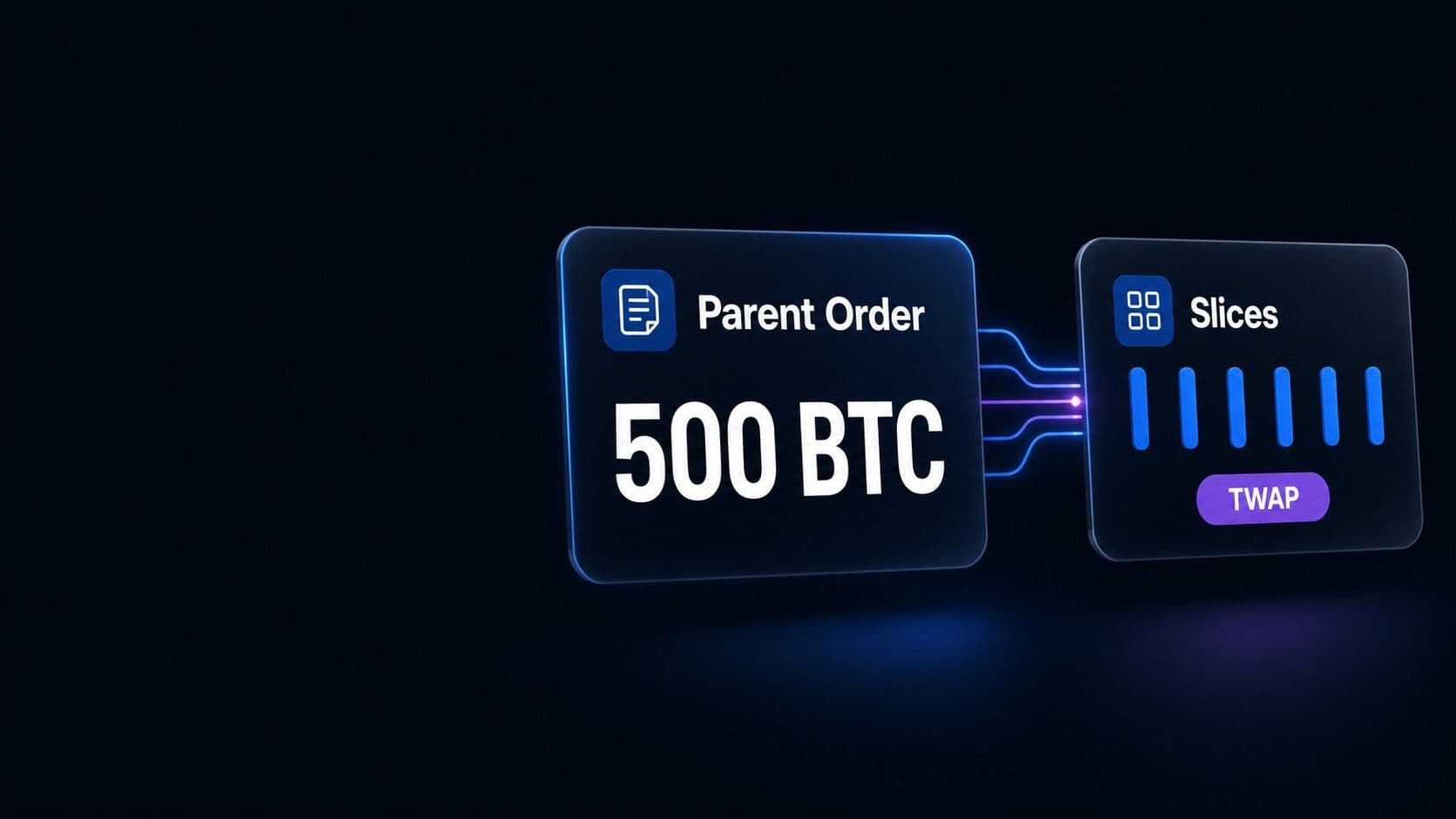
Six Engines, One Order Path
Every capability below writes into the same parent-order record, runs inside the same operator limits, and reports through the same execution log. Deploy the whole toolkit or switch on the parts a desk actually needs.

TWAP and VWAP Schedules
Even pacing by the clock or volume-paced pacing by the tape, with configurable windows, adaptive slice intervals and randomisation so the pattern is not readable.

Large-Order Splitting
One parent order becomes many child orders sized as a share of the visible book, so the order never has to clear the depth standing in front of it.

Smart Order Routing
Each slice is sent to the venue with the best live depth, spread and fee-adjusted price at that moment, inside per-venue caps and an operator allowlist.

Signal Execution
Signals from strategies, models and external providers arrive as parent orders with a tactic and limits already attached, checked before anything is sent.

Portfolio Rebalancing
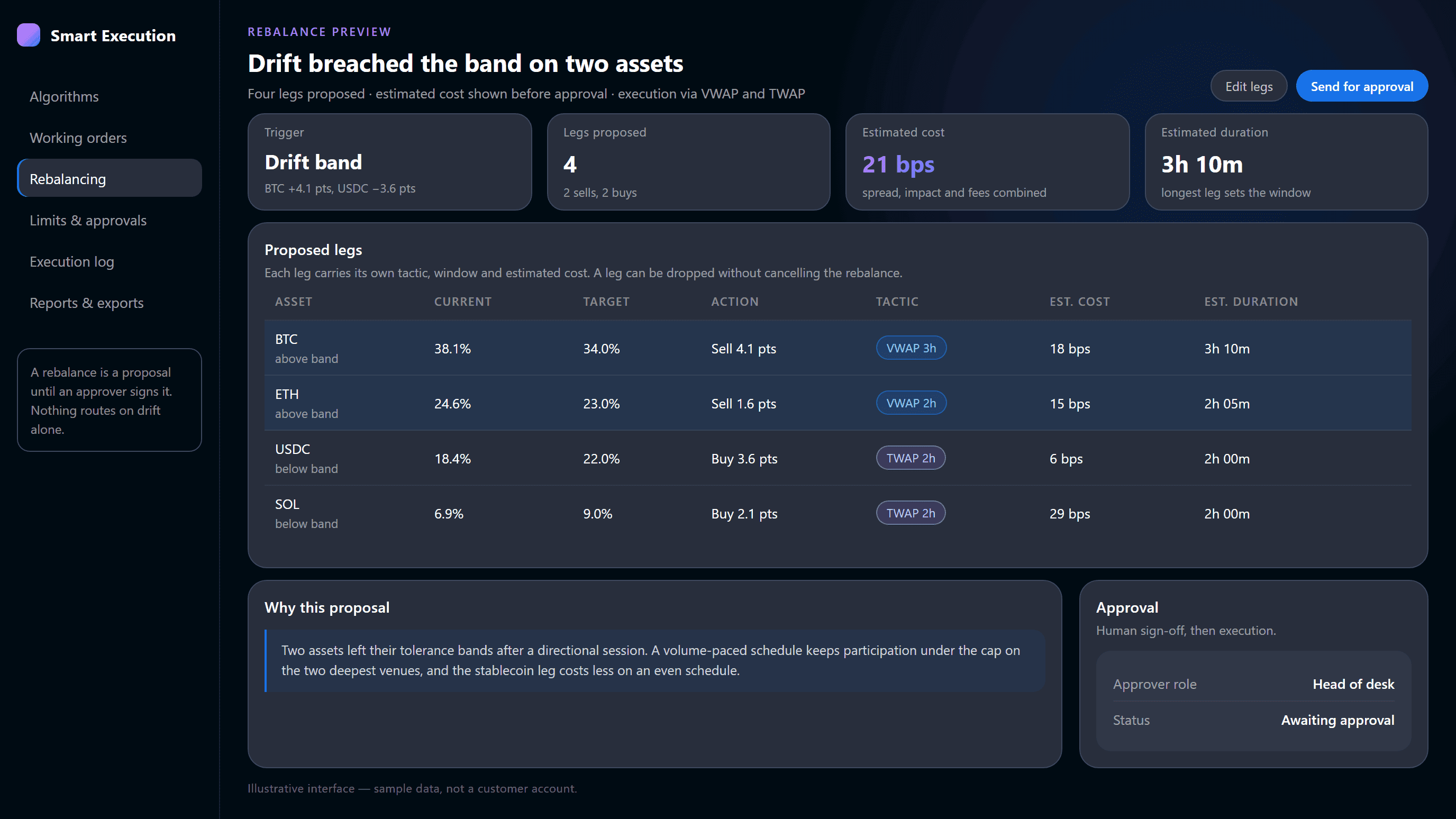
Drift outside a tolerance band becomes a set of proposed legs with an estimated cost and duration, executed only after a named approver signs it.

Execution and Exposure Limits
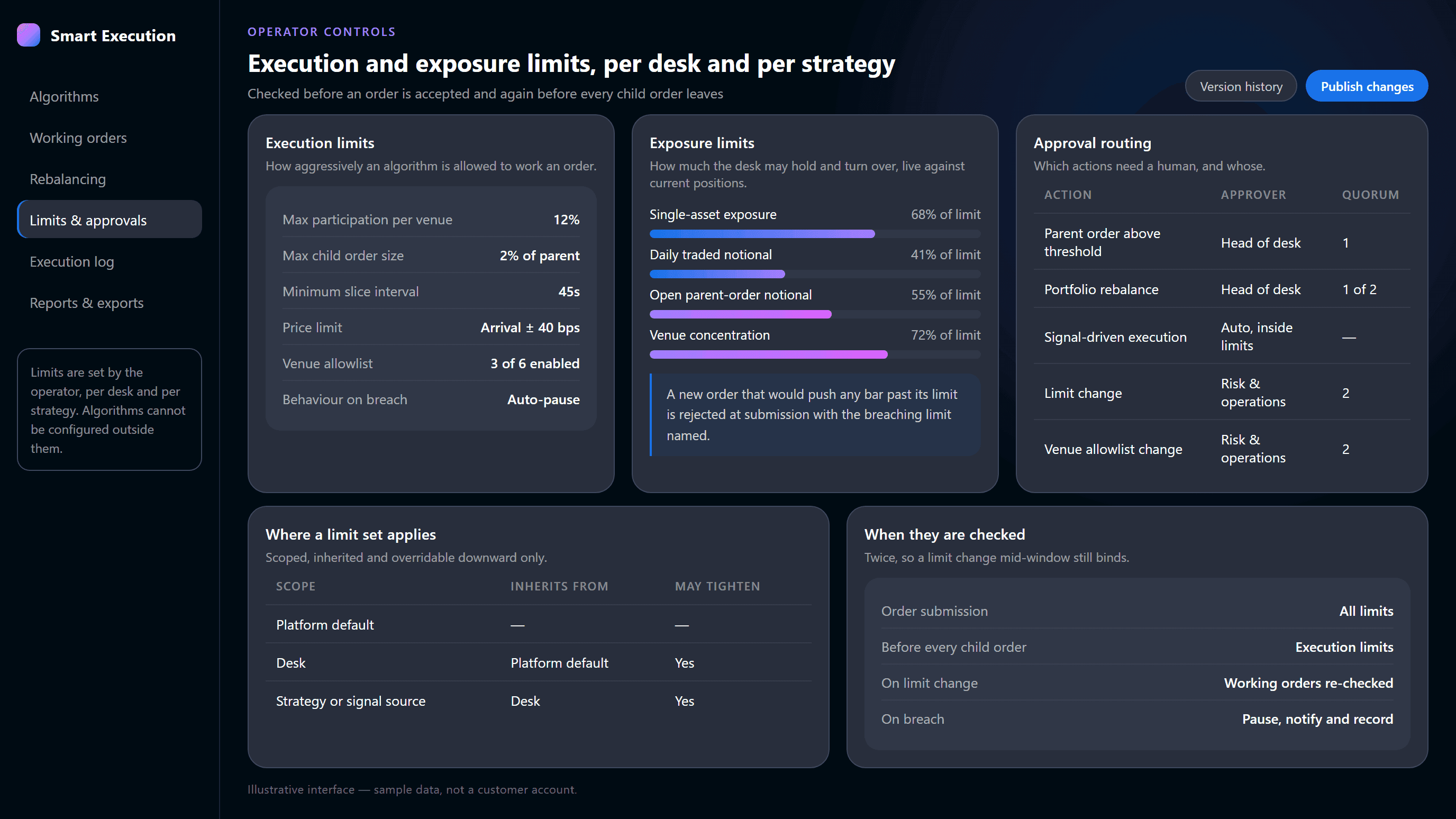
Participation caps, child order size, slice interval, price limits, venue allowlists and desk-level exposure ceilings, checked at submission and again per slice.
Configure Smart Order Routing Once, Then Route Every Slice
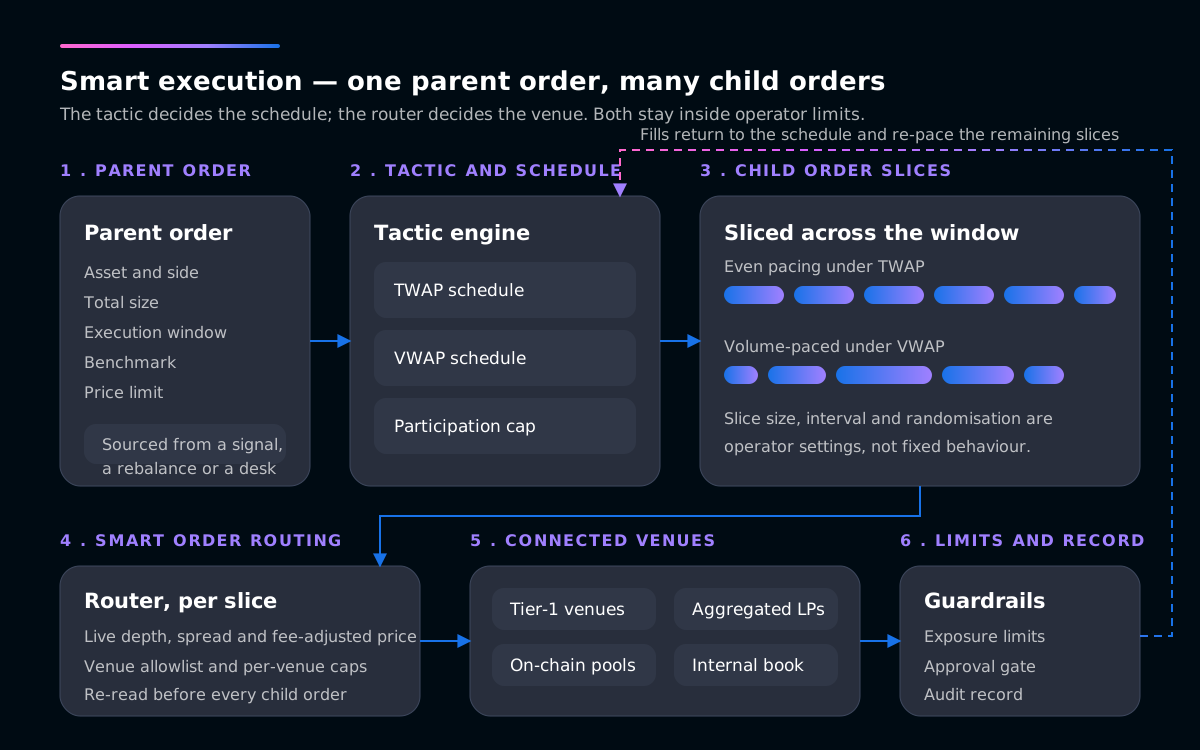
The tactic decides the schedule; the router decides the venue. A parent order is sliced by TWAP or VWAP, each slice is scored against live depth, spread and fee-adjusted price on the venues the operator enabled, and fills come back to re-pace whatever size is left.
Configure It, Watch It Work, Approve What Matters
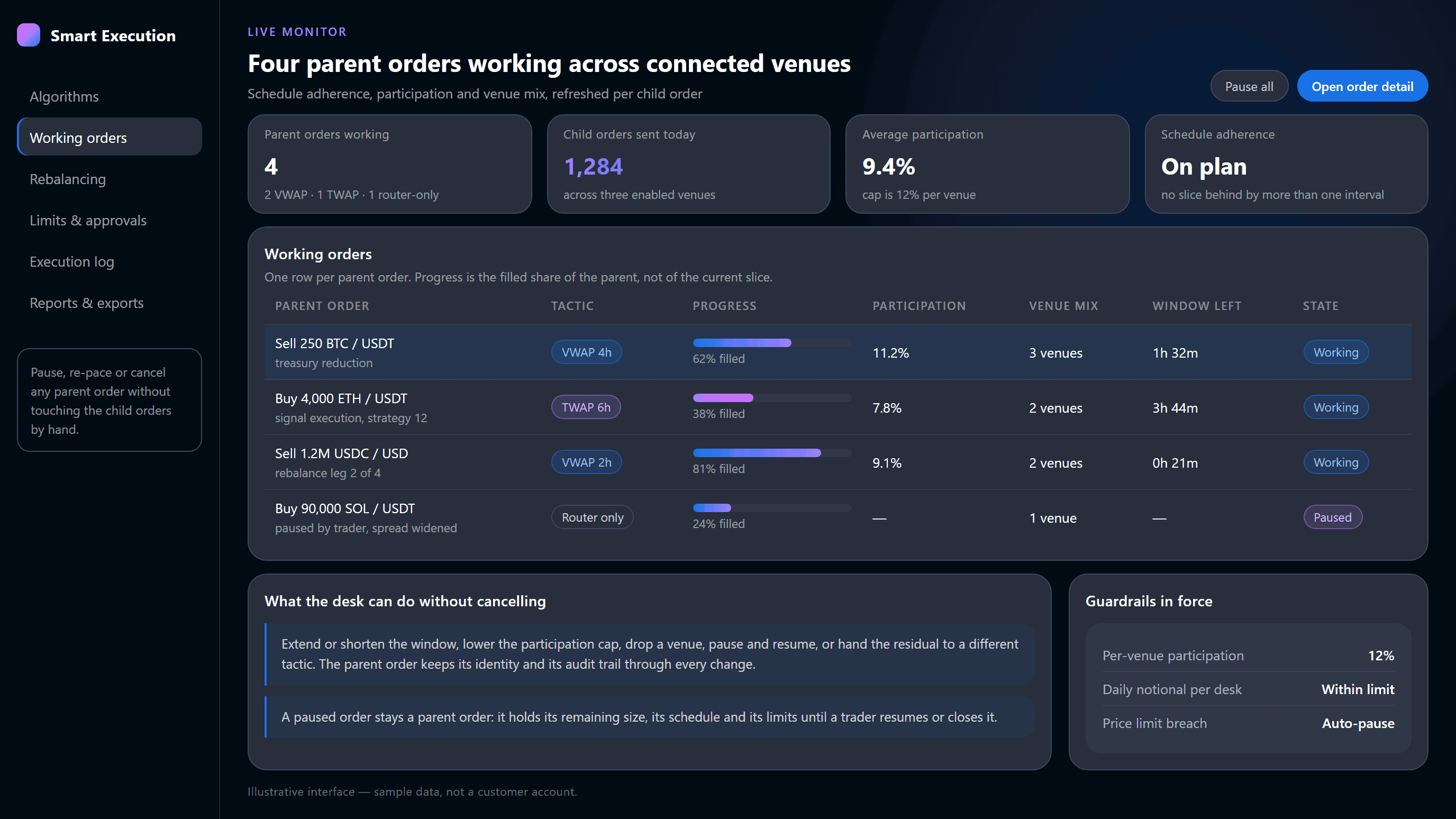
Four screens cover the whole working life of an order: how a tactic is configured, what a working parent order looks like while it runs, how a rebalance is previewed and approved, and where the limits that govern both are set.
Pick the schedule then the routing and the limits
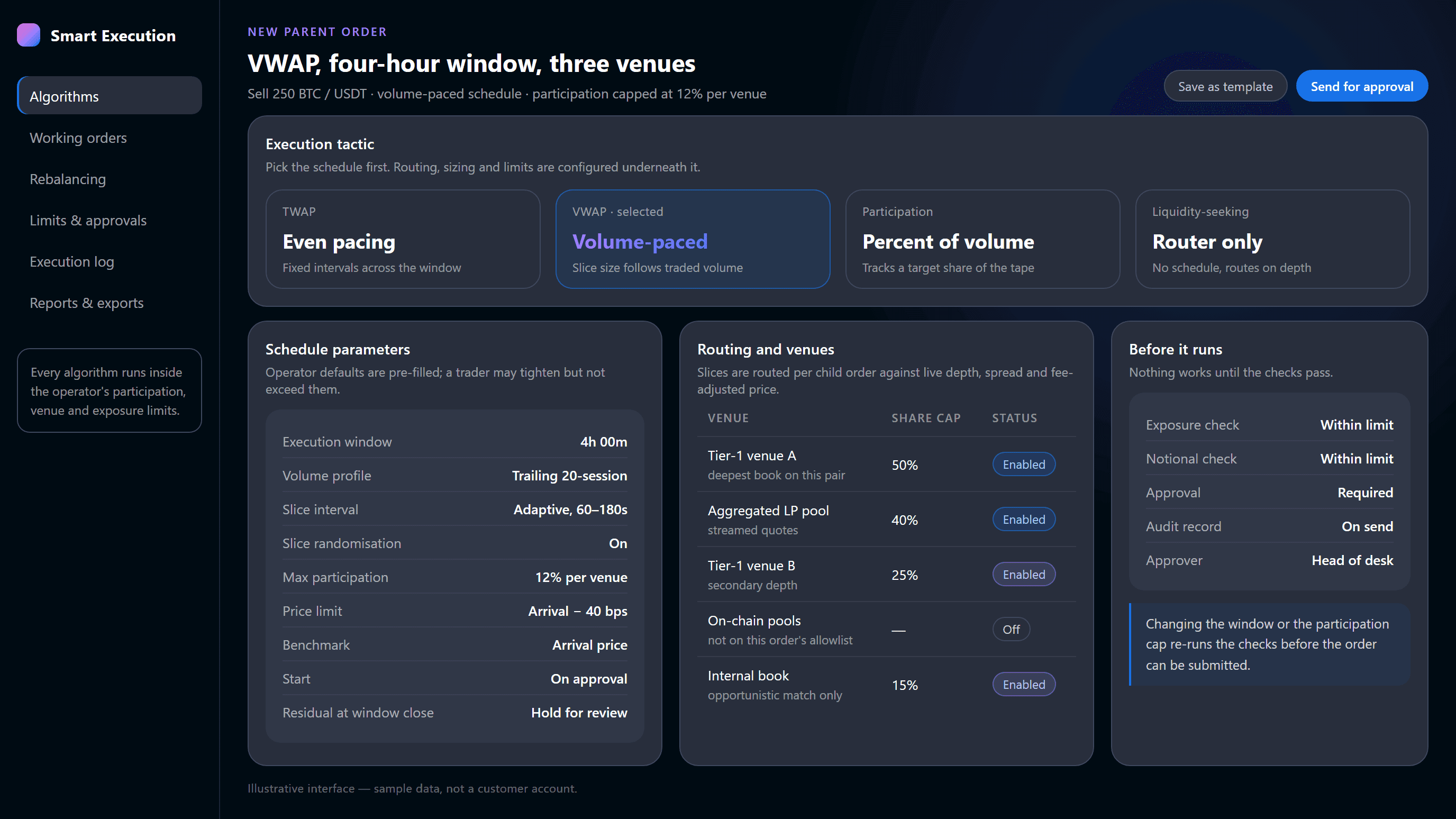
A parent order starts with a tactic. TWAP, VWAP, a participation rate or router-only, each with its own window, slice behaviour and venue mix. Operator defaults are pre-filled and a trader may tighten them but never exceed them.
- Window, slice interval, randomisation and participation cap per venue
- Venue allowlist with a share cap on each enabled venue
- Price limit expressed against the order's own benchmark
- Exposure and notional checks run before the order can be submitted
Which Tactic Works Which Order
There is no best algorithm, only the right one for the order in hand: schedules trade timing risk against market impact, and routing decides where the size lands. The table below is the working rule a desk applies before it configures anything.
| # | Tactic | How it paces the order | Use it when | The trade-off it makes |
|---|---|---|---|---|
| 1 | TWAP scheduletime-weighted average price | Evenly spaced child orders across the windowintervals randomised so the pattern is not readable | Volume carries no useful signal, or the finish time has to be predictable | Ignores a volume spike it could have usedsteady by design |
| 2 | VWAP schedulevolume-weighted average price | Slice size follows traded volume through the windowmore size when the tape is active, less when it is thin | The pair has an intraday volume profile worth tracking | A quiet session stretches the fillthe tape sets the pace |
| 3 | Participation ratepercentage of volume | Holds a target share of whatever the market tradescap enforced per venue | Urgency matters more than the clock | Completion time is not known in advancethe market decides it |
| 4 | Smart order routingvenue choice per child order | Each slice goes to the best live depth, spread and fee-adjusted pricere-scored per request, never cached | The size exists but is spread across several venues | Needs connectivity and per-venue caps to stay honestor route through managed liquidity |
| 5 | Order splittinglarge-order handling | Child orders capped as a share of the visible booksize and interval both operator-bounded | The order is large enough to move the book on its own | More child orders means a longer working windowimpact traded for time |
| 6 | Rebalance executionportfolio automation | Drift becomes legs, each with its own tactic and windowcosted before anything is sent | Weights have left their tolerance bands | Waits for a named approver before the first legby design, not by delay |
One Record Per Parent Order, From Schedule to Fill
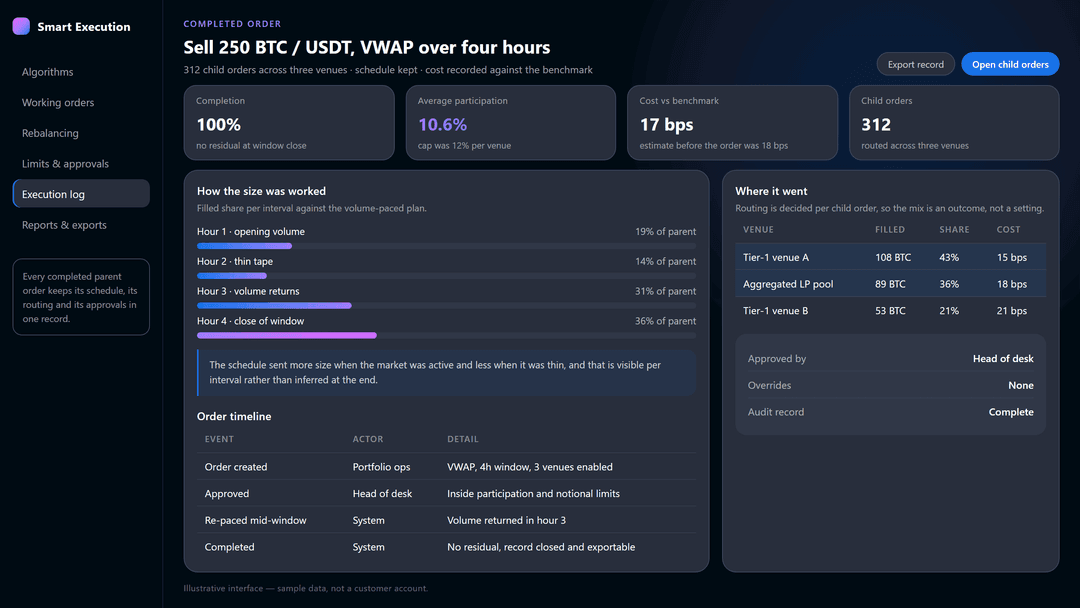
An algorithm that cannot be reviewed is a liability. Every parent order Coiny works keeps its tactic, its schedule adherence, its venue mix, its approvals and its achieved cost in a single record — so the desk answers what happened, and why, from one screen instead of reassembling it from three systems and a chat log.
- Filled share per interval against the plan the tactic committed to
- Venue mix as an outcome of live routing, not a setting someone typed in
- Achieved cost against the benchmark the order was measured on
- Approvals, overrides and limit changes attached to the same order
- Exportable per desk, per strategy and per reporting period
What Desks Ask Before Handing Orders to an Algorithm
- What stops an algorithm running away with the book?Limits it cannot be configured outside of. Participation per venue, child order size, minimum slice interval, price limit, venue allowlist and desk exposure ceilings are operator settings, checked when the order is submitted and again before every child order leaves. A breach auto-pauses the parent order rather than trimming quietly.
- Can a trader intervene once an order is working?At any point, without cancelling. Extend or shorten the window, lower the participation cap, drop a venue, pause and resume, or hand the residual to a different tactic. The parent order keeps its identity and its audit trail through every change, so the review afterwards reads as one story.
- Does rebalancing move funds without anyone signing off?No. Drift produces a proposal, never an order. The desk sees the legs, the estimated cost and the estimated duration before anything is sent, and a named approver has to sign it — with a quorum where the operator wants one. A leg can be dropped without cancelling the rest of the rebalance.
- How do external signals get executed safely?A signal becomes a parent order with a tactic, a window and limits already attached, and is checked against the desk's exposure and execution limits before it is accepted. A signal that would breach a limit is rejected and recorded rather than silently reduced, so nothing arrives in the book that the operator did not permit.
- Do we have to run our own venue connectivity for this?Only if you want to. The routing layer works across whatever venues an operator enables, including the venues Coiny already connects through its managed liquidity service — so a desk can configure routing itself, take the managed version, or run both for different books.
What This Layer Plugs Into
Execution is never a standalone product. These algorithms take their cost forecasts from one Coiny system, their venues from another, and their rebalancing triggers from a third — all deployed together rather than integrated after the fact.


Execution Algorithms, Answered
TWAP (time-weighted average price) and VWAP (volume-weighted average price) are the two standard schedules for working a large crypto order, and the difference between them is what sets the pace. TWAP splits the order into evenly spaced slices across a chosen window, which suits thin or unpredictable markets where volume carries no useful signal. VWAP paces the order in line with traded volume, sending more size when the market is active and less when it is quiet. Coiny Exchange ships both as configurable algorithms with participation caps, price limits and randomised slice timing.
A large crypto order is split into many smaller child orders that are released over time and spread across venues, so no single order has to consume the visible book. Coiny Exchange's smart execution layer sizes each child order as a share of the parent, caps participation per venue, randomises the interval between slices, and re-reads live depth before every release. Market impact falls because the order never demands more liquidity than the book is showing at that moment.
Smart order routing software decides which venue each child order goes to at the moment it is sent, using live depth, spread and fee-adjusted price rather than a fixed preference list. Coiny Exchange routes every slice across the venues an operator has enabled, inside per-venue share caps and allowlists, and re-scores those venues per request rather than on a cached snapshot. Coiny also runs routing as a managed liquidity service for operators who would rather not configure it themselves.
Automated portfolio rebalancing compares a portfolio against its target weights, and when an asset drifts outside its tolerance band the system proposes the legs that would bring it back. Coiny Exchange shows the estimated cost and duration of each leg before anything is sent, works the approved legs through TWAP or VWAP schedules, and requires a named approver to sign the proposal first. Drift never executes on its own, and a single leg can be dropped without cancelling the rebalance.
A trading signal is executed automatically when the system converts it into a parent order that already carries a tactic, a window and a set of limits. Coiny Exchange accepts signals from strategies, models and external providers, checks each one against the desk's exposure and execution limits, and works the resulting order with the same algorithms a trader would use by hand. A signal that would breach a limit is rejected and recorded rather than trimmed silently.
An operator sets execution limits that govern how aggressively an algorithm may work an order, and exposure limits that govern how much a desk may hold or turn over. On Coiny Exchange these include maximum participation per venue, maximum child order size, minimum slice interval, price limits, venue allowlists, single-asset exposure, daily traded notional and open parent-order notional. An order that would breach any of them is rejected at submission with the breaching limit named.
Smart execution is the layer that acts: it schedules an order, splits it, routes each slice and rebalances a portfolio. Execution analytics is the layer that predicts and measures, forecasting cost before an order goes out and reporting achieved quality afterwards. Coiny Exchange deploys both on one platform, so the tactic the analytics layer recommends is the tactic these algorithms run, and the record of what was actually executed flows straight back into the measurement.
Execution algorithms on Coiny Exchange can run without per-order approval, but only inside limits the operator has already set, and the operator chooses which actions still require a human. Signal-driven orders that sit inside the limits typically run automatically, while portfolio rebalances and parent orders above a notional threshold route to a named approver. Every order, override, approval and limit change is written to an audit record with the actor and the timestamp.
Bring a Parent Order. Watch It Get Worked.
Walk through a TWAP and a VWAP schedule on a size that looks like yours, a rebalance preview with its cost and its approval step, and the limit set that governs both — then see how the toolkit deploys on your desk.
Book a Demo