50+
Networks
50+ networks including Ethereum, Tron, Solana, Base, BNB Chain, Polygon and Arbitrum. Operators enable networks per merchant and asset, so a business receives only on the chains it reconciles.
EthereumTronSolanaBase
Stablecoin Payments & Treasury Infrastructure lets businesses accept stablecoins, settle merchants, run global payouts, and manage multi-wallet treasury with sweeping, rebalancing, and reporting. This is the rails layer — accept, settle, pay out, hold and report — and it runs 24/7, because the networks underneath it do.
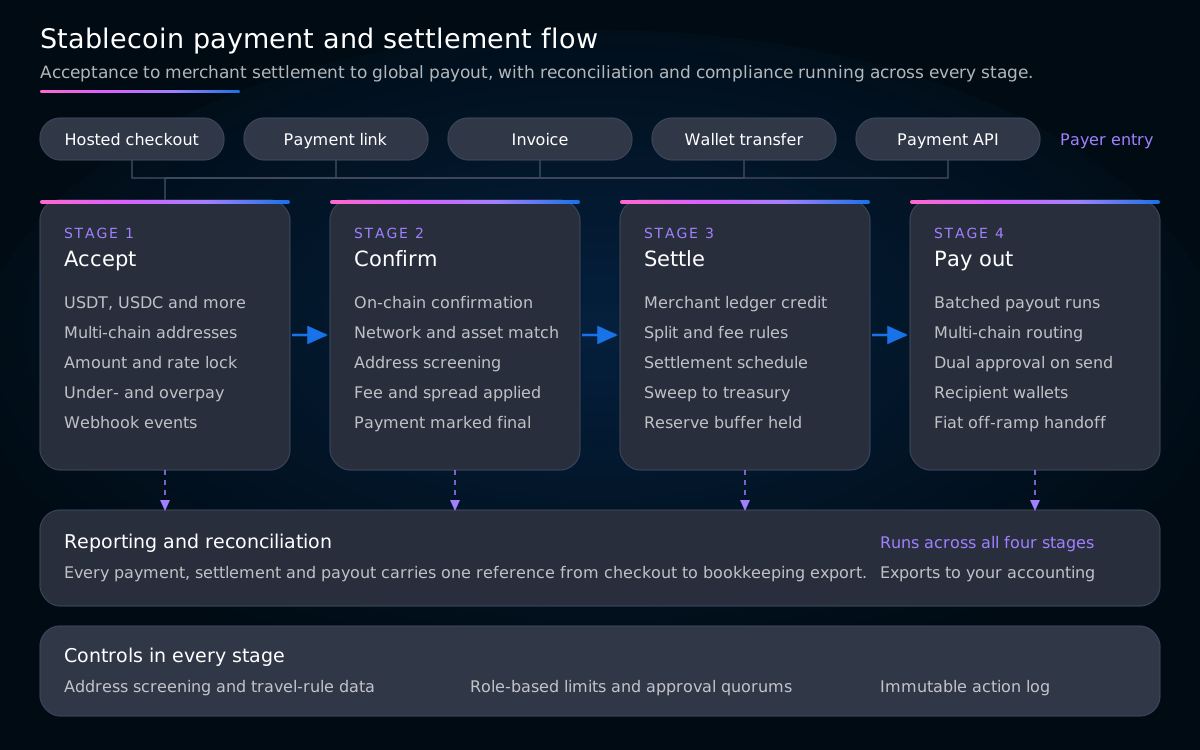
The full money path a stablecoin payment takes on your platform — from the moment a payer opens checkout to the moment a supplier is paid on the other side of the world.
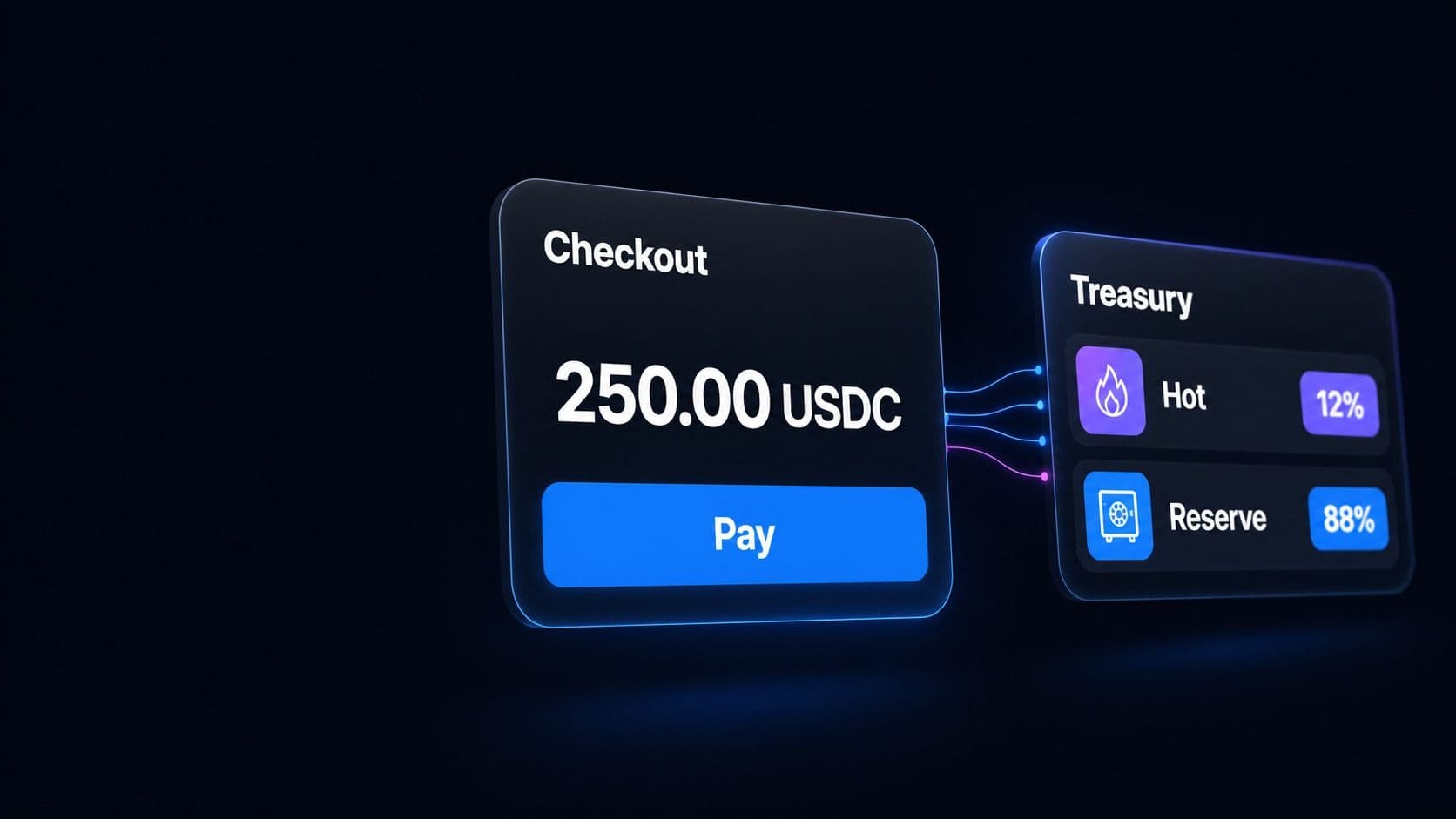
The payer picks a stablecoin and network from the ones you enabled and pays through hosted checkout, a payment link, an invoice, a wallet transfer or your own interface. Amount and rate lock for the quote window.
The platform watches the chain for the expected transfer, checks network and asset against the quote, screens the sending address, applies your fee and marks the payment final at your confirmation depth.
The merchant or sub-account is credited in the settlement asset you agreed, split rules distribute revenue, and the balance releases on that merchant’s schedule. Collected funds sweep to treasury on your rules.
Payouts leave as batches to recipient wallets, after address screening and an approval quorum. Where a recipient needs local currency, the payout hands off to integrated licensed payment providers.
Every stage below is a real subsystem in the deployment, not a conceptual step: acceptance, confirmation, settlement and payout each have their own controls, and reconciliation runs across all four.
Stablecoin rails only pay off when the payer's asset, the payer's chain and the recipient's destination are all supported — so coverage is configured per merchant, not fixed by us.
50+ networks including Ethereum, Tron, Solana, Base, BNB Chain, Polygon and Arbitrum. Operators enable networks per merchant and asset, so a business receives only on the chains it reconciles.
USDT, USDC, EURC and further operator-approved stablecoins, each with its own confirmation depth, fee treatment and settlement asset. Merchants take what they collected, or one settlement asset.
Payouts reach recipients in 180+ countries because a wallet address has no banking geography. Where local currency is required, the payout hands off to integrated licensed payment providers.
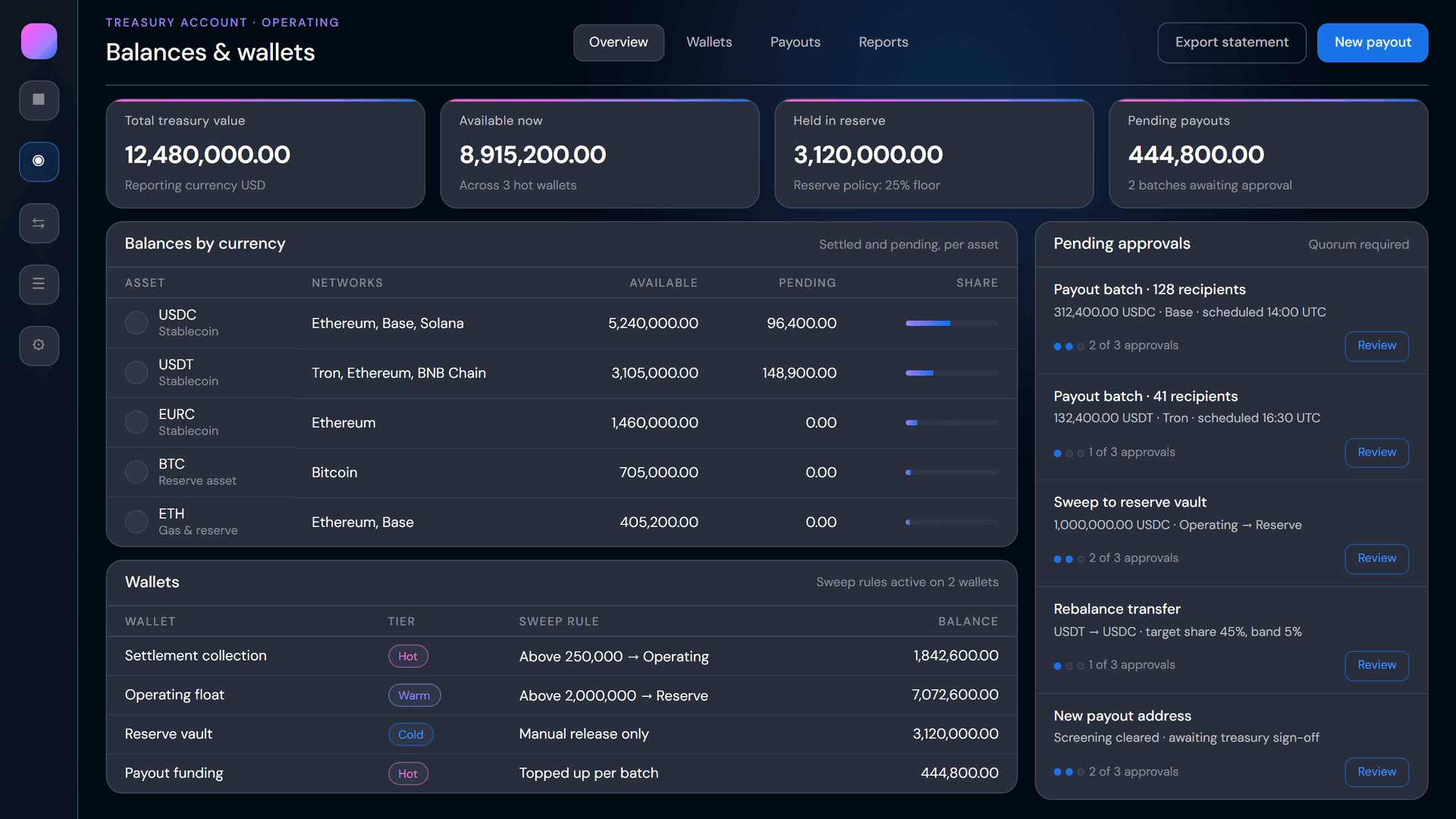
Balances are not one pooled address. Accounts, wallets, sweep rules, rebalance targets and reserve policy are separate objects with explicit relationships — which is what makes a payout limit, a reserve floor or a month-end statement possible at all.
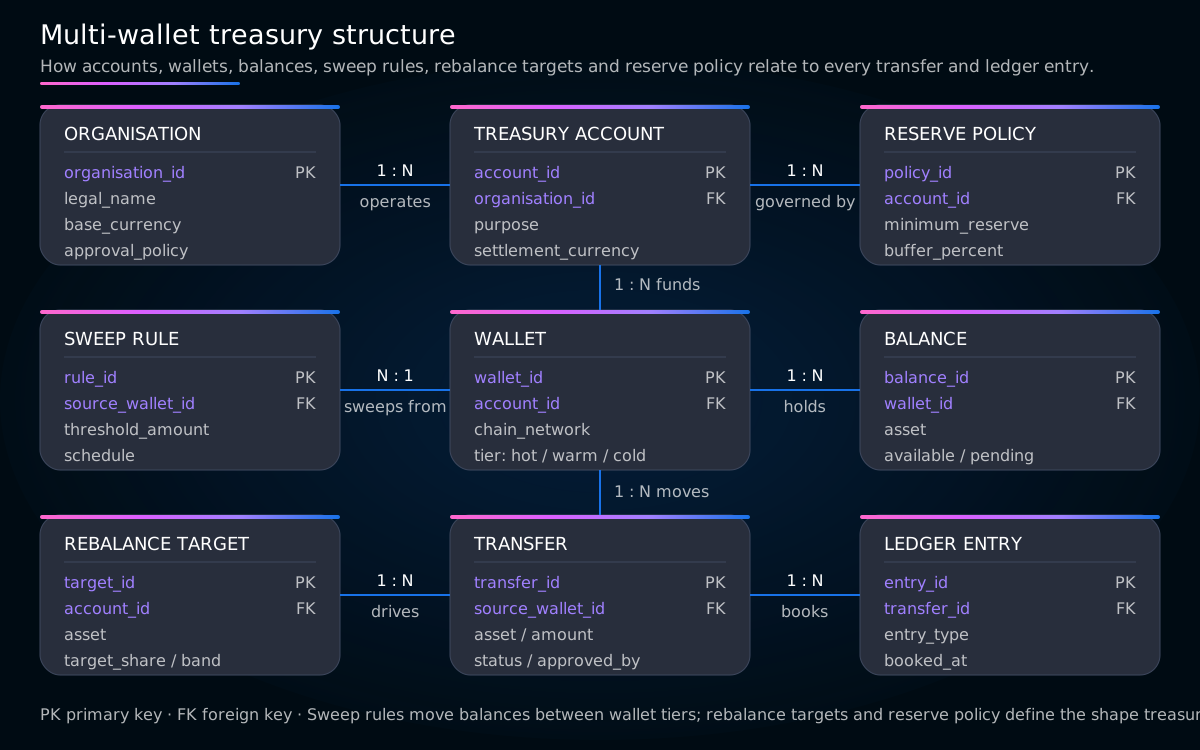
One console for the finance team: what you hold, where you hold it, what is committed to pending payouts, and what is waiting on a second signature before it moves.
Incumbent providers sell acceptance, payouts and treasury as separate products with separate integrations. The conclusion of the table below is simple: these five rails ship together, share one ledger and one set of controls, so a payment you accepted and a payout you sent reconcile against the same reference.
| # | Rail | What moves | Who it serves | Controls that apply |
|---|---|---|---|---|
| 1 | Stablecoin acceptanceCheckout, links, invoices, API | Inbound stablecoin transfersOn-chain, payer to your wallet | Merchants, marketplaces, platformsAnyone billing a customer | Address screening, amount and rate lockConfirmation depth per network |
| 2 | Merchant settlementBalance credits and releases | Internal ledger movementsNo chain transaction required | Merchants and sub-accounts on your platformSellers, partners, franchises | Fee and split rules, settlement scheduleConfigured per merchant |
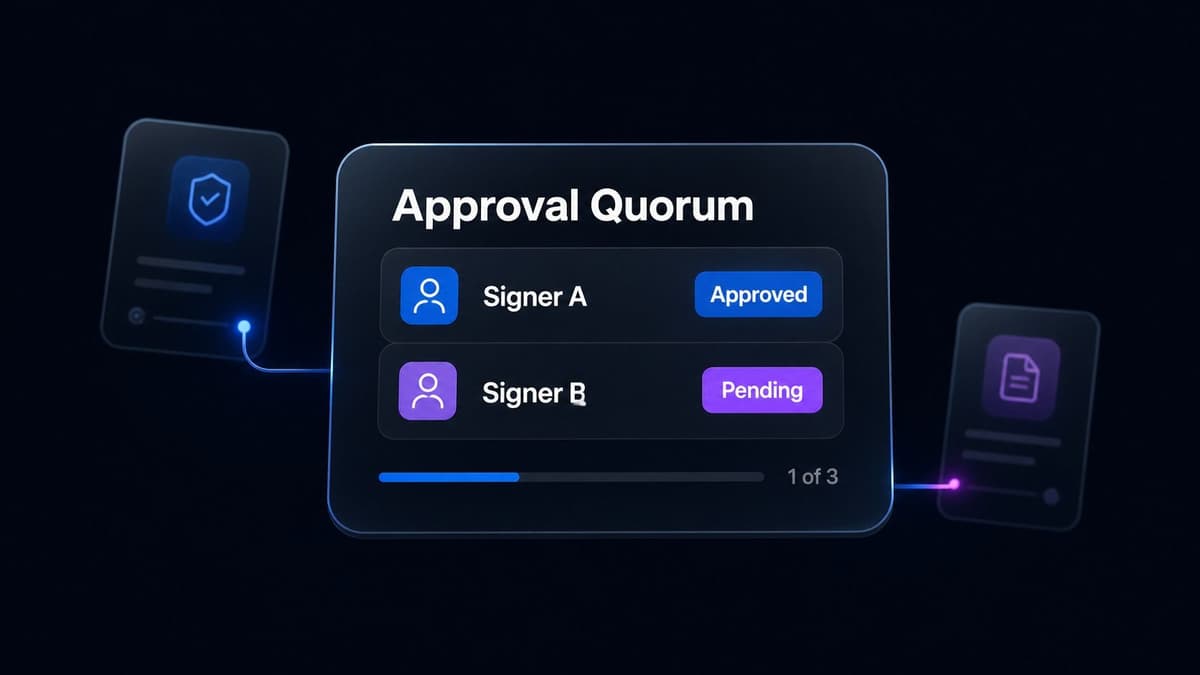
| 3 | Global payoutsBatched outbound transfers | Outbound stablecoin transfersMulti-chain, to any wallet | Suppliers, contractors, sellers, usersRecipients in 180+ countries | Approval quorum, allowlists, batch limitsScreening before every send |
| 4 | Fiat handoffWhere local currency is required | Conversion and bank settlementExecuted by the provider, not by us | Recipients who need money in a bank accountRegional coverage varies | Routed to integrated licensed payment providersProviders carry the licensing |
| 5 | Treasury holdingsMulti-wallet, tiered | Movements between your own walletsSweeps and rebalance transfers | Your finance and treasury teamNot customer-facing | Reserve floor, tier limits, signing policyEvery movement logged |
Acceptance and payouts are the visible half. The half that decides whether finance trusts the platform is the wallet structure, the reserve policy and the reconciliation trail underneath them.
Hosted checkout, payment links, invoices, wallet transfers and a payment API, all returning the same payment object. Quotes lock amount and rate, and underpayment and expiry are explicit outcomes.
Merchant, seller and sub-account balances credited on finality, with your fee schedule and revenue splits applied at credit time. Releases run instantly, daily or on a fixed cycle per merchant.
Collection, operating, payout-funding and reserve wallets tiered hot, warm and cold, each with its own signing policy. Sweep rules consolidate on thresholds; reserve policy sets a floor nothing may break.
REST endpoints and signed webhooks for payments, settlements, payouts, wallets and statements, with idempotency keys, per-key scopes and an isolated test environment provisioned during integration.
One reference travels from checkout through confirmation, settlement, sweep and payout, so the on-chain transaction, the ledger entry and the accounting export all describe the same event.
Stablecoin payouts settle to wallets. When a recipient needs local currency, the payout hands off to the fiat ramp, which routes cards and bank transfers across licensed providers under your brand.
This page is the rails: accept, settle, pay out, hold, report. The operational layer that proposes rebalancing and routes it to approvers is a separate product built on these same wallets.
Address screening, transaction monitoring and travel-rule data are part of the same platform, not a bolt-on. Actions are screened as they happen and cases land in the compliance console.
The wallets these rails move value between run on Coiny wallet infrastructure — custodial, MPC, non-custodial and multi-signature models with HSM-backed key handling.
Stablecoin payments and treasury are one layer of the digital asset finance stack, alongside wallets, cards, staking, fiat ramps and treasury automation.
The buyer is usually the person who owns both the payment experience and the balance sheet behind it.
Add stablecoin acceptance and payouts to an existing payment product without rebuilding settlement, keeping the merchant relationship.
Collect from buyers, split revenue at credit time, and pay sellers across borders in batches, with screening and approvals between.
Turn an exchange deployment into a business that also accepts payment and pays out, on the same wallets and compliance console.
Replace a pooled address and a spreadsheet with tiered wallets, sweep rules, a reserve floor and statements that reconcile.
Stablecoin payment infrastructure is the software layer a business uses to accept stablecoin payments, credit and settle the merchants or users behind them, send stablecoin payouts, and hold the resulting balances in a controlled set of wallets. Coiny Exchange deploys that layer under your brand: checkout and payment APIs on the inbound side, settlement and payout engines on the outbound side, and a multi-wallet treasury with reporting in between.
A merchant settles in stablecoins when the payment platform confirms the inbound transfer on-chain, credits the merchant's balance in the agreed stablecoin, applies the platform's fee and split rules, and releases the balance on a settlement schedule. In Coiny Exchange deployments the operator sets that schedule per merchant — instant, daily or on a fixed cycle — and every credit, fee and release carries the same reference through to the accounting export.
A business running Coiny Exchange payment rails accepts the stablecoins and networks its operator enables, including USDT, USDC and EURC across widely used chains such as Ethereum, Tron, Solana, Base, BNB Chain, Polygon and Arbitrum. The platform supports 50+ networks in total. Each asset and network pair is switched on or off per merchant, so a payer sees only the routes that business actually wants to receive.
Cross-border stablecoin payouts work by sending value directly to a recipient's wallet address on a public network, which settles in minutes at any hour rather than waiting for correspondent banking hours. Coiny Exchange payout rails batch those transfers, screen destination addresses, require an approval quorum before anything leaves a funding wallet, and hand off to integrated licensed payment providers where a recipient needs local currency in a bank account.
Multi-wallet treasury management is the practice of holding business balances across several purpose-built wallets — collection, operating, payout funding and reserve — instead of one pooled address, so exposure, access and approval rules can differ per wallet. Coiny Exchange treasury infrastructure gives each wallet a tier of hot, warm or cold, its own signing policy, and a live view of available and pending balances by asset and network.
Sweeping moves funds out of collection wallets into an operating or reserve wallet once a balance passes a threshold or a schedule fires, keeping working balances small and reserves consolidated. Rebalancing moves value between assets or networks until each holding sits inside its target share and tolerance band. In Coiny Exchange deployments both are rule-driven, both respect the reserve floor, and both leave a signed record for the finance team.
Compliance on stablecoin payment rails works through address screening on every inbound and outbound transfer, transaction monitoring against operator-defined rules, travel-rule data where the jurisdiction requires it, and role-based approval before funds move. Coiny Exchange ships this with AML/KYC compliance built in from the same platform, so payment, payout and treasury actions are screened and logged rather than checked in a separate system afterwards.
Walk through a live deployment — checkout to confirmation, merchant settlement and splits, a batched global payout with its approval quorum, and the treasury console with sweep rules, reserve floor and statements.
Book a Demo