Crypto Market Making Software and Arbitrage Engines
Market-Making & Arbitrage Engines are configurable systems that quote two-sided markets with spread and inventory controls, hedge automatically, and run cross-venue, cross-market, and triangular arbitrage.
See a Live Configuration
Six Engines, One Set of Controls
Quoting and arbitrage share the same venue connections, the same risk limits and the same kill switch, so nothing runs outside the boundary an operator set for it.

Two-Sided Quoting Engine
Continuous bid and ask ladders per market, rebuilt on every book update. Levels, sizing profile, refresh behaviour and order time-to-live are all configured per pair.

Spread Controls
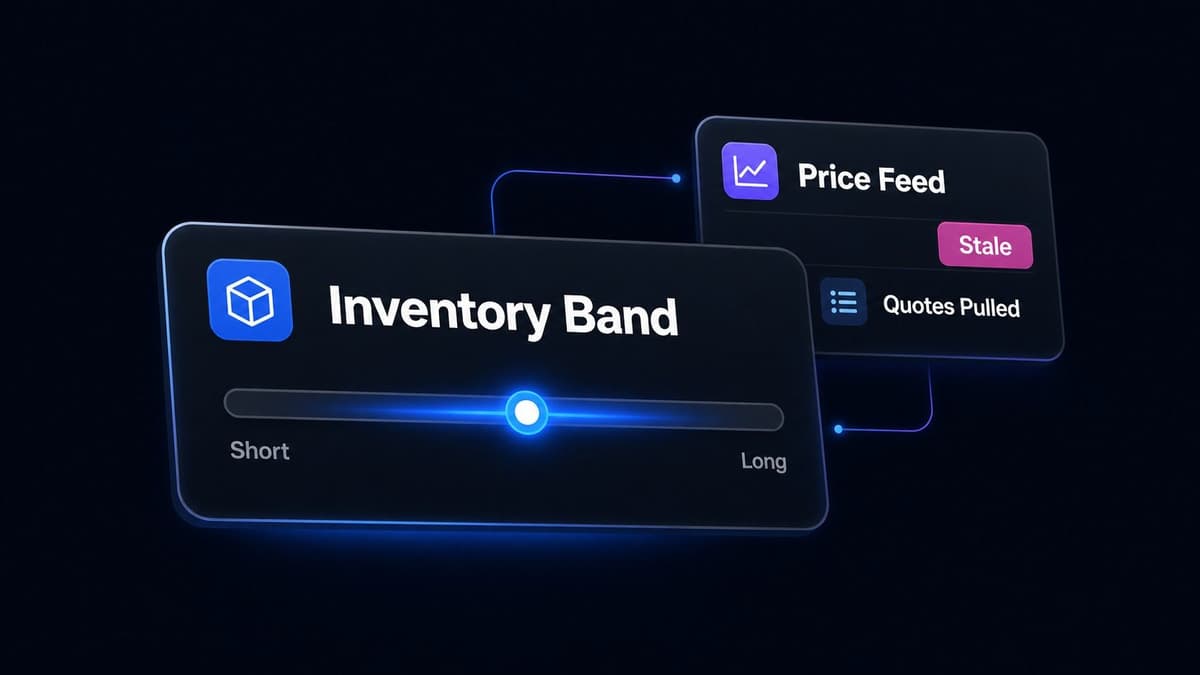
Base spread with a hard floor and ceiling, automatic widening as reference volatility rises, and an immediate pull when the feed goes stale.

Inventory Bands & Skew
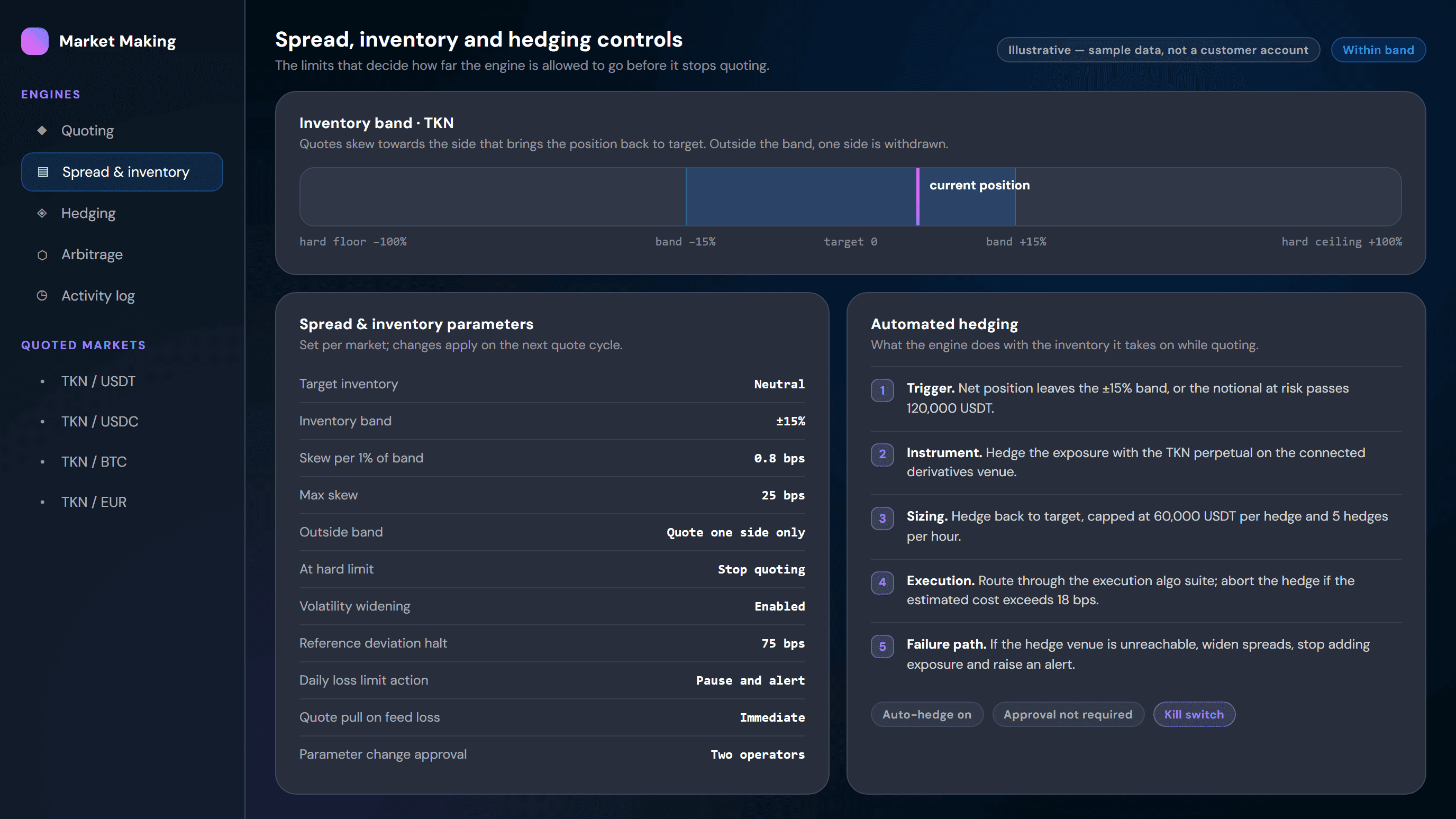
Set a target position and a band around it. Quotes skew towards the side that restores the target, one side is withdrawn at the band edge.

Automated Hedging
Offset accumulated inventory with a perpetual leg on a connected derivatives venue, with the trigger, instrument and sizing set per market.

Arbitrage Scanning
Cross-venue, cross-market and triangular paths scored continuously across every connected venue.

Risk Limits & Kill Switch
Per-path notional caps, per-venue exposure caps, staleness blocks, daily loss-limit actions and a kill switch that cancels every quote at once.
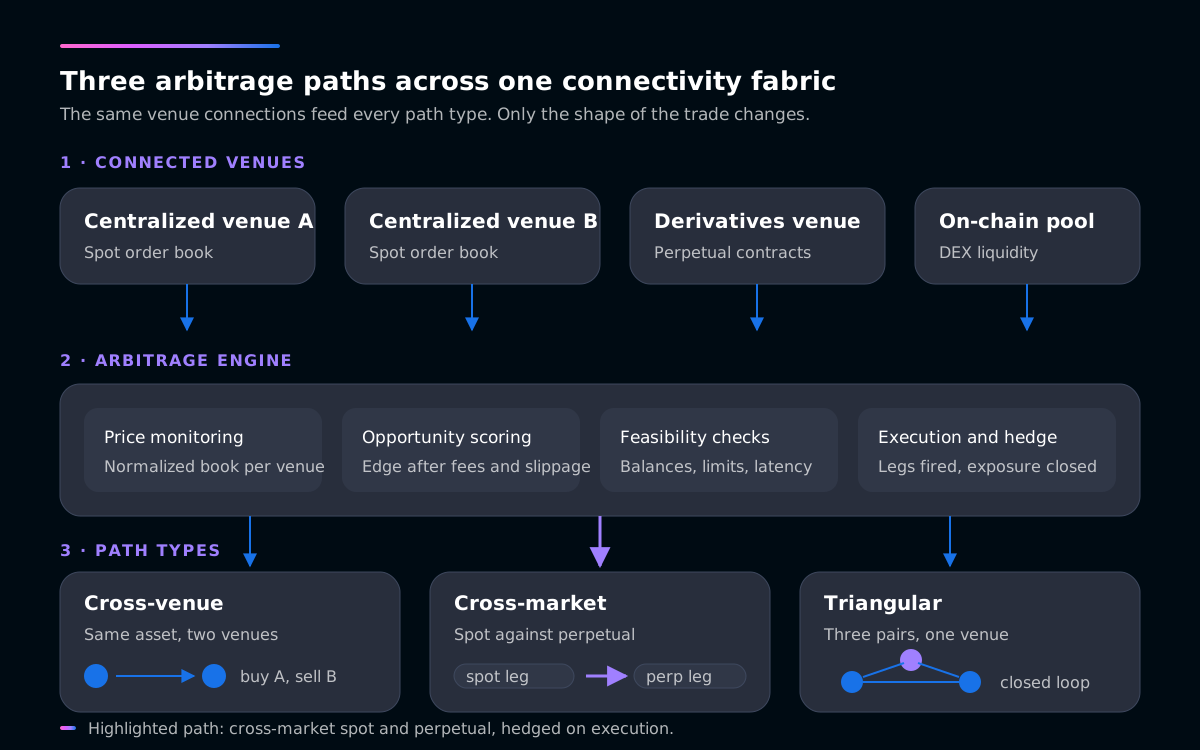
One Connectivity Fabric, Three Arbitrage Paths
The same venue connections that feed the quoting engine feed the arbitrage scanner. Only the shape of the trade changes.
Every Parameter an Operator Actually Sets
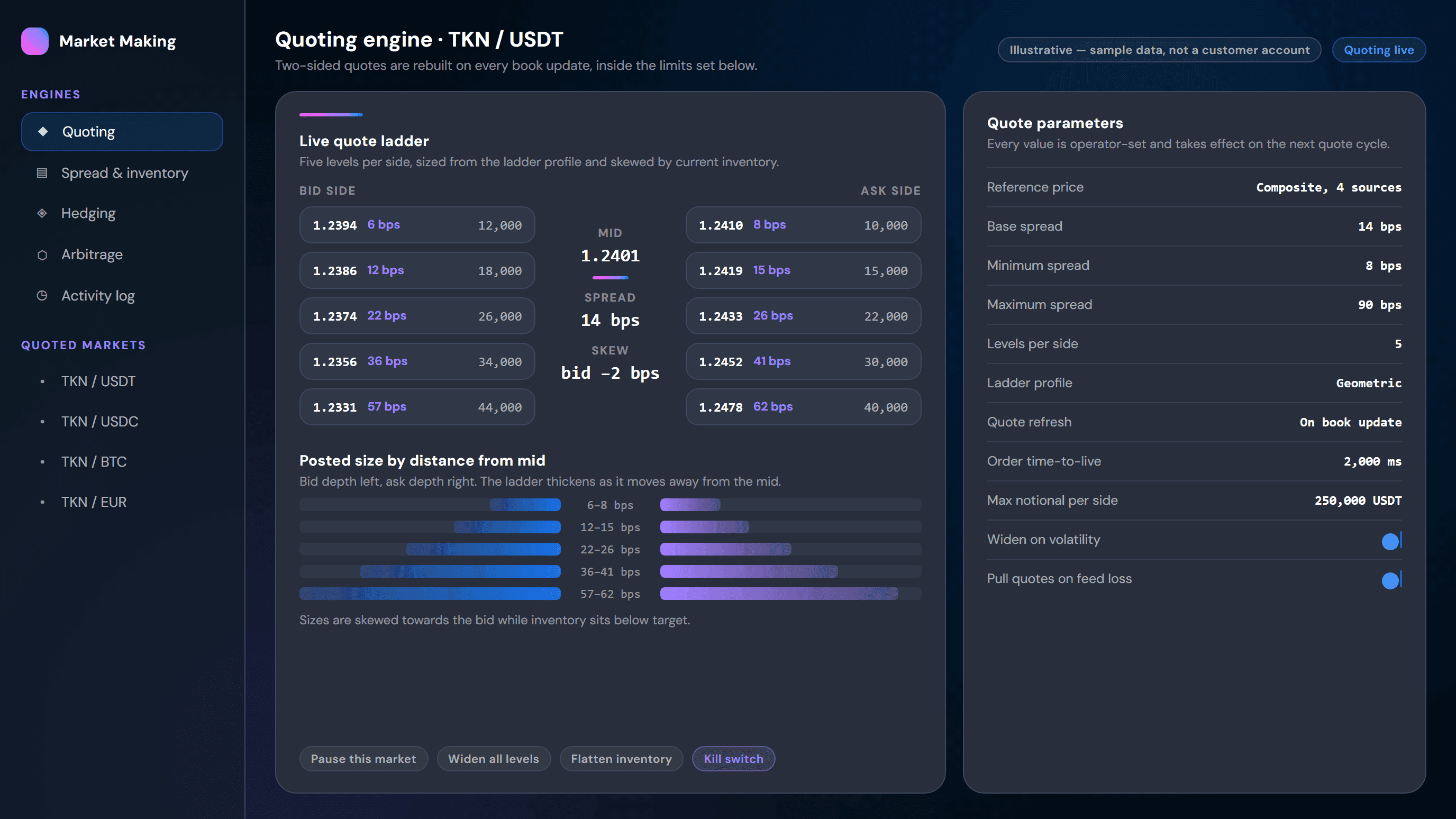
Market-making software is bought on its controls, not on its strategies. These are the screens where the quoting ladder, the inventory band, the hedging rules and the arbitrage thresholds are decided.
Quoting engine ladder, spread, refresh
Two-sided quotes are rebuilt on every book update from a composite reference price. The ladder profile decides how size grows with distance from the mid, and inventory skew tilts the whole ladder towards the side that restores the target position.
- Composite reference price across multiple sources
- Base, minimum and maximum spread per market
- Levels per side, ladder profile and order time-to-live
- Automatic widening on volatility, immediate pull on feed loss
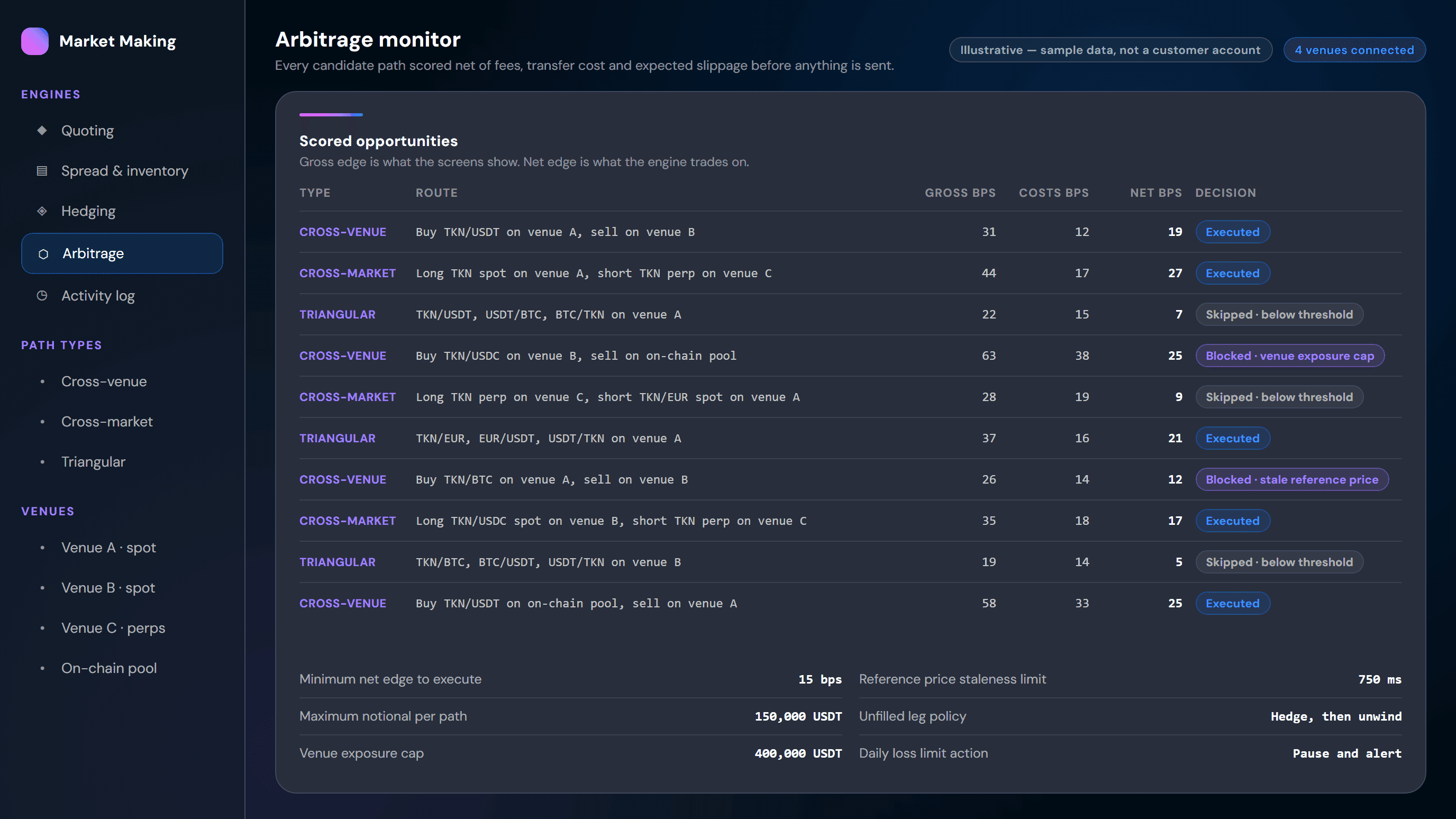
Cross-Venue, Cross-Market and Triangular
Cross-venue arbitrage is the easiest to start and the hardest to keep balanced, because balances drift between venues. Cross-market is the most capital-efficient, because the hedge is built into the trade. Triangular needs the fewest connections but the fastest execution. The engine runs all three from the same connections and the same limits.
| # | Compared on | Cross-venue | Cross-market | Triangular |
|---|---|---|---|---|
| 1 | What it exploits | The same asset priced differently on two venues | Spot and perpetual prices drifting apart | Three pairs whose implied rate does not close |
| 2 | Where the legs sit | Two venues, one asset | Two markets, often two venues | One venue, three pairs |
| 3 | Dominant cost | Taker fees plus transfers or pre-positioned balances | Taker fees plus funding carried on the perpetual leg | Three sets of taker fees on a thin edge |
| 4 | Dominant risk | One leg fills and the other moves away | Funding turns against the position while it is held | The third leg is gone before the first two fill |
| 5 | Inventory effect | Balances drift between venues and need rebalancing | Hedged by construction; funding is the carry | Ends flat on the base asset when all three legs fill |
| 6 | Suits an operator who | Is connected to more than one venue | Already runs perpetual markets | Has deep cross-pair coverage on one venue |
Managed Liquidity as a Service vs Market-Making Software
Both put two-sided prices on your book. The difference is who operates the engine and who carries the inventory: a service delivers depth under a commercial agreement, while software puts the parameters, the positions and the economics in your own hands. Operators often begin with the service and move to the software once a desk exists to run it.
| # | Question | Managed liquidity as a service | Market-making software you operate |
|---|---|---|---|
| 1 | Who runs the quoting | Coiny and its integrated liquidity partners | Your own team, from the operator console |
| 2 | What you configure | Pairs, coverage and service terms | Spread, ladder, inventory bands, hedging and arbitrage rules |
| 3 | Where the inventory sits | With the provider | In your own venue accounts |
| 4 | What you need in-house | A commercial owner for the relationship | Someone accountable for parameters and limits |
| 5 | How behaviour is controlled | Through the service agreement | Through limits, kill switches and the audit trail |
| 6 | Choose it when | You want depth without operating anything | You want the strategy and the economics in your own hands |
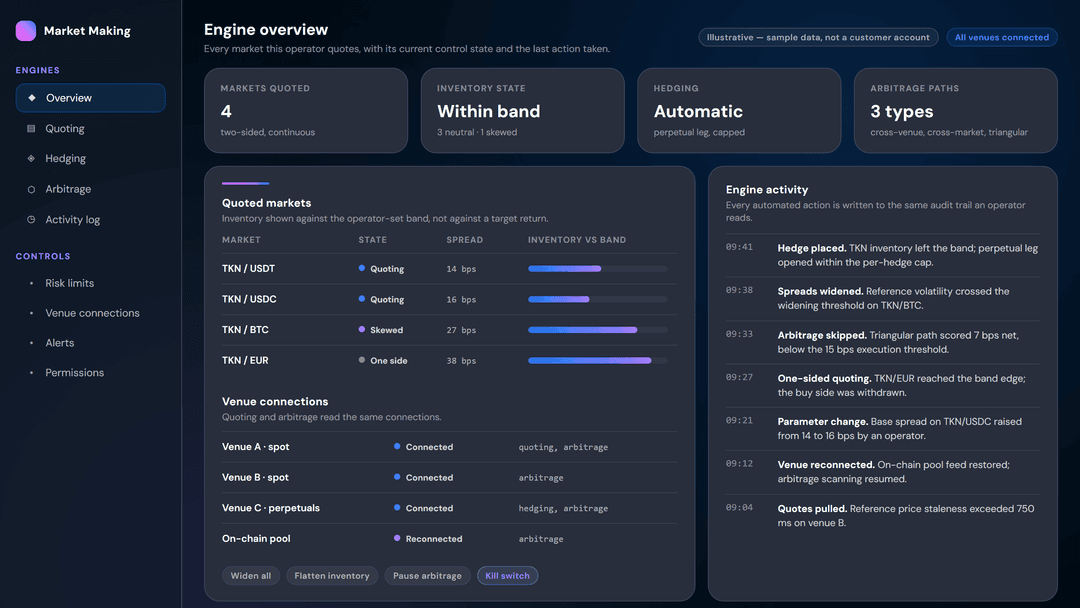
One Console for Every Market You Quote
The engine overview is where a desk lead starts the day: which markets are quoting, which are skewed, which have gone one-sided, and what the engines did overnight without being asked.
- Quoting state, spread and inventory band for every market on one screen
- Hedging, arbitrage and quoting share one set of venue connections
- Widen all, flatten inventory, pause arbitrage and kill switch, one click each
- Automated actions and operator changes in a single audit trail
- Deployable inside your own infrastructure, under your own brand
The Questions Desks Ask Before They Switch an Engine On
Market-making software fails on operations, not on ideas. These are the answers that decide whether a desk is comfortable running it.
- What happens when the price feed goes stale mid-quote?Quotes are pulled immediately once the reference price passes the staleness limit, and arbitrage paths built on that price are blocked rather than traded. The engine resumes on its own once the feed is healthy, and both events are logged.
- How do we stop inventory building up on one side?The inventory band does it before anyone notices. Quotes skew towards the restoring side as the position drifts, one side is withdrawn at the band edge, hedging fires on its own trigger, and quoting stops entirely at the hard limit.
- Can we run this without a quant team?Every rule is an operator-set parameter in a console, not code to be written. What a desk needs is somebody accountable for the numbers in that console; the engines, the connectivity and the risk plumbing ship ready to run.
- Who can change a parameter, and can we prove what changed?Parameter changes are permissioned and can require a second operator, and each one is written to the audit trail with its author and timestamp beside the automated actions the engines took.
- What does an arbitrage engine do when one leg does not fill?The unfilled-leg policy is configured up front: hedge the exposure and then unwind it, inside the same cost ceiling that governs every other hedge. Paths whose legs cannot both be covered are never scored as executable in the first place.
Where the Engines Sit in the Coiny Stack
Market-making and arbitrage engines are one of five quant systems on the same execution core. These are the pieces around them.


Market-Making & Arbitrage FAQ
Crypto market making software is a system that continuously quotes two-sided prices on a venue and manages the inventory those quotes accumulate. Inventory controls work from a target position and a band around it: as the holding drifts towards the edge of the band the engine skews its quotes to favour the side that brings the position back, withdraws one side at the band edge, and stops quoting at the hard limit. On Coiny Exchange every one of those thresholds is an operator-set parameter rather than something buried in code.
Market-making software is an engine your own team operates, and liquidity as a service is depth delivered to your venue by someone else. With software you set the spread, the ladder, the inventory band and the hedging rules, and the inventory sits in your own accounts. With a service, a provider runs the quoting under a commercial agreement and carries the inventory. Coiny Exchange offers both, and operators frequently start with the service and move to the software once a desk exists.
Automated hedging offsets the inventory a market-making engine picks up while quoting, usually with a perpetual contract on a connected derivatives venue. In Coiny Exchange the hedge fires on an operator-set trigger such as leaving the inventory band or passing a notional-at-risk threshold, is sized back to target within per-hedge and per-hour caps, and is abandoned if the estimated execution cost exceeds the limit set for it. If the hedge venue is unreachable the engine widens spreads and stops adding exposure.
Triangular arbitrage trades three pairs on a single venue in a loop, for example a token against a stablecoin, that stablecoin against bitcoin, and bitcoin back against the token, capturing the gap when the implied rate does not close. It is worth running where a venue quotes many cross pairs, because it needs no transfers between venues and ends flat on the base asset. Coiny Exchange scores each loop net of three sets of fees before any leg is sent.
A crypto arbitrage engine needs to act inside the life of the price gap it found, which on liquid venues is short enough that stale data is the main cause of losing trades. Coiny Exchange addresses this with direct venue connectivity over REST, WebSocket and FIX 4.4, opportunity scoring that runs continuously rather than on a poll, and a staleness limit that blocks any path whose reference price is older than the operator-set threshold. Being fast enough to skip a bad trade matters more than being first.
A token project can run market making on its own token using Coiny Exchange's engines, quoting two-sided prices on the venues where the token is listed under spread, inventory and exposure limits the project sets itself. This keeps the treasury position, the parameters and the audit trail inside the project rather than with an external desk. Market making improves the quality of a market; it is not a mechanism for supporting a price, and every rule stays subject to the venue's own listing terms.
Coiny Exchange's market-making bots run inside limits that act before an operator can. Quotes are pulled when the reference feed goes stale or deviates beyond a set threshold, one side is withdrawn at the inventory band edge, quoting stops at the hard position limit, a daily loss limit pauses the engine and raises an alert, and a kill switch cancels everything on every market at once. Each of those actions is written to the same audit trail as operator parameter changes.
Ready to Configure Your First Market?
Book a walkthrough of the quoting ladder, the inventory band, the hedging rules and the arbitrage monitor, and we will set them up against the pairs and venues you actually trade.
Book a Demo