RWA Trading Infrastructure for Tokenized Real-World Assets
RWA Trading Infrastructure provides spot and perpetual markets, market data, liquidity, and risk controls for already-issued tokenized real-world assets; it does not originate or issue assets. Coiny supplies the venue layer.
Book a Demo
Six Systems Behind Every Tokenized-Asset Market
Everything below sits on the exchange side of the line. The asset arrives already issued; these are the systems that make it tradable, priceable and safe to run.

Spot Markets for Real-World Assets
A full order-book market on the tokenized asset itself, with quote asset, tick size, lot size, minimum notional.

Perpetual Markets on RWAs
Cash-settled perpetual contracts referencing a tokenized asset without delivering it, on the same engine as the rest of your derivatives markets.

Instrument Configuration
One asset record, as many instruments as you need. Chain and contract reference, precision, deposit and withdrawal rules and the custody account are defined once.

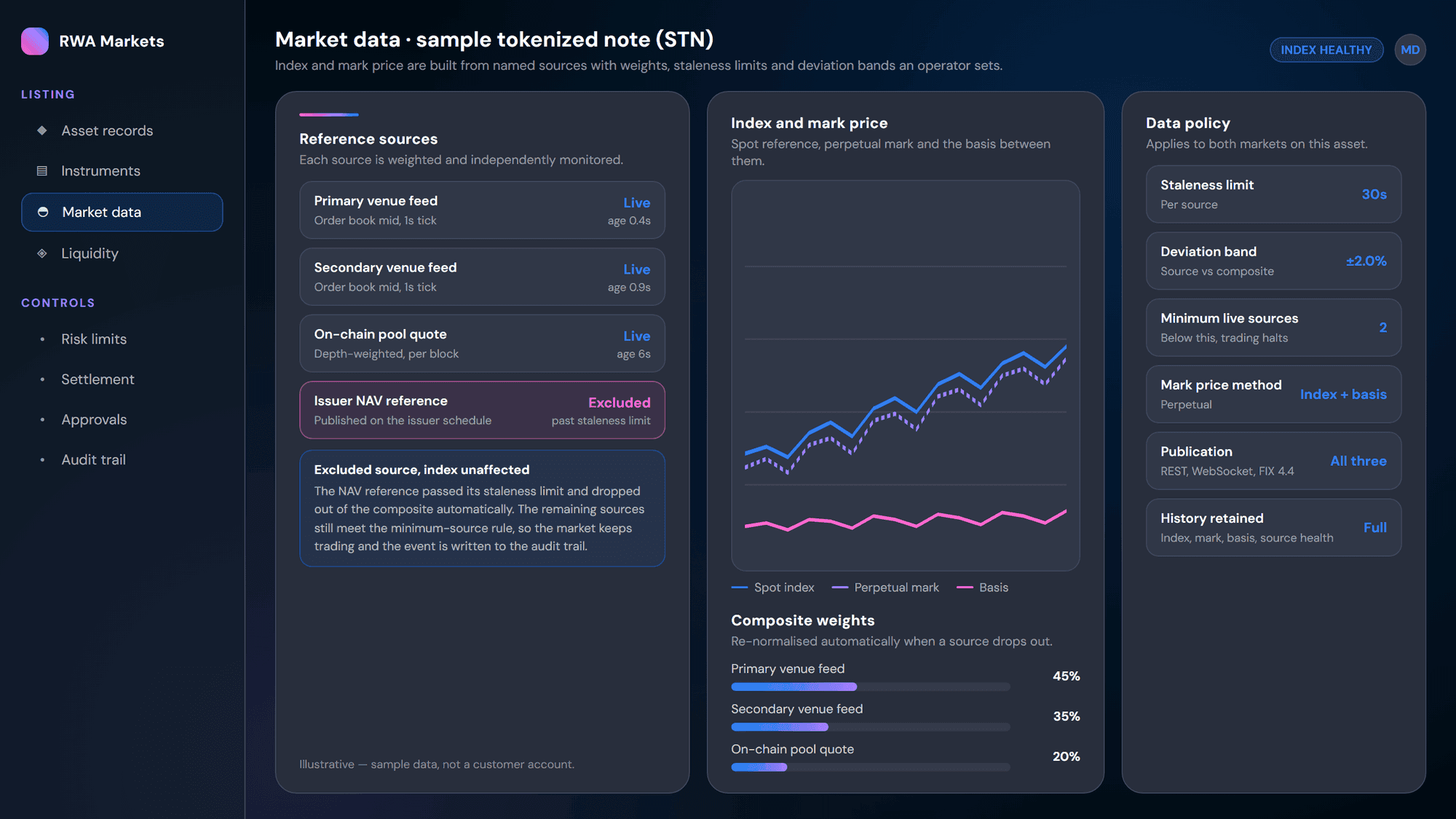
Market Data and Reference Pricing
A composite index built from named, weighted sources — venue feeds, on-chain pool quotes and any issuer-published reference.

Liquidity and Execution
The same matching engine, routing and aggregated liquidity that serve your crypto pairs serve your tokenized-asset pairs.

Risk Controls
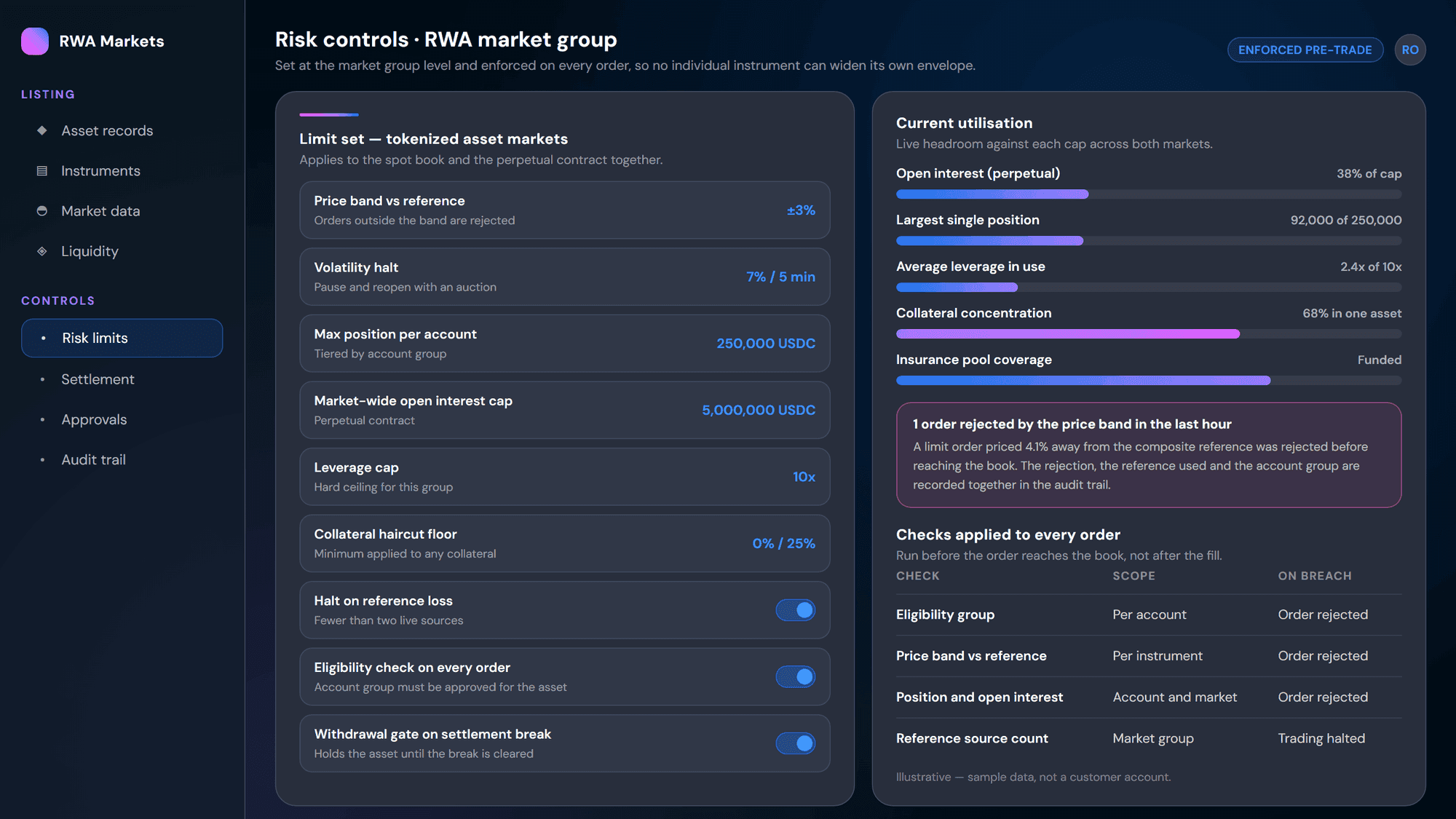
Price bands against the composite reference, volatility halts with auction reopens, per-account position limits, a market-wide open interest cap.
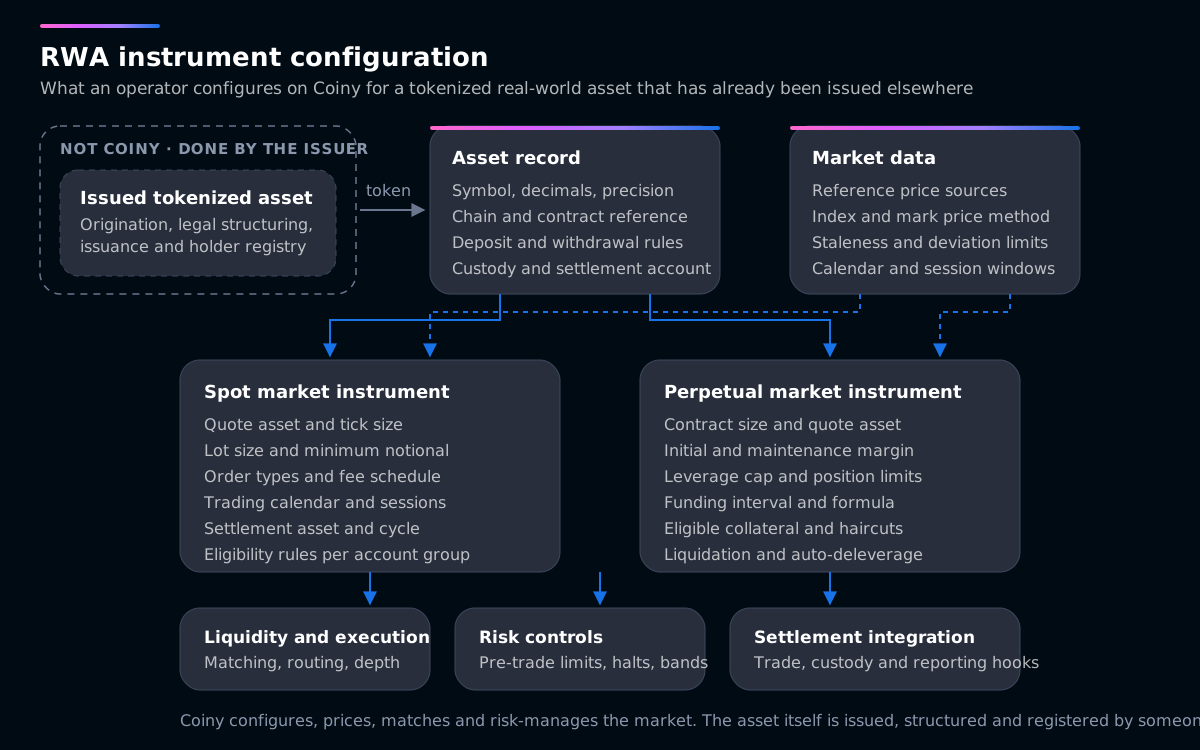
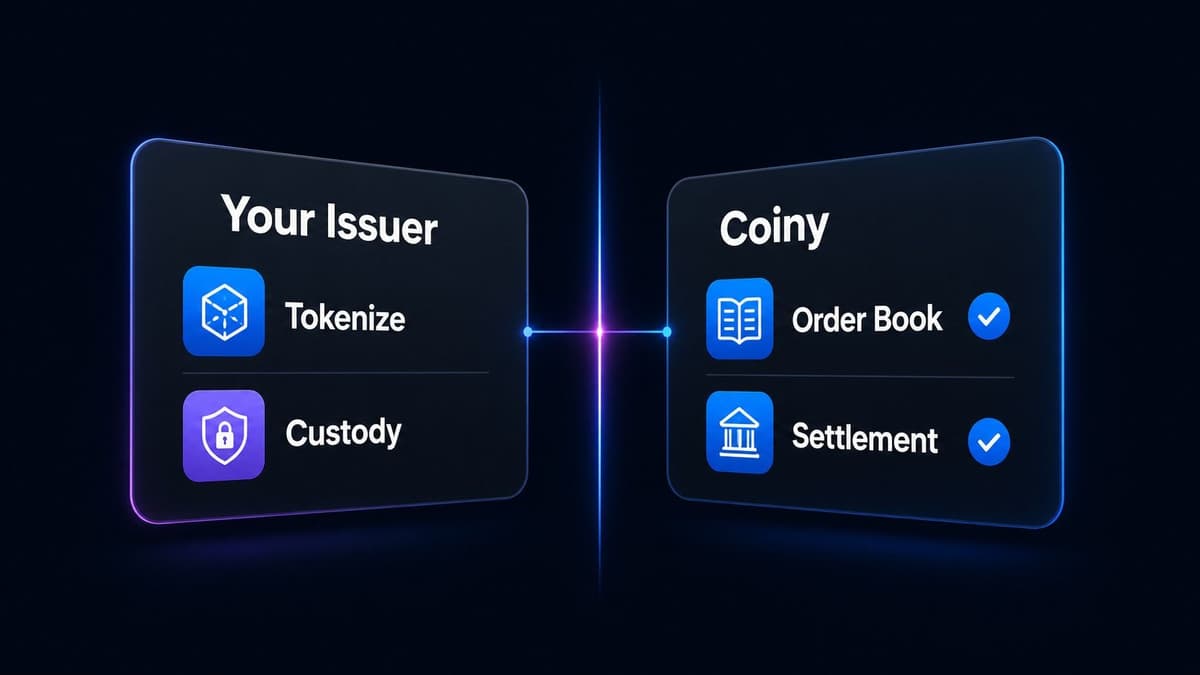
One Asset Record, Two Markets, One Boundary
The diagram is deliberately drawn with the issuer outside the frame. Everything inside it is what an operator configures on Coiny.
Every Field an Operator Sets Before a Market Opens
RWA markets are bought on their controls. These are the screens where the instrument, the reference price and the risk envelope are decided for a tokenized asset.
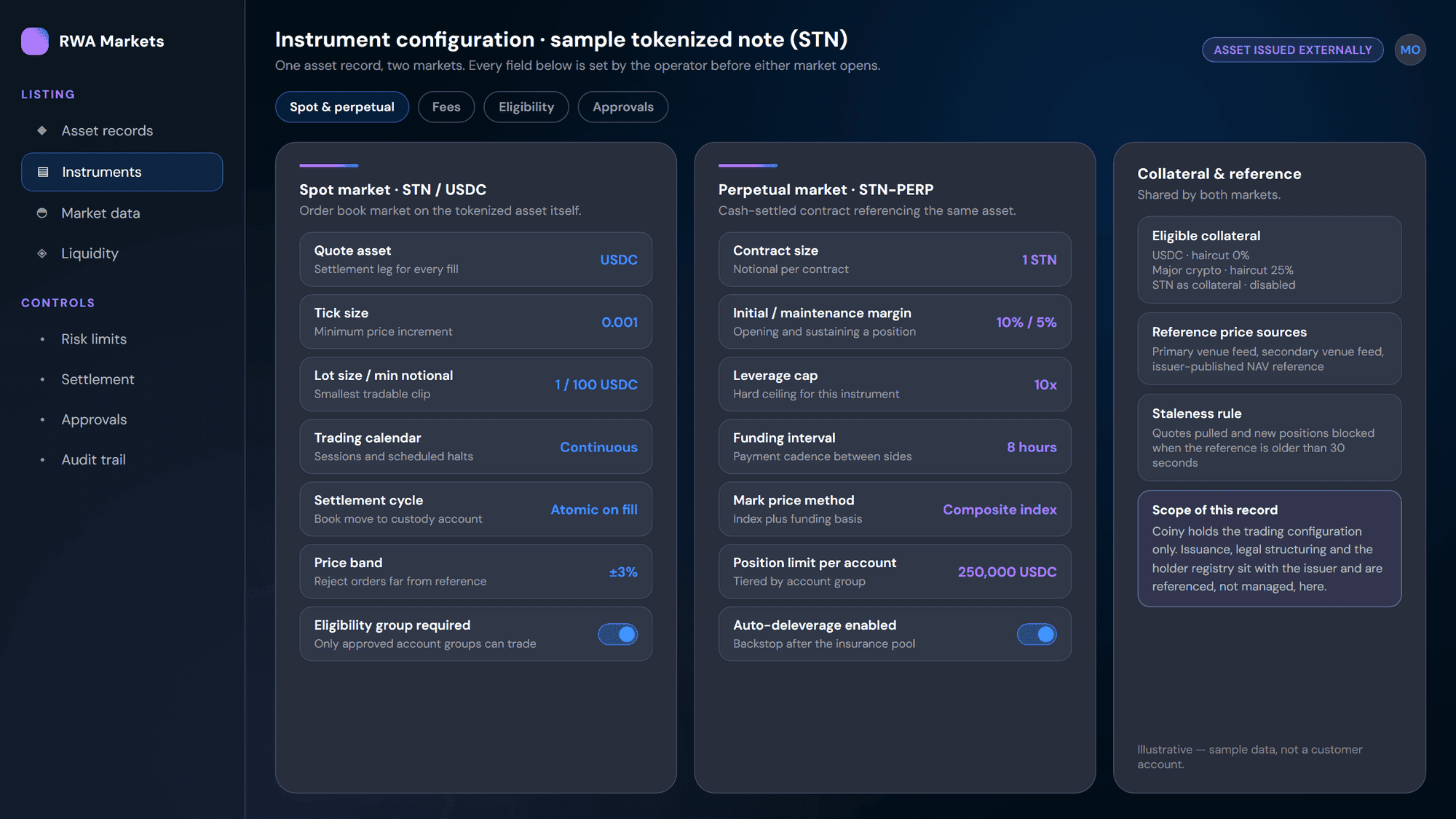
Instrument configuration spot and perpetual, one record
The spot book and the perpetual contract are configured side by side against the same asset record, so the price fields, the capital rules and the eligibility groups can be reasoned about together rather than in two consoles.
- Quote asset, tick size, lot size and minimum notional per book
- Contract size, margin schedule, leverage cap and funding interval per contract
- Trading calendar, sessions and scheduled halts
- Eligible collateral and haircuts shared by both markets
Configuring a Spot Market and a Perpetual on the Same Asset
The short version: a spot instrument delivers the token and needs settlement plumbing; a perpetual instrument references the token and needs a mark price, margin and funding. Most operators open the spot book first, because it establishes the reference the perpetual depends on — but the two are separate instruments on one asset record, and either can run without the other.
| # | Configured on | Spot market instrument | Perpetual market instrument |
|---|---|---|---|
| 1 | What actually trades | The tokenized asset itself, delivered on settlement | A cash-settled contract that references the asset |
| 2 | Core price fields | Quote asset, tick size, lot size, minimum notional | Contract size, quote asset, mark price method |
| 3 | Capital rules | Full balance required; no leverage on the book | Initial and maintenance margin, leverage cap, eligible collateral and haircuts |
| 4 | Reference data needed | Composite index for price bands and reporting | Composite index plus a mark price and a funding basis |
| 5 | Ongoing mechanics | Trading calendar, sessions and scheduled halts | Funding paid between long and short on a set interval |
| 6 | Risk envelope | Price bands, volatility halts, per-account position caps | Position limits, open interest cap, liquidation and auto-deleverage |
| 7 | Settlement path | Token and quote asset move to the custody account on fill | Profit and loss settles in the collateral asset; the token never moves |
| 8 | Open it when | Your users want to hold the asset itself | Your users want exposure without holding or transferring the token |
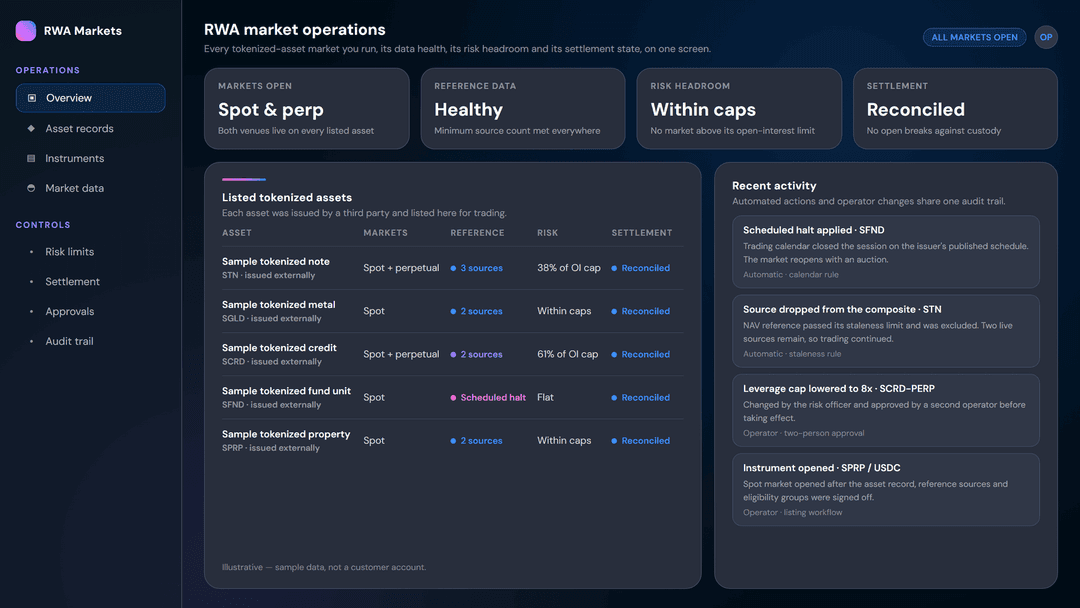
Every Tokenized-Asset Market on One Screen
The operations view is where a venue lead starts the day with RWA markets open: which assets are trading, whether each one still has enough live price sources, how much of the open interest cap is used, and whether book positions still reconcile against custody.
- Spot and perpetual state for every listed tokenized asset on one screen
- Reference-source health and scheduled halts surfaced as normal operations
- Risk headroom shown against caps, not only realised exposure
- Book positions reconciled against custody, with breaks that hold the asset
- Automated actions and operator changes in a single audit trail
- Deployable inside your own infrastructure, under your own brand
What Coiny Does, and What Stays With Your Issuer
The most useful thing a trading-infrastructure vendor can do on this topic is be exact about its boundary. These are the answers venues ask for before they commit to an RWA roadmap.
- Do you issue or tokenize the asset for us?No. Coiny does not originate real-world assets, structure them legally, issue tokens, act as a transfer agent, maintain an investor registry or run primary-market distribution. You bring a token an issuer has already created, and Coiny gives it markets, prices, liquidity, risk controls and a settlement path.
- What do you need from us before a market can open?The token's chain and contract reference and its precision, a custody or settlement account to hold it, at least two reference price sources you are willing to stand behind, the risk envelope you want enforced, and the account groups permitted to trade it. Everything else is configuration.
- Can we run a perpetual without running the spot book?Yes, provided a reliable reference price exists from sources outside your venue. The perpetual references the asset rather than delivering it, so it needs an index and a mark price, not a settlement path for the token. Most venues still open the spot book first, because it improves the index.
- What happens when the reference goes stale or the session closes?A stale source drops out of the composite and the remaining weights re-normalise. If live sources fall below the minimum you set, the market halts rather than trading on thin data. Scheduled closes follow the trading calendar configured for the asset and reopen with an auction.
- Where does the asset sit while it is trading?In the custody arrangement you configured on the asset record — Coiny's wallet and custody infrastructure, or a custody provider you already use. Book positions are reconciled against those balances, and a settlement break holds the asset rather than passing it on.
Where RWA Markets Sit in the Coiny Stack
Tokenized-asset markets reuse the engines, liquidity and review workflows already running on your venue. These are the pieces around them.


RWA Trading Infrastructure FAQ
RWA trading infrastructure is the exchange-side software that turns an already-issued tokenized real-world asset into a tradable market: instrument definition, reference pricing, an order book, an optional perpetual contract, liquidity, risk controls and a settlement path. Coiny Exchange provides that venue layer. It is distinct from tokenization, which is the issuance side, where an issuer originates the asset, structures it legally and creates the token.
Real-world assets can be traded as perpetuals when a tokenized version of the asset already exists and a reliable reference price can be built for it. On Coiny Exchange an RWA perpetual is a cash-settled contract that references the tokenized asset rather than delivering it, with its own contract size, margin schedule, leverage cap, funding interval and mark price. Coiny operates the market on an asset someone else has issued; it does not issue the asset.
No. Coiny Exchange does not originate real-world assets, structure them legally, issue tokens, act as a transfer agent, maintain an investor registry or run primary-market distribution. Those functions belong to the issuer and its advisers. Coiny Exchange provides the trading infrastructure for assets that have already been issued: spot and perpetual markets, instrument configuration, market data, liquidity and execution, risk controls, and integration with trading and settlement systems.
Listing a tokenized real-world asset takes an asset record, at least one instrument and a reference price. On Coiny Exchange an operator registers the token with its chain and contract reference, precision and custody account, defines a spot instrument and optionally a perpetual, names the reference price sources and their staleness limits, sets the risk envelope, and decides which account groups may trade it. The listing decision itself sits with the operator.
The traded price of a tokenized real-world asset is set by the order book, while the reference price used for risk is built separately from named sources. Coiny Exchange composes an index from weighted venue feeds, on-chain pool quotes and any issuer-published reference, each with a staleness limit and a deviation band. A source that goes stale drops out and the weights re-normalise; below the minimum source count the market halts rather than trading on thin data.
Markets on tokenized real-world assets need controls for thin liquidity, scheduled trading calendars and reference data that can go stale. Coiny Exchange enforces price bands against the composite reference, volatility halts with auction reopens, per-account position limits, a market-wide open interest cap on perpetuals, collateral haircuts, and an automatic halt when too few price sources are live. Every check runs before the order reaches the book, not after the fill.
Spot trades in a tokenized real-world asset settle by moving the token and the quote asset between accounts on fill, into the custody arrangement the operator configured for that asset. Perpetual trades settle in the collateral asset and never move the token itself. Coiny Exchange integrates with the operator's trading, custody and reporting systems, and reconciles book positions against custody balances so a settlement break holds the asset rather than passing it on.
Ready to Open Your First RWA Market?
Book a walkthrough of the instrument configuration, the reference price composition and the risk envelope, and we will set them up against a tokenized asset you are actually planning to list.
Book a Demo