AI Knowledge Assistant for Financial Institutions — Answers Cited to Your Own Documents
Ask it the way you would ask a colleague. Every answer comes back cited to the exact document and passage it came from, scoped to what the person asking is entitled to read, and generated inside your own environment.
From Scattered Documents to a Cited Answer
Seven steps take a firm from document collections nobody can search to answers a reviewer can verify at the source — without moving a single document outside your perimeter.
1. Connect Your Document Collections
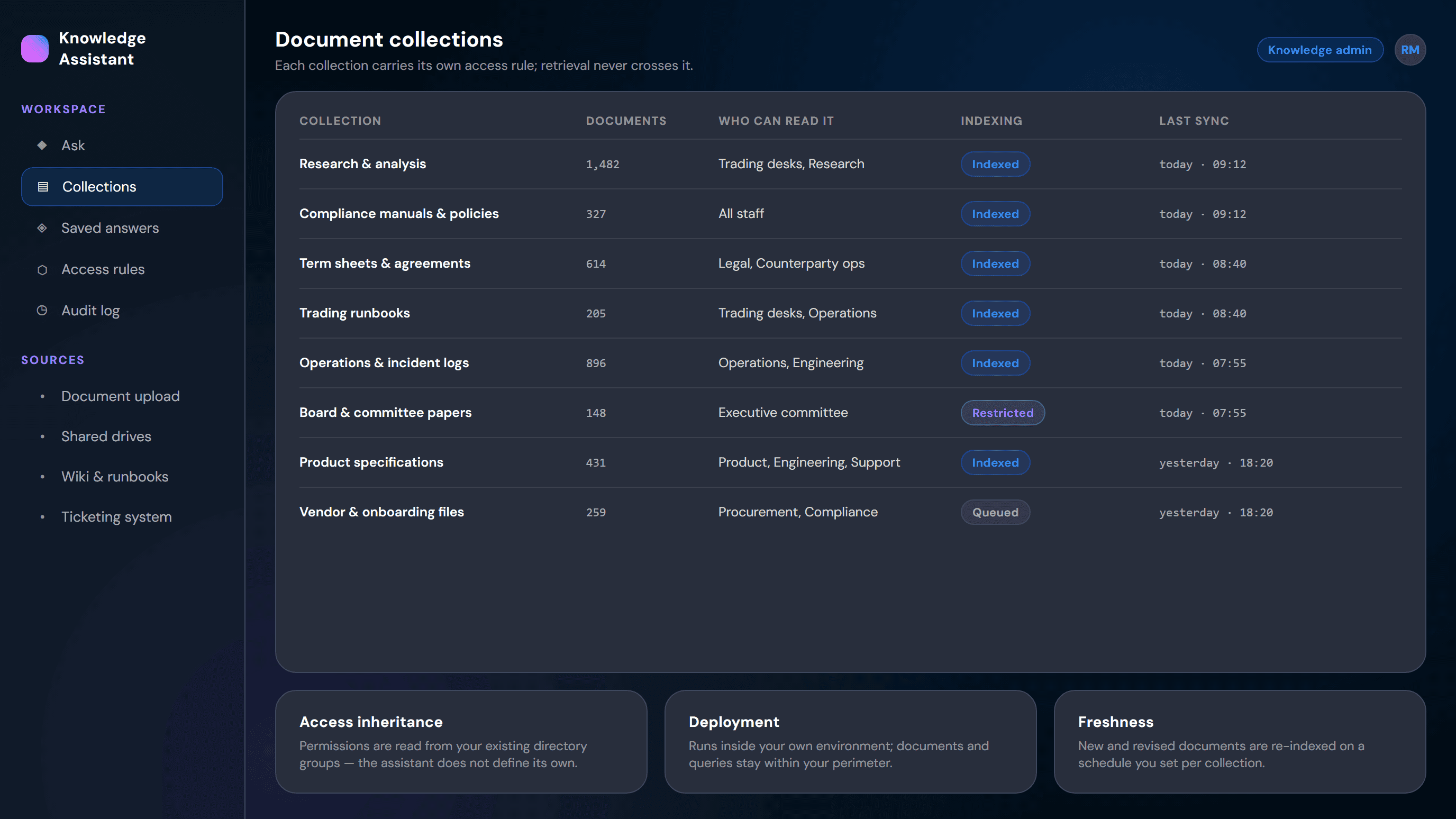
Point the assistant at the material your desks already rely on — research, compliance manuals, term sheets, runbooks, incident logs. Collections stay separate, so each keeps its own access rule.
2. Index Privately, With Permissions Attached
Every document is parsed and segmented inside your environment, and each segment carries its source reference and access rules into the private index. Re-indexing runs on your schedule, per collection.
3. Map Roles, Desks and Entitlements
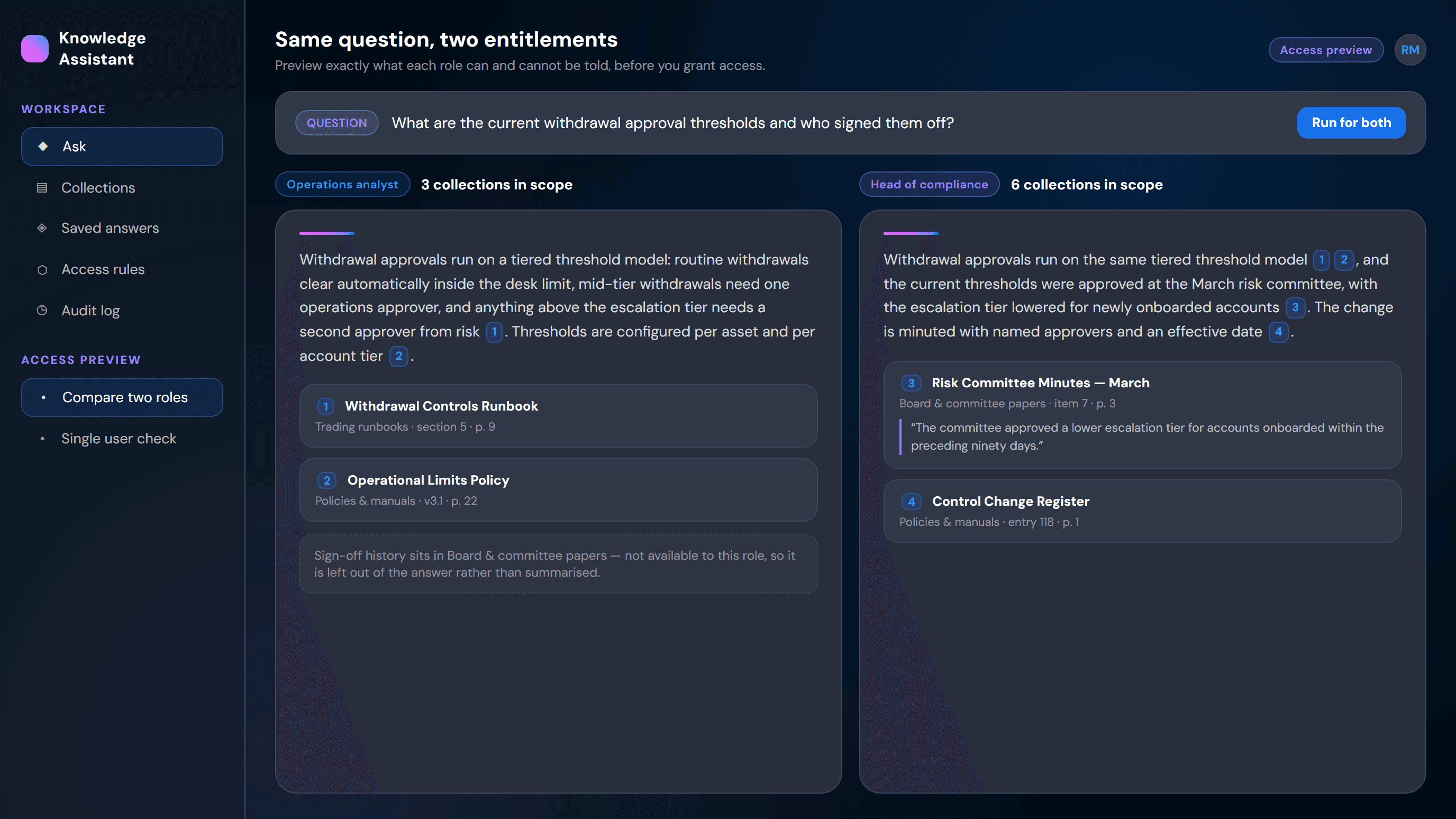
The permission model is inherited from the directory groups your firm already uses. Before granting anything, run the same question as two different roles and see what each one can and cannot be told.
4. Ask in Plain Language
A trader asks about collateral terms, an operations lead asks for an escalation path, a compliance officer asks which control version is in force. No query syntax and no knowing which folder it lives in.
5. Retrieve Only What the Asker May See
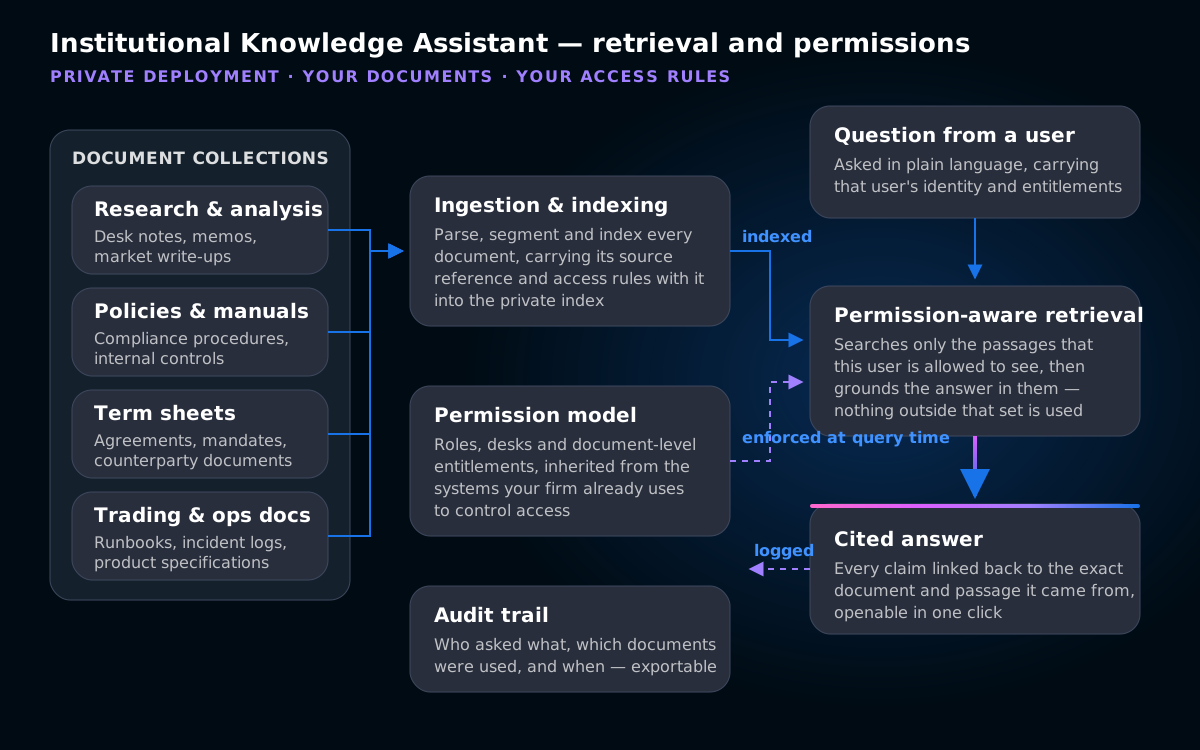
Access rules are applied at query time, not after. Retrieval searches only the passages that user may read, and the answer is grounded solely in those. Restricted material is left out, and the decision recorded.
6. Answer With Citations, Verify at the Source
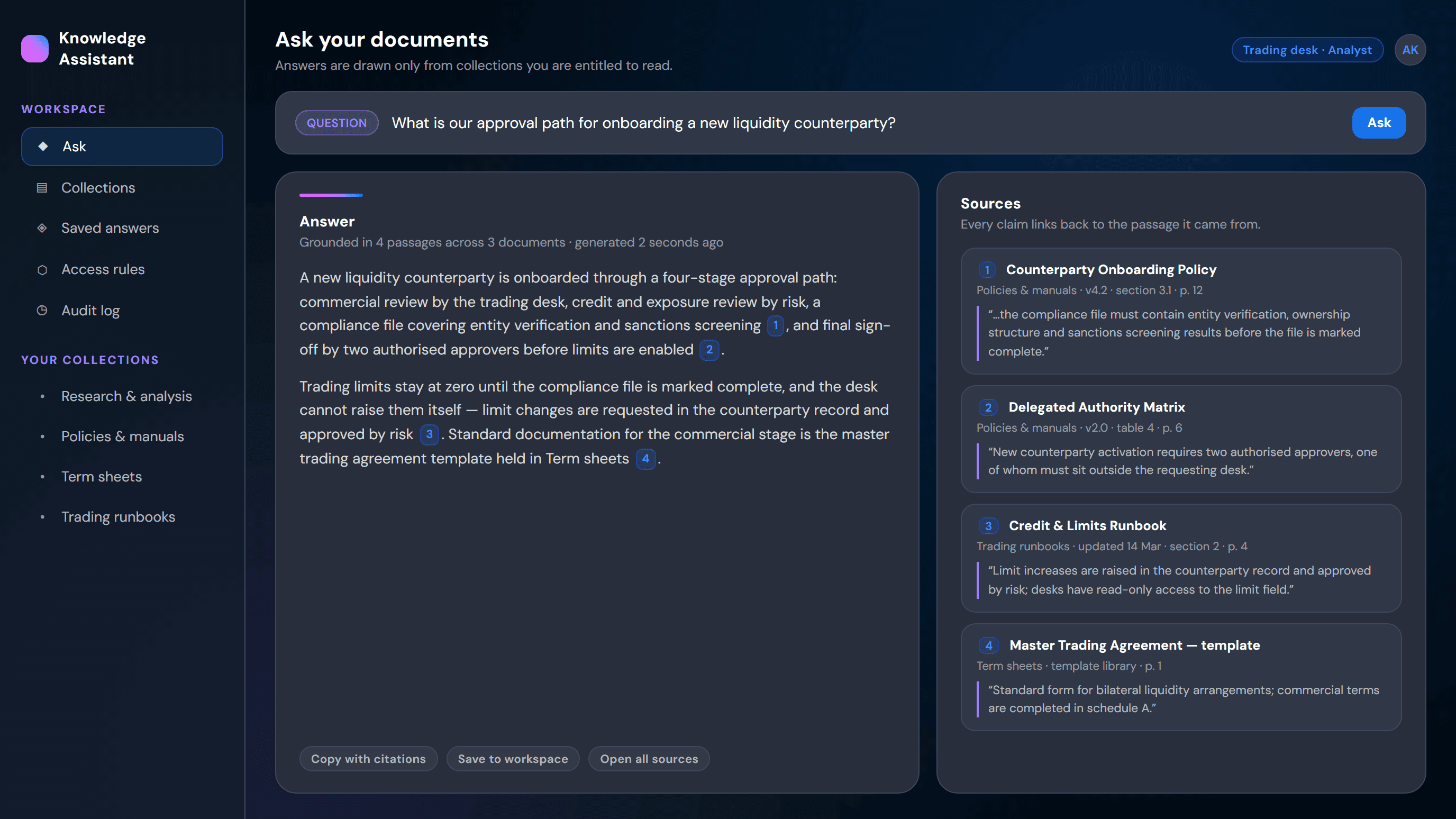
Every claim carries a citation to the document, version, section and page behind it, openable beside the answer. Answers copy out with citations intact for a memo, a review file or a regulator.
7. Log Every Query and Every Access Decision
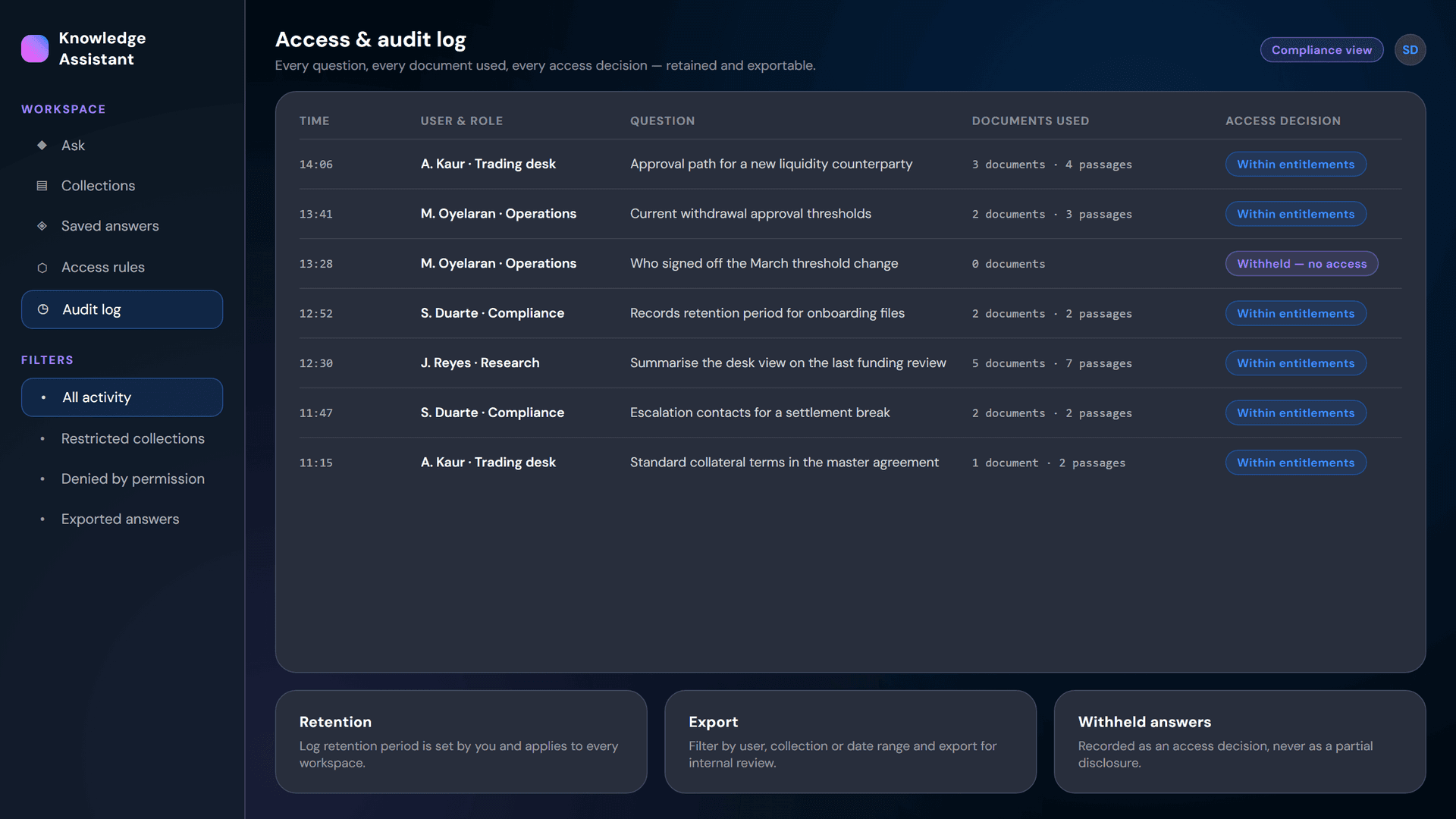
Questions asked, passages used, and answers withheld for lack of entitlement are written to an audit trail. Filter by user, collection or date and export it. Retention is set by your firm.
RAG With Your Permission Model Enforced at Query Time
Retrieval-augmented generation means the assistant retrieves passages from your document set first and writes its answer only from what it retrieved — which is what makes every claim traceable to a source.
Ask, Verify, Control
The Screens Your Team Works In
Six Capabilities That Make Institutional Retrieval Usable
Not a general-purpose search box. Each capability exists because a trading, compliance or operations team could not act on an answer without it.

Citation-Based Answers
Every claim links to the exact document, version, section and page, with the quoted passage shown beside the answer. A reviewer reads the source, not a summary of it.

Permission-Aware Retrieval
Access rules are applied at retrieval, so the assistant searches only what the asker may read. Material outside an entitlement is withheld outright and logged — never paraphrased or hinted at.

Private Deployment
Deployed inside the environment your firm controls. Documents, queries and answers stay in your perimeter, which is what makes it usable on board papers and term sheets.

Document Collection Management
Connect collections one by one, each with its own entitlement and re-indexing schedule, so a control question returns the policy in force today rather than a superseded edition.

Built for the Documents a Desk Actually Uses
Research notes, compliance manuals, term sheets, counterparty agreements, runbooks, incident logs and product specs — the vocabulary of a trading institution, not an afterthought.

Query Audit Trail
Who asked what, which passages answered it, and every access decision including withheld answers. Filter by user, collection or date, export it, and set the retention yourself.
What It Retrieves, What Your Team Decides
The assistant finds, cites and assembles what your firm has already written; every judgement call and approval stays with a named person on your team. That split is deliberate — it is a retrieval system, not an adviser.
| # | Task | What the assistant does | What your team decides |
|---|---|---|---|
| 1 | Finding the policy in forceCompliance manuals and policies | Retrieves the current passage and cites the document, version and pageSuperseded editions are not returned as current | Whether the policy applies to the case in front of you |
| 2 | Reviewing a term sheetAgreements and counterparty documents | Pulls the relevant clauses and shows them against the standard templateClause text quoted, not summarised away | Whether to accept, negotiate or escalate the terms |
| 3 | Answering an operational questionTrading and operational runbooks | Assembles the procedure steps and the named escalation path from your own runbooksCited step by step | Whether to run the procedure, and who signs it off |
| 4 | Preparing for an internal reviewControls, procedures and change records | Gathers the control documents and change-register entries that relate to the questionWith an exportable trail of what was used | What is submitted, and how the firm's position is stated |
| 5 | Onboarding a new joiner or a new counterpartyResearch, analysis and desk notes | Surfaces what the firm has already written on the market, product or counterpartyEvery point traceable to its author's document | What weight that prior work carries in a live decision |
| 6 | Handling restricted materialBoard and committee papers | Withholds it from anyone outside the entitlement and records the access decisionNo partial disclosure, no paraphrase | Who is granted the entitlement in the first place |
The Access Rules You Already Have, Enforced on Every Answer
An assistant that can read everything is a data-leak surface. This one reads what the asker reads — and writes down what it did.
Institutions Whose Knowledge Lives in Documents, Not Databases
Trading firms, funds and exchange operators accumulate written knowledge faster than anyone can index it — and lose most of its value to the fact that nobody can find it under time pressure.
Trading Desks
Collateral terms, product specifications and prior desk research retrieved when they are needed, not reconstructed from memory.
Compliance and Risk Teams
Query manuals, procedures and change registers in plain language, and answer a control question with the version in force, cited.
Operations and Support
Runbooks, escalation paths and incident history answerable in seconds, so a stuck process does not depend on who is online.
Exchange and Fund Leadership
A permission-aware assistant leadership can use on restricted material without creating a shadow copy of it.
Institutional Knowledge Assistant FAQ
An institutional knowledge assistant is a privately deployed AI system that answers staff questions from a firm's own documents — research, policies, term sheets and operational records — and cites the source behind every claim. Coiny Exchange's Institutional Knowledge Assistant runs inside your environment, enforces your existing access rules on every query, and links each answer back to the exact document and passage it came from.
RAG, or retrieval-augmented generation, is a method in which an AI system first retrieves passages from a defined document set and then writes its answer only from what it retrieved, so every statement can be traced to a source. Financial institutions use RAG to query research, compliance manuals, term sheets and operational runbooks without exposing that material to a public model. Coiny Exchange's Institutional Knowledge Assistant applies RAG with your permission model enforced at retrieval time and a citation on every claim.
The Institutional Knowledge Assistant applies your access rules at retrieval time: it searches only the passages the person asking is entitled to read, and grounds the answer solely in those passages. Material a user cannot open is not summarised, paraphrased or hinted at — it is left out of the answer and the access decision is recorded. Entitlements are inherited from the directory groups your firm already uses to control document access.
The Institutional Knowledge Assistant is deployed privately, inside the environment your firm controls, so documents and queries stay within your perimeter rather than moving into a shared public index. Deployment covers connecting your document collections, indexing them with their access rules attached, and mapping roles and desks onto the permission model before anyone asks a question.
The Institutional Knowledge Assistant answers from the collections you connect: research and desk notes, compliance manuals and internal policies, term sheets and counterparty agreements, trading and operational runbooks, incident logs and product specifications. Each collection carries its own access rule, is indexed separately and is re-indexed on a schedule you set, so answers reflect the current version of a document rather than a stale copy of it.
Every claim in an answer from the Institutional Knowledge Assistant carries a citation to the exact document and passage behind it, openable beside the answer in one click. Verification is therefore a read rather than a research task: the reviewer sees the source text with its document name, version and page, and judges whether the passage supports the claim. Answers can be copied out with their citations intact.
The Institutional Knowledge Assistant records every query, the documents and passages used to answer it, and each access decision — including answers withheld because the asker lacked the entitlement. The log is filterable by user, collection and date range and can be exported for internal review. Retention is set by your firm and applies across every workspace in the deployment.
Compliance teams query manuals, procedures and control records the same way anyone else does — in plain language, with each answer cited to the policy version it came from. Because the assistant retrieves rather than recalls, a control question returns the passage in force today instead of a summary of a superseded edition. It sits alongside the AML/KYC/KYT compliance infrastructure Coiny Exchange deploys on the exchange platform itself.
Where the Knowledge Assistant Sits
The assistant answers from what your firm has written. These are the systems that generate, govern and act on the rest of it.


Bring a Collection, Ask It Anything
Walk through a private deployment on your material: connecting collections, mapping entitlements, previewing what each role can be told, and reading an answer back to its source.
Book a Demo