Crypto Instant Swap Engine for Exchanges and Wallets
The Instant Swap Engine converts one asset to another in a single action using smart routing, best-price execution, slippage controls, and MEV protection, embeddable in exchanges and wallets.
Try the Engine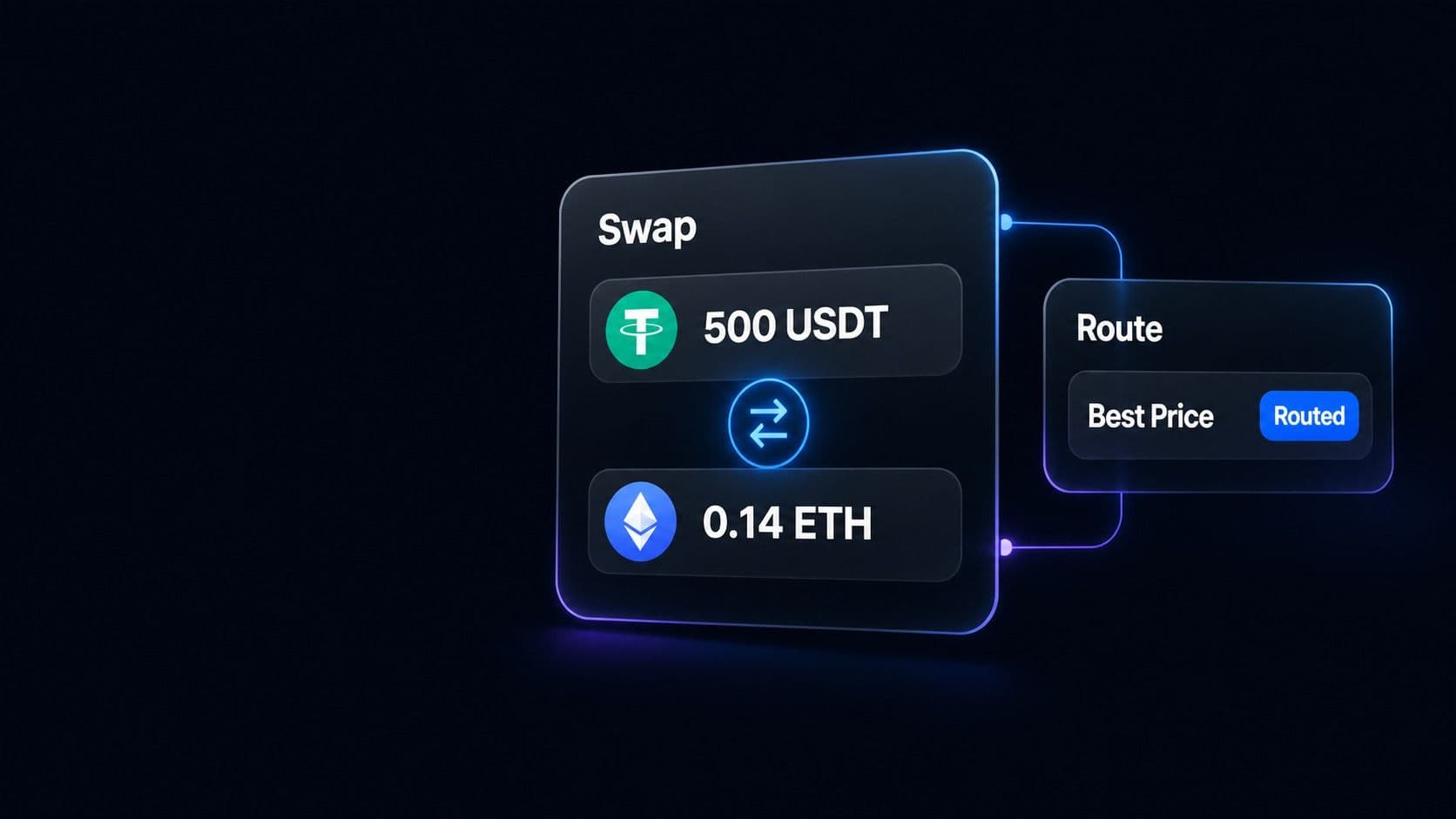
One Screen for the User, Six Jobs Underneath
Everything a conversion needs — pricing, routing, cost modelling, limits, protection and settlement — happens between the tap and the confirmation.

One-Click Asset Conversion
Two assets, one amount, one net rate. The user confirms once and the destination asset lands in the same account or wallet the request came from.

Smart Routing Across Every Source
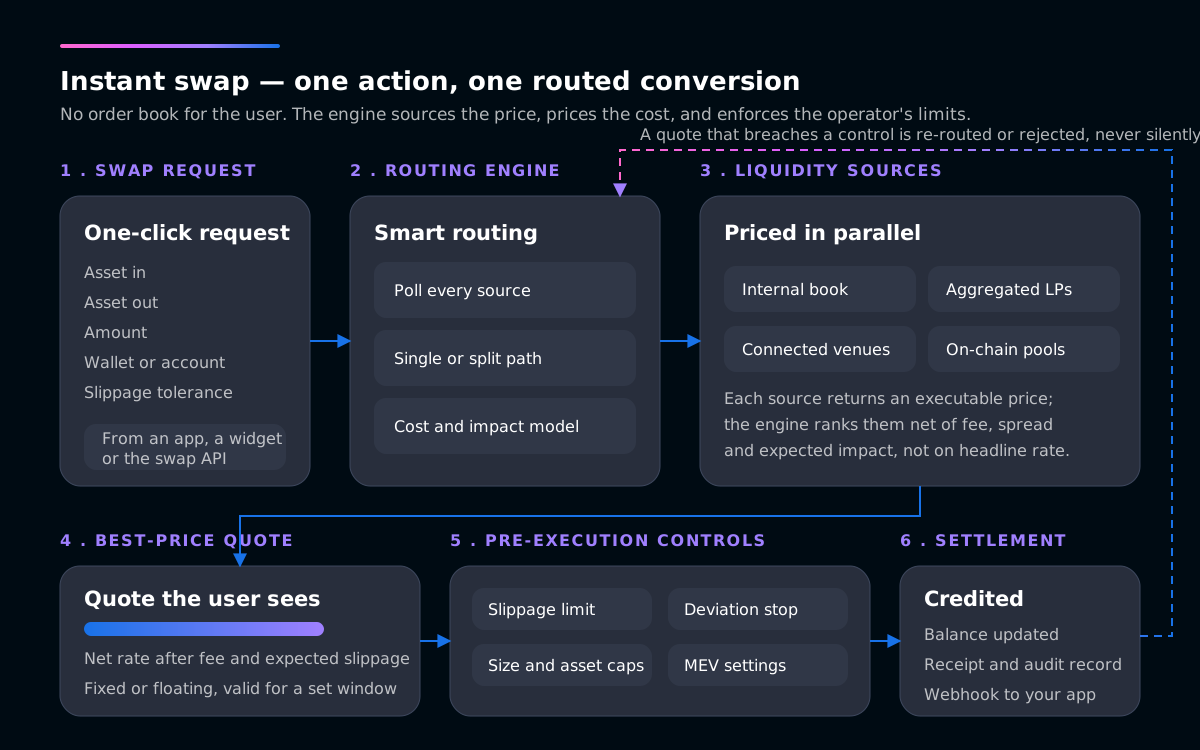
Each conversion is priced against the internal book, aggregated liquidity providers, connected venues and on-chain pools at the same moment.

Best-Price Execution, Costed
Sources are ranked on the amount the user actually receives, not on the headline rate. Fee, spread and expected market impact are subtracted before the comparison.

Slippage Controls
Maximum slippage per pair, a price-deviation stop between quote and execution, and per-swap and per-user size caps.

Configurable MEV Protection
For on-chain routes, operators can enable protected submission, tighter slippage bounds and batching per chain and per pair.

Embed It Anywhere
A branded swap widget for the front end, a swap API and SDKs for everything else. Fee, spread, asset coverage, quote type and slippage defaults are operator settings.
From Tap to Credited Balance
The whole path a conversion takes, from the request your app sends to the receipt it gets back.
Instant Swap or an Order Book
Both move a user from one asset to another, and most platforms ship both. The order book gives a trader control over price and timing; the swap engine takes that decision away deliberately, because the person converting a balance does not want to make it. Offer the swap to everyone and the book to the people who ask for it.
| # | Compared on | Instant Swap Engine | Order-book market |
|---|---|---|---|
| 1 | What the user does | Picks two assets and an amount, confirms one net rate | Chooses a market, an order type, a price and a size |
| 2 | Where the price comes from | Routed across internal, aggregated, venue and on-chain sources | The resting depth on that one book |
| 3 | Certainty before confirming | A net rate, fixed for a window or floating to execution | A limit price, with no certainty the order fills |
| 4 | How it can go wrong | Slippage, capped by the operator tolerance and deviation stop | Partial fills, stale orders and unfilled size |
| 5 | Where it belongs | Wallets, apps, portfolio screens, any convert button | The trading screen, for users who trade |
| 6 | What the operator configures | Fee, spread, pairs, quote type, slippage and size limits | Listings, tick and lot sizes, maker and taker fees |
What Product Teams Ask Before They Embed a Swap
A conversion feature is judged on how little it disturbs the product it goes into. These are the answers that decide whether it ships this quarter.
- How does it get into our app?Drop in the branded swap widget, or call the swap API directly and build your own screen. Both give you a quote, a validity window and an execution call, with SDKs and webhooks for the states in between.
- Can it run inside a wallet without moving custody?Yes. The engine debits and credits the accounts or wallets your platform already controls, so the swap is a balance operation inside your existing wallet and custody infrastructure rather than a transfer out to somebody else's.
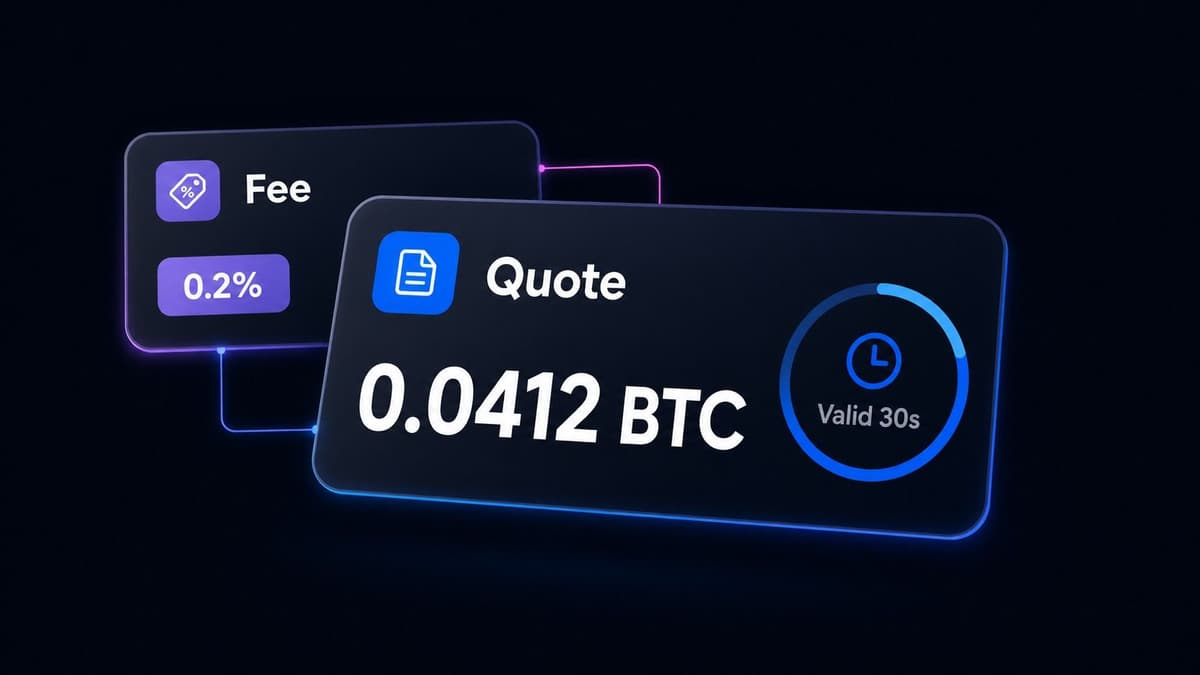
- Who sets the fee, and can we see it?You do. The operator fee and spread are configured per pair and are shown separately from the routed rate, so what the user pays and what you earn are both explicit on the quote and on the receipt.
- What happens when a route is not available?The engine re-routes to the next best source, and if none of them clears your slippage and size limits it returns a rejection with a reason instead of a worse fill. Your app decides whether to re-quote or stand down.
- Does it inherit our compliance and limits?Swaps run under the same identity, screening and per-user limit framework as the rest of the platform, and every conversion writes a receipt to the audit record with its route, its costs and the settings in force when it executed.
Where the Swap Engine Sits in the Coiny Stack
Instant swap is the simple path across the same liquidity, custody and connectivity everything else on the platform runs on. These are the pieces next to it.


Instant Swap FAQ
A crypto instant swap engine is software that converts one asset directly into another in a single action, without the user placing an order on an order book. Coiny Exchange's Instant Swap Engine prices the conversion by routing across internal, aggregated, venue and on-chain liquidity, applies the operator's slippage and size limits, and credits the destination asset to the same account or wallet the request came from. It embeds in an exchange, a wallet or a fintech app.
Converting crypto without an order book means asking a pricing engine for an executable rate instead of resting an order and waiting for a counterparty to meet it. Coiny Exchange's Instant Swap Engine polls every connected liquidity source, ranks the results net of fee, spread and expected market impact, and returns one net rate the user either accepts or does not. The user never chooses a venue, a price level or an order type.
Smart routing finds the best price for a swap by pricing the same conversion against every connected source at once — the internal book, aggregated liquidity providers, connected venues and on-chain pools — and ranking them on the amount the user actually receives rather than the headline rate. Coiny Exchange's engine subtracts fee, spread and expected market impact before ranking, and splits a larger conversion across more than one source when splitting produces a better net result.
A fixed-rate swap locks the conversion rate for a defined validity window, while a floating-rate swap settles at whatever the routed price is at the moment of execution. Fixed rates suit consumer flows where the user wants certainty and the operator prices that certainty into the spread; floating rates suit larger conversions where the user prefers the live market. Coiny Exchange's Instant Swap Engine supports both, and the operator decides which is offered per pair and per size band.
Slippage controls on a swap are the boundaries beyond which the engine refuses to fill. In Coiny Exchange an operator sets a maximum slippage tolerance per pair, a price-deviation stop that rejects a quote when the reference price moves too far between quoting and execution, size caps per swap and per user, and the failure behaviour: re-route, re-quote or reject. A quote that breaches any of them is never silently filled.
MEV protection on a crypto swap is a set of measures that reduce how much value can be extracted from a transaction while it waits to be included on-chain, typically protected or private submission, tighter slippage bounds and batching. In Coiny Exchange these are configurable settings an operator enables per chain and per pair. They lower exposure to front-running and sandwich attacks rather than removing it; no swap engine can promise that a transaction cannot be targeted.
Instant swap is added to an exchange or a wallet through Coiny Exchange's embeddable swap widget or its swap API, both of which return a quote, hold it for its validity window and execute inside the operator's limits. Custody does not move: the engine debits and credits the accounts or wallets the host platform already controls. Branding, fee, asset coverage and slippage defaults are operator settings, so the feature ships looking like the host product.
Ready to Put One-Click Swaps in Your Product?
Book a walkthrough of the routing engine, the slippage and MEV settings and the swap API, and we will run it against the pairs and the flow your users actually need.
Book a Demo