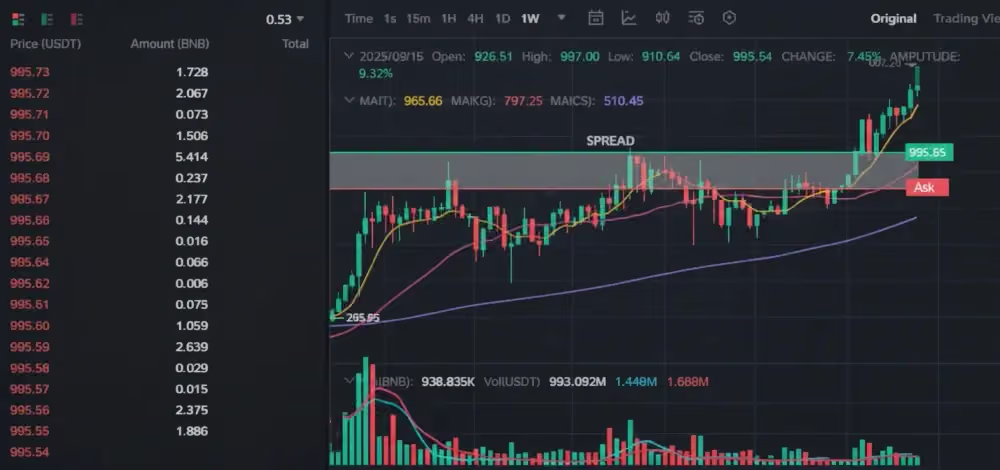
Crypto exchanges and token projects face a critical liquidity challenge that threatens their survival in competitive markets. Thin order books, wide spreads, and unpredictable trading volumes create poor user experiences that drive traders to better-liquid alternatives.
Manual market making has proven inadequate for modern crypto markets. Human traders cannot monitor hundreds of trading pairs across multiple exchanges 24/7, respond to millisecond price changes, or maintain optimal spreads during volatile conditions. The result is inconsistent liquidity that fails when markets need it most.
Crypto market making software has emerged as the essential solution. Automated systems execute thousands of trades per second, maintain tight spreads across all market conditions, and provide continuous liquidity without human intervention. These sophisticated algorithms analyze real-time market data, predict price movements, and adjust strategies instantly based on changing conditions.
In 2025, crypto market making software isn't optional it's fundamental infrastructure. Projects without automated liquidity provision struggle with poor trading experiences, while those leveraging professional market making software attract more traders, generate higher volumes, and build sustainable market presence.
What Is Crypto Market Making Software?
Crypto market making software is automated technology that continuously places buy and sell orders across cryptocurrency markets to provide consistent liquidity. These systems automatically manage bid/ask placement, adjust spreads based on market conditions, and execute trades without human intervention.
Unlike traditional market makers who rely on human traders and manual decision-making, crypto market making software operates through sophisticated algorithms that process market data in real-time. The software analyzes order books, price movements, and trading volumes to determine optimal order placement strategies instantly.
Key Operational Differences:
- Traditional Market Makers: Human traders making manual decisions, limited reaction speed, prone to errors during high volatility
- Market Making Software: Automated algorithms, millisecond response times, consistent performance regardless of market conditions
Modern crypto market making software supports both centralized exchanges (CEXs) like Binance and Coinbase, and decentralized exchanges (DEXs) such as Uniswap and SushiSwap. This dual compatibility allows operators to provide liquidity across the entire crypto ecosystem, maximizing trading opportunities while maintaining unified risk management across all venues.
The software handles complex tasks like inventory balancing, risk assessment, and multi-exchange arbitrage automatically, making professional-grade market making accessible to projects that previously couldn't afford dedicated trading teams.
Core Features of Market Making Software
AI/ML Trading Algorithms
Advanced machine learning models analyze historical price data, order flow patterns, and market sentiment to predict short-term price movements. These algorithms automatically adjust bidding strategies based on volatility forecasts, ensuring optimal positioning before market shifts occur. Neural networks process thousands of market variables simultaneously, enabling more accurate pricing decisions than human traders.
Smart Order Routing
Intelligent routing systems automatically distribute orders across multiple exchanges to achieve best execution prices. The software continuously compares liquidity, fees, and execution speeds across venues, directing trades to optimal destinations. This ensures maximum profit margins while minimizing transaction costs and slippage.
Arbitrage Tools
Built-in arbitrage detection identifies price discrepancies between exchanges instantly. When Bitcoin trades at $50,000 on Binance but $50,100 on Coinbase, the software simultaneously buys low and sells high, capturing the $100 spread. Cross-exchange arbitrage tools monitor hundreds of trading pairs continuously, executing profitable trades within milliseconds.
Spread and Slippage Management
Dynamic spread control adjusts bid-ask margins based on market volatility and trading volume. During calm markets, spreads tighten to attract more volume. During volatile periods, spreads widen to protect against adverse price movements. Slippage management algorithms break large orders into smaller chunks, preventing market impact that could reduce profitability.
Order Book Management
Real-time order book analysis tracks market depth, competitor positioning, and liquidity distribution. The software maintains optimal position sizing across multiple price levels, ensuring competitive quotes while managing inventory risk. Advanced algorithms automatically refresh orders when market conditions change, maintaining market presence without manual intervention.
Risk Management Systems
Comprehensive risk controls include position limits, drawdown protection, and automated stop-losses. The software monitors portfolio exposure across all assets and exchanges, automatically reducing positions when risk thresholds are exceeded. Real-time P&L tracking ensures trading stays within predefined risk parameters, protecting capital during adverse market conditions.
Supported Markets and Asset Coverage
Comprehensive Trading Venue Support
Centralized Exchanges (CEXs) Professional market making software integrates with major centralized platforms including Binance, Coinbase, Kraken, OKX, and KuCoin. These integrations provide access to deep liquidity pools and institutional trading infrastructure with sub-millisecond execution speeds.
Decentralized Exchanges (DEXs) Advanced systems support leading DEX protocols like Uniswap, SushiSwap, Curve, and Balancer across multiple blockchains. Smart contract integration enables automated liquidity provision to AMM pools while maintaining centralized risk management controls.
Multi-Market Trading Capabilities
Spot Markets Core functionality covers immediate settlement trading across all major cryptocurrency pairs. Software manages real-time inventory balancing and cross-exchange arbitrage opportunities in spot markets with instant execution.
Perpetual Futures Specialized algorithms handle leveraged perpetual contracts, managing funding rates, basis spreads, and delta hedging strategies. The software automatically adjusts positions based on futures-spot basis differentials and funding rate predictions.
Options & Derivatives Advanced systems support options market making with automated volatility surface management, Greeks hedging, and expiration risk controls. Derivatives coverage includes both traditional options and innovative crypto-native instruments.
Asset Class Coverage
- Major Cryptocurrencies: Bitcoin (BTC), Ethereum (ETH), and top-tier altcoins with deep liquidity across multiple exchanges.
- Stablecoins: USDT, USDC, BUSD, and DAI pairs for arbitrage opportunities and risk-off positioning during volatile periods.
- Altcoins: Comprehensive coverage of emerging tokens and DeFi assets, with dynamic risk adjustment based on volatility and liquidity metrics.
- Cross-Chain Assets: Support for wrapped tokens, bridge assets, and multi-chain deployments enabling unified liquidity provision across different blockchain ecosystems.
This comprehensive coverage ensures market making operations can capture opportunities across the entire crypto ecosystem while maintaining consistent risk management standards.
Customization and Strategy Control
User-Defined Strategy Parameters
Liquidity Depth Configuration Users control order book depth by setting position sizes across multiple price levels. Configure $10,000 positions every 0.1% from market price, or concentrate $100,000 at tighter 0.05% intervals for high-volume pairs. Dynamic depth adjustment automatically increases positions during high-demand periods.
Spread Management Controls Customizable spread parameters allow precise profit targeting. Set minimum spreads of 0.05% for major pairs like BTC/USDT, while maintaining 0.5%+ spreads for volatile altcoins. Advanced users configure volatility-based spread scaling that widens margins during unstable market conditions.
Hedging Strategy Selection Risk management tools include delta-neutral hedging, basis arbitrage between spot and futures, and cross-exchange inventory balancing. Users define maximum position exposure, automatic rebalancing triggers, and stop-loss parameters for each trading pair.
Deployment Models
SaaS Cloud-Based Solutions Cloud deployment offers instant setup, automatic updates, and scalable infrastructure without technical overhead. Monthly subscription models starting around $5,000 include hosting, maintenance, and technical support. Ideal for smaller exchanges and token projects requiring immediate liquidity without IT infrastructure investments.
On-Premise Enterprise Software Institutional clients deploy market making software on private servers for enhanced security and customization. On-premise solutions provide complete control over algorithms, data privacy, and integration with existing trading infrastructure. Enterprise licenses typically range from $50,000-$200,000 annually depending on features and support levels.
Strategy Examples by Use Case
Token Launch Strategy New token deployments use tight spread configurations (0.1-0.3%) with moderate depth to create attractive trading conditions while managing inventory risk. Automated price discovery algorithms gradually adjust spreads as organic volume develops, transitioning from launch support to sustainable market making.
Institutional Trading Strategy Large-scale operations employ sophisticated multi-exchange arbitrage with substantial position sizes. Institutions configure cross-venue hedging, basis trading between spot and derivatives, and algorithmic rebalancing across global exchanges. These strategies require higher capital allocation but generate consistent returns through professional execution.
DeFi Pool Optimization Decentralized exchange strategies focus on concentrated liquidity provision within optimal price ranges, automated fee tier selection, and impermanent loss minimization through dynamic rebalancing across multiple AMM protocols.
Risk Management and Compliance Tools
Automated Risk Controls
Stop-Loss Automation Advanced stop-loss systems trigger automatic position closure when losses exceed predefined thresholds. Configure portfolio-wide drawdown limits (e.g., 2% daily loss) or individual asset stops (5% maximum loss per position). Multi-layered stops include time-based exits, volatility-adjusted triggers, and correlation-based risk management across correlated assets.
Dynamic Hedging Systems Automated hedging algorithms maintain delta-neutral positions across spot and derivatives markets. When Bitcoin inventory exceeds $500,000, the system automatically sells futures contracts to offset price risk. Cross-exchange hedging balances positions between venues, while basis trading captures funding rate opportunities while managing directional exposure.
Real-Time Exposure Dashboards Comprehensive risk monitoring displays portfolio exposure, P&L attribution, and risk metrics across all markets simultaneously. Visual alerts highlight when positions approach maximum limits, correlation risks spike, or market conditions threaten profitability. Integration with enterprise risk management systems provides institution-grade oversight capabilities.
Regulatory Compliance Integration
AML Transaction Monitoring Built-in Anti-Money Laundering tools scan trading patterns for suspicious activities, unusual volume concentrations, and potential wash trading. Automated reporting generates compliance documentation required by regulators, while real-time monitoring flags transactions requiring manual review.
KYC Integration Support Know Your Customer frameworks integrate with exchange onboarding systems, ensuring market making activities comply with customer identification requirements. Enhanced due diligence capabilities support institutional compliance standards required for regulated market operations.
Leading Market Making Software Providers
Hummingbot
Open-source market making software with extensive community support and customizable strategies. Offers free access to basic algorithms while providing enterprise features through paid subscriptions. Strong DeFi integration and active developer community make it popular among smaller operators and educational users seeking transparent, modifiable code.
Empirica
Institutional-grade market making platform designed for professional trading firms and large exchanges. Provides enterprise-level risk management, regulatory compliance tools, and high-frequency trading capabilities. Premium pricing reflects sophisticated features including multi-venue arbitrage, derivatives support, and institutional custody integration.
AlgoTrader
Comprehensive algorithmic trading platform combining market making with systematic trading strategies. Supports both quantitative research and production trading with extensive backtesting capabilities. Popular among hedge funds and proprietary trading firms requiring sophisticated analytics alongside market making functionality.
Modulus
Customizable liquidity solutions provider offering both software licensing and turnkey market making services. Specializes in white-label exchange integration with configurable algorithms tailored to specific market requirements. Strong focus on regulatory compliance and institutional-grade infrastructure for regulated operators.
Conclusion
Crypto market making software has become indispensable infrastructure for successful cryptocurrency operations in 2025. Manual liquidity provision simply cannot compete with automated systems that provide 24/7 trading, millisecond execution, and sophisticated risk management across multiple markets simultaneously.
Many newcomers entering the crypto market dream of launching their own exchange but quickly discover the overwhelming complexity of market making software integration. Questions arise: Which market makers to partner with? How to integrate APIs? What about compliance requirements? How to manage risk controls? These technical complexities can delay launches by months or kill projects entirely.
This is where Coinyexchange steps in to solve all these challenges.
If you're new to crypto markets and want to launch your exchange without understanding the intricate complexities of market making software connections, Coinyexchange provides the complete solution. Our white label cryptocurrency exchange comes with pre-integrated professional market making tools, eliminating the technical headaches that overwhelm newcomers.