Triangular arbitrage is a risk-free trading strategy that use price discrepancies between three different currencies in the foreign exchange market to generate profit. By executing three simultaneous trades that convert one currency to a second, the second to a third, and the third back to the original, traders capitalize on temporary inefficiencies before the market self corrects.
How Does Triangular Arbitrage Work Step by Step?
Triangular arbitrage works through a three step circular trading process where a trader converts currency A to currency B, then B to currency C, and finally C back to A, ending with more of currency A than they started with. The entire process happens nearly simultaneously to capture fleeting price discrepancies before market forces eliminate them.
The Three-Step Process
Step 1: Identify the Discrepancy The trader monitors exchange rates between three currencies and calculates whether the cross rate derived mathematically matches the actual quoted cross rate.
Step 2: Execute Three Simultaneous Trades Once a discrepancy is identified, the trader executes all three currency conversions almost instantaneously:
- Trade 1: Convert the base currency to the first foreign currency
- Trade 2: Convert the first foreign currency to the second foreign currency
- Trade 3: Convert the second foreign currency back to the base currency
Step 3: Capture the Profit If executed correctly, the trader ends up with more of the original currency than they started with, representing the arbitrage profit.
The Mathematical Foundation
For triangular arbitrage to be absent (market equilibrium), the following equation must hold:
Cross Rate = (Currency A/Currency B) × (Currency B/Currency C) = Currency A/Currency C
When this equation doesn't balance, an arbitrage opportunity exists.
What Is a Practical Example of Triangular Arbitrage?
A practical example involves trading between USD, EUR, and GBP where market inefficiencies create a profit opportunity: starting with $1,000,000, converting to euros, then to pounds, and back to dollars yields $1,005,127 a risk-free profit of $5,127. This example demonstrates how even small rate discrepancies generate significant returns at scale.
Detailed Calculation Example
Given Exchange Rates:
- EUR/USD = 1.0850 (1 Euro = 1.0850 US Dollars)
- GBP/USD = 1.2700 (1 British Pound = 1.2700 US Dollars)
- EUR/GBP = 0.8530 (1 Euro = 0.8530 British Pounds)
Step 1: Check for Arbitrage Opportunity
Calculate the implied EUR/GBP rate:
- Implied EUR/GBP = EUR/USD ÷ GBP/USD
- Implied EUR/GBP = 1.0850 ÷ 1.2700 = 0.8543
The market quotes EUR/GBP at 0.8530, but our calculation shows it should be 0.8543. This discrepancy signals an arbitrage opportunity.
Step 2: Execute the Trades
Starting with $1,000,000:
| Trade | Action | Calculation | Result |
|---|---|---|---|
| 1 | USD ? EUR | $1,000,000 ÷ 1.0850 | €921,658.99 |
| 2 | EUR ? GBP | €921,658.99 × 0.8530 | £786,175.12 |
| 3 | GBP ? USD | £786,175.12 × 1.2700 | $998,442.40 |
Wait this resulted in a loss! This means we need to trade in the opposite direction.
Step 3: Reverse Direction
| Trade | Action | Calculation | Result |
|---|---|---|---|
| 1 | USD ? GBP | $1,000,000 ÷ 1.2700 | £787,401.57 |
| 2 | GBP ? EUR | £787,401.57 ÷ 0.8530 | €923,097.97 |
| 3 | EUR ? USD | €923,097.97 × 1.0850 | $1,001,561.30 |
Profit: $1,561.30 (0.156% return)
This example shows why direction matters traders must calculate both paths to find the profitable route.
Why Do Triangular Arbitrage Opportunities Exist?
Triangular arbitrage opportunities exist because currency markets are decentralized with multiple trading venues, leading to temporary price discrepancies caused by differences in liquidity, trading volumes, time zones, and the speed of information flow. These inefficiencies, though brief, create windows where exchange rates fall out of perfect mathematical alignment.
Primary Causes of Price Discrepancies
1. Market Fragmentation The forex market operates across numerous platforms, banks, and exchanges worldwide. Each venue sets its own rates based on local supply and demand, creating momentary differences.
2. Latency in Information Transfer Even with modern technology, there's a tiny delay in price updates across different platforms. During these milliseconds, rates can diverge.
3. Liquidity Variations Some currency pairs trade more actively than others. Less liquid pairs may have wider spreads and slower price adjustments, creating opportunities.
4. Time Zone Effects When major financial centers open or close, trading activity shifts, potentially causing temporary rate misalignments.
5. Large Order Impact When institutional investors execute substantial trades, they can temporarily move exchange rates, creating short-lived discrepancies.
6. Different Counterparty Pricing Banks and brokers may quote slightly different rates based on their inventory, risk exposure, and client relationships.
Who Uses Triangular Arbitrage in the Forex Market?
Triangular arbitrage is primarily used by institutional traders, hedge funds, large banks, and proprietary trading firms with access to advanced algorithmic trading systems and substantial capital. Individual retail traders rarely execute successful triangular arbitrage because the opportunities are too small and brief for manual trading.
Key Market Participants
Investment Banks Major banks like Goldman Sachs, JP Morgan, and Citibank have dedicated arbitrage desks with sophisticated systems monitoring hundreds of currency pairs simultaneously.
Hedge Funds Quantitative hedge funds use complex algorithms to identify and exploit arbitrage opportunities across global markets.
High-Frequency Trading Firms HFT firms specialize in capturing micro profits from fleeting price discrepancies, executing thousands of triangular arbitrage trades daily.
Market Makers These entities provide liquidity and often use arbitrage strategies to profit from bid ask spreads while keeping markets efficient.
Why Retail Traders Face Challenges
| Factor | Institutional Advantage | Retail Limitation |
|---|---|---|
| Speed | Microsecond execution | Manual or slow automated |
| Capital | Billions of dollars | Limited funds |
| Technology | Custom algorithms | Standard platforms |
| Market Access | Direct interbank | Through brokers |
| Transaction Costs | Negligible spreads | Higher spreads |
| Information | Real-time feeds | Delayed data |
What Technology Is Required for Triangular Arbitrage?
Successful triangular arbitrage requires ultra low latency trading infrastructure, algorithmic trading systems capable of scanning thousands of currency pairs per second, direct market access (DMA), and co-located servers positioned near exchange data centers. The technology investment can range from hundreds of thousands to millions of dollars.
Essential Technology Components
1. Algorithmic Trading Software Custom-built algorithms continuously monitor exchange rates, calculate cross-rates, identify discrepancies, determine optimal trade direction, and execute orders all within milliseconds.
2. Low-Latency Connectivity Network connections must minimize delay between receiving price data and executing trades. Even a few milliseconds can mean the difference between profit and loss.
3. Co-Location Services Trading servers physically located next to exchange servers reduce transmission time to microseconds.
4. Real-Time Data Feeds Premium market data services provide instant price updates from multiple liquidity providers simultaneously.
5. Smart Order Routing Systems that automatically direct orders to venues offering the best prices at any given moment.
6. Risk Management Systems Automated safeguards prevent excessive exposure and handle situations where one leg of the trade fails.
What Are the Risks and Limitations of Triangular Arbitrage?
Despite being theoretically "risk-free," triangular arbitrage carries execution risk, slippage risk, technological failure risk, and counterparty risk that can turn expected profits into losses. The narrow profit margins mean even small unexpected costs or delays can eliminate or reverse gains.
Primary Risks
1. Execution Risk All three trades must complete successfully. If one fails or is delayed, the trader holds an unhedged currency position exposed to market movements.
2. Slippage The actual execution price may differ from the expected price, especially during volatile markets or when trading large volumes.
3. Transaction Costs Bid-ask spreads, commissions, and fees can exceed the arbitrage profit, particularly for smaller trades.
4. Technology Failures System crashes, network outages, or software bugs can prevent trade completion or cause incorrect execution.
5. Counterparty Risk The other party in a trade might fail to fulfill their obligation, though this is rare with major financial institutions.
6. Regulatory Considerations Different jurisdictions have varying rules about high-frequency trading and arbitrage strategies.
Why "Risk-Free" Is Misleading
The term "risk-free" applies only in theoretical models where:
- All trades execute simultaneously at expected prices
- No transaction costs exist
- Technology never fails
- Infinite liquidity exists
In practice, none of these conditions perfectly hold, introducing real risk into every triangular arbitrage attempt.
How Does Triangular Arbitrage Differ from Other Arbitrage Strategies?
Triangular arbitrage specifically exploits price discrepancies among three currencies in a single market, while other arbitrage types like spatial arbitrage, statistical arbitrage, and merger arbitrage operate across different markets, time periods, or asset classes. Each strategy has unique mechanics, risk profiles, and capital requirements.
Comparison of Arbitrage Types
| Strategy | Description | Markets | Risk Level |
|---|---|---|---|
| Triangular Arbitrage | Three-currency forex trades | Single forex market | Low (execution risk) |
| Spatial Arbitrage | Same asset, different locations | Multiple exchanges | Low (transfer risk) |
| Statistical Arbitrage | Historical price relationships | Various markets | Medium (model risk) |
Triangular vs. Spatial Arbitrage
Spatial arbitrage involves buying an asset in one market where it's cheaper and simultaneously selling it in another where it's more expensive. For example, buying Bitcoin on one exchange and selling on another.
Triangular arbitrage stays within a single market but exploits the mathematical relationships between multiple currencies.
Triangular vs. Statistical Arbitrage
Statistical arbitrage uses quantitative models to identify assets that have historically moved together but temporarily diverged, betting on their convergence.
Triangular arbitrage doesn't rely on historical patterns it exploits real-time mathematical inconsistencies that should not exist if markets were perfectly efficient.
Understanding the Three Types of Crypto Triangular Arbitrage
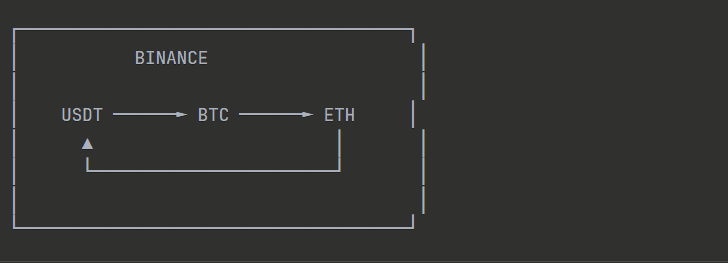
Type 1: Single Exchange Triangular Arbitrage
What it is: All three trades happen on one exchange (like Binance).
How it works:
Advantages:
- Fastest execution (all trades on same platform)
- No withdrawal/deposit delays
- Single set of fees
- Easiest to automate
Challenges:
- Opportunities are rare (exchanges arbitrage themselves)
- Competition from high-frequency bots
- Small profit margins
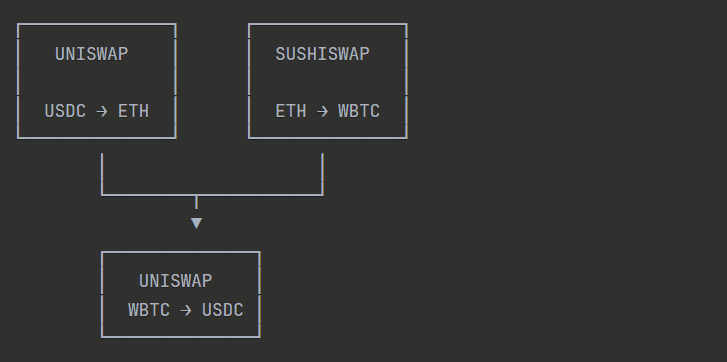
Type 2: Cross-DEX Triangular Arbitrage
What it is: Trading across multiple decentralized exchanges (like Uniswap + SushiSwap).
How it works:
Advantages:
- More opportunities due to fragmented liquidity
- Can use flash loans (borrow millions with zero collateral)
- Atomic execution (all trades succeed or all fail)
Challenges:
- Gas fees on Ethereum can be expensive
- Requires smart contract knowledge
- MEV bots may front-run your trades
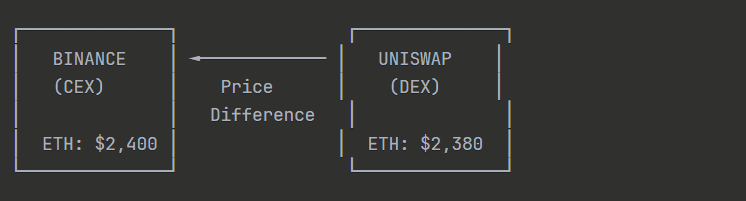
Type 3: CEX-DEX Hybrid Arbitrage
What it is: Combining centralized and decentralized exchanges.
How it works:
Advantages:
- Larger price discrepancies
- More arbitrage opportunities
Challenges:
- Requires capital on multiple platforms
- Withdrawal times create execution risk
- Complex coordination needed