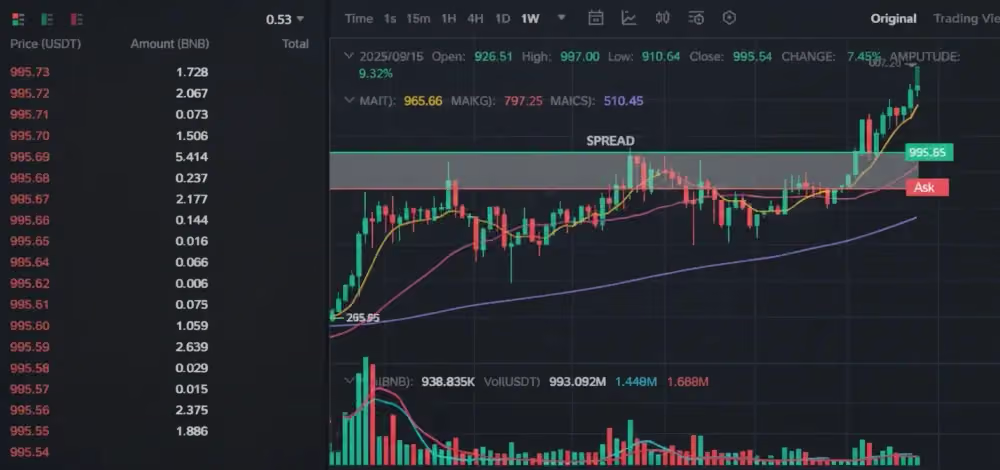
Liquidity providers in crypto are individuals or entities that supply digital assets to trading platforms. Their main role is to ensure there’s always enough volume for smooth, efficient transactions. These providers are essential for market health, allowing traders to buy and sell cryptocurrencies without significant price disruptions or delays. By maintaining sufficient market depth, reducing volatility, and enabling instant order execution, liquidity providers serve as the backbone of digital asset trading across various platforms.
The Role of a Crypto Liquidity Provider in Digital Markets
A crypto liquidity provider maintains market liquidity by continuously supplying assets to exchanges, making sure traders can execute orders at fair prices. Their primary responsibilities include supporting market depth with buy and sell orders, stabilizing prices during high-volume trading to prevent extreme swings, and enabling quick, seamless transactions.
Different platforms operate differently: centralized exchanges rely on professional market makers who use advanced algorithms and substantial capital, while decentralized exchanges depend on individual users contributing assets to automated liquidity pools.
No matter the platform whether Binance or Uniswap the crypto ecosystem ensures there’s always enough liquidity for smooth trading.
How Liquidity Providers Work in Crypto Exchanges
Understanding how liquidity providers operate involves two main mechanisms:
Centralized Exchanges: These use an order book model where market makers place continuous buy and sell orders. Sophisticated algorithms adjust prices based on market conditions, with professional firms providing most of the liquidity.
Decentralized Exchanges: These employ the Automated Market Maker (AMM) model. Users deposit token pairs into smart contract pools. The AMMs use mathematical formulas to determine prices, and liquidity provider (LP) tokens represent ownership in these pools. For example, depositing ETH/USDT into Uniswap grants LP tokens that can later be redeemed for assets plus earned fees.
Both systems aim to ensure traders have access to the assets they need, whenever they need them.
Why Are Crypto Liquidity Providers Important?
Crypto liquidity providers are vital for market stability. They help reduce price slippage during large trades, maintain tight bid-ask spreads, and prevent extreme volatility caused by low trading volume. They enhance the trading experience by enabling instant order fulfillment, supporting higher transaction volumes, and improving overall market efficiency.
Furthermore, they foster growth by attracting more traders, supporting new token launches, and encouraging innovation in DeFi protocols. Without sufficient liquidity, markets could experience wild price swings, making trading unpredictable and costly which hampers the growth and adoption of cryptocurrencies.
How Do Crypto Liquidity Providers Earn?
Liquidity providers earn through multiple revenue streams:
- Transaction Fees: They receive a percentage of each trade executed using their liquidity, typically between 0.1% and 0.3%.
- Governance Tokens: Some platforms offer incentives through governance tokens, enabling providers to participate in protocol decisions and earn rewards.
- Yield Farming: Providers can stake their LP tokens for extra rewards, often in the form of platform-native tokens.
Examples include Uniswap providers earning UNI tokens and PancakeSwap users receiving CAKE rewards, creating multiple income sources beyond just trading fees.
Risks for Crypto Liquidity Providers
While profitable, being a liquidity provider involves significant risks:
- Impermanent Loss: This occurs when the relative prices of deposited tokens change compared to holding them separately, potentially leading to lower returns.
- Smart Contract Vulnerabilities: Bugs or exploits in protocols can result in loss of funds.
- Platform Risks: Hacks, regulatory changes, or platform shutdowns can impact assets.
- Market Volatility: Fluctuations in asset values can affect holdings, and providers may face liquidation if their positions fall below certain thresholds.
Mitigating these risks involves diversifying across platforms, starting small, and thoroughly researching protocols before depositing funds.
Top Crypto Liquidity Platforms in 2025
The best platforms balance security, rewards, and usability:
Decentralized Platforms:
- Uniswap: Largest DEX with over $4 billion in total value locked, offering 0.3% fees and UNI rewards.
- Curve Finance: Focuses on stablecoins, with lower impermanent loss risk and 5-15% APY.
- PancakeSwap: BSC’s leading DEX, offering CAKE rewards and yield farming with APYs over 100%.
- SushiSwap: Multi-chain pools with SUSHI rewards and additional incentives.
Centralized Platforms:
- Binance: Offers maker rebates up to 0.02% and institutional services.
- Coinbase Pro: US-regulated, with fee discounts and professional tools.
- Kraken: Known for security, tiered fees, and institutional custody.
- OKX: Provides liquidity mining, staking, and cross-margin trading.
Choosing the right platform depends on your risk appetite, preferred blockchain, and involvement level.
How to Choose the Best Crypto Exchange Liquidity Provider
When selecting a provider, consider:
- Security: Look for audited smart contracts, insurance, and a good security track record.
- Pool Size & Volume: Larger pools tend to generate more stable fees, but may offer lower percentage returns.
- Reputation: Check community feedback, transparency, and developer activity.
- Fee Structure: Understand all costs, including withdrawal and hidden fees.
- Additional Factors: Regulatory compliance, customer support, user interface, and educational resources.
Final Thoughts
Crypto liquidity providers are essential to the ecosystem, enabling efficient, stable, and accessible trading for millions worldwide. Their role in stabilizing markets, lowering transaction costs, and supporting innovation is fundamental.
Whether you’re considering becoming a provider or just want to understand how markets work, recognizing their importance helps appreciate the complexity behind modern digital asset trading. Their continued participation is vital for the growth and maturation of cryptocurrency markets.
What are liquidity providers in crypto? Liquidity providers are individuals or institutions that supply crypto assets to trading platforms or liquidity pools to ensure smooth trading without large price swings.
What does it mean to provide liquidity in crypto? It means depositing tokens into a liquidity pool or exchange so that others can trade them. This helps maintain market efficiency and reduces price volatility.
How do liquidity providers make money? They earn a share of trading fees, bid-ask spreads, and sometimes extra rewards like native tokens or incentives for providing liquidity.
What is the difference between a broker and a liquidity provider? A broker connects buyers and sellers and executes trades, while a liquidity provider supplies the actual assets to keep markets running smoothly.
Who is the biggest liquidity provider? Top crypto liquidity providers include Wintermute, Amber Group, and DWF Labs.
Can anyone be a liquidity provider? Yes, anyone can provide liquidity on decentralized platforms like Uniswap by depositing token pairs, but it involves risks like impermanent loss.
Who controls liquidity in crypto? In DeFi, liquidity is controlled by protocols and the LPs themselves. In centralized platforms, it’s managed by the exchange and large institutional LPs.